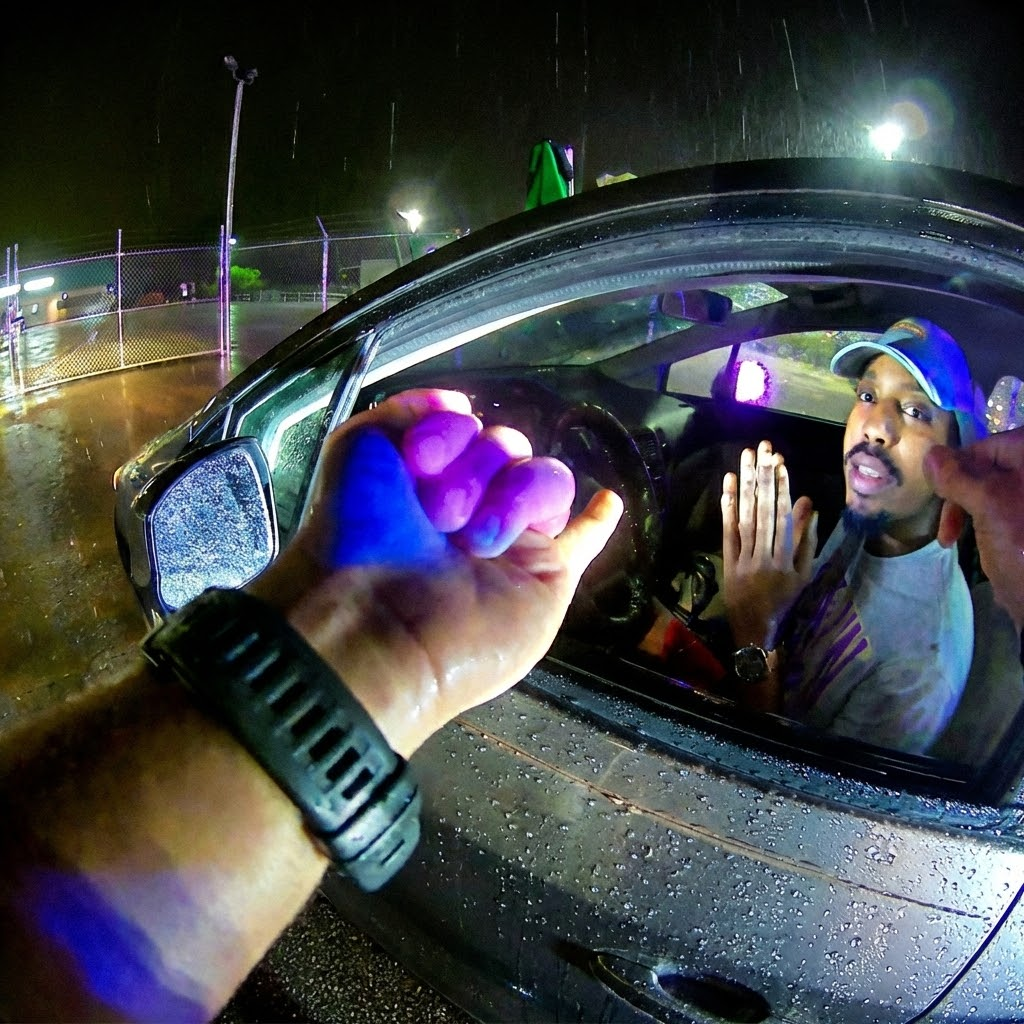
What Happens if You Resist Police During an Arrest?
If you resist arrest in Los Angeles, you could face criminal charges under a variety of California statutes, such as Penal Code 148(a)(1) PC.
Getting arrested for any type of crime is never a good experience. If you resist the police who are performing their lawful duties, it will always make a bad situation worse. This is not to suggest you don’t have rights when you are stopped by police and decline to answer any questions.
However, you don’t have the right to impede an officer’s lawful investigation, during a DUI stop or other type of situation. If you fail to understand the difference, then you could quickly find yourself facing additional criminal charges.
Under California law, resisting arrest by a law enforcement officer can both give rise to its own criminal charges under Penal Code 148 as well as being treated as an aggravating factor in the adjudication of whatever underlying offense led to the defendant’s arrest.

Resisting arrest under California Penal Code 148(a)(1) is the misdemeanor version of Penal Code 69, which is a “wobbler” that can be charged as a misdemeanor or felony crime. PC 148(a)(1) is violated when you obstruct law enforcement when they are performing their duties.
The prosecutor has to prove you knew or should have known that the person affected was a law enforcement officer performing such duties. In order to prove this, a prosecutor will argue what a reasonable person would have realized or understood the nature of the obstruction.
Running Away vs. Physical Confrontation
In general, resisting arrest takes two forms: running away and engaging in a physical struggle with law enforcement to prevent them from handcuffing or taking the defendant away from the scene.
There is an exceedingly narrow set of cases in which physically resisting law enforcement during their attempts to execute an arrest will be excused by courts. These are the situations in which the arresting officer was acting unlawfully, and therefore the arrest did not fall within the officer’s performance of their job duties (CALCRIM 2670).
Since a law enforcement officer’s job does not include unlawfully arresting citizens, when an officer attempts to do so it is permitted to resist that arrest provided that only reasonable force is used to do so.
The reason this category is very narrow is that the standard for arresting someone lawfully is much lower than that required to actually convict them in criminal court. A law enforcement officer can arrest someone based on probable cause whereas a conviction in criminal court requires proof beyond a reasonable doubt.
Even if the defendant is later acquitted of the underlying charges, they can still be guilty of resisting arrest as long as the arrest was supported by probable cause.
Resisting Arrest Charges – Penal Code 148(a)(1)
In the majority of cases, where the arrest is supported by probable cause, any physical resistance to law enforcement is a crime in of itself. The officers need not be injured and the degree of force utilized by the defendant need not be significant.
Squirming, pushing and pulling, attempting to turn away to prevent handcuffs from being applied, or any other physical movement designed to frustrate the arrest will qualify as resisting arrest.
These forms of basic physical resistance often result in charges of resisting arrest under Penal Code Section 148(a)(1). This is a misdemeanor offense punishable by up to a year in the county jail.
Assault of Police Officer Charges – Penal Code 241(c)
Where more violent resistance is offered by the defendant, several other charges may apply. Penal Code Section 241(c) codifies the crime of assault on a peace officer (CALCRIM 900). Assault differs from battery in that no actual physical contact needs to occur.
Rather, the defendant must merely possess the present ability to use force against a peace officer and take some action which would probably result in the application of force to the peace officer.
A paradigmatic example would be throwing a rock at a police officer, but missing. A Section 241(c) charge is also a misdemeanor which can result in up to a year in the county jail.
Battery on Police Officer Charges – Penal Code 243(b)
When the application of force to the peace officer actually succeeds, the defendant may be charged with battery on a peace officer under California Penal Code Section 243(b) or 243(c)(2).
The difference between the two battery provisions is whether or not injury occurred to the victim requiring medical treatment. If it did not, Section 243(b) is used and the defendant faces a misdemeanor charge with a maximum punishment of one year in the county jail.
If it did, Section 243(c)(2) provides for potential felony punishment including 16 months, two years, or three years in the California State Prison.
Note that the same amount of force might be used in both scenarios, but if an injury results even from a relatively minor use of force by the defendant, the punishment can include a felony conviction. This makes a Section 243(c)(2) charge much more serious than the standard Section 148(a) resisting charge.
Plea Bargaining in Resisting Arrest Cases
One of the unfortunate realities in plea bargaining for defendants who were themselves arguably the victims of unreasonable or excessive police action is that a Penal Code Section 148(a)(1) charge may be used as a disincentive to file a civil rights lawsuit against the law enforcement agency who effected the defendant’s arrest.
If the defendant is convicted of resisting, the chances of obtaining civil relief in the form of money damages based on the wrongful actions of the officers is decreased dramatically.
There are cases in which prosecuting agencies are willing to dismiss all underlying charges and give extremely lenient sentences to defendants but insist on a plea to a Section 148(a) offense, likely as a way of shielding the government from potential civil liability.
If the defendant is dead set on a civil rights suit, therefore, they may have to risk a jury trial in the criminal case to secure an acquittal.
Eisner Gorin LLP are top-rated Los Angeles criminal defense lawyers with decades of experience and a track record of success in any type of offense. We are located at 1875 Century Park E #705, Los Angeles, CA 90067. Our main office is next to the Van Nuys Court at 14401 Sylvan St #112 Van Nuys, CA 91401. Contact our office at (310) 328-3776.
Resisting Arrest: Should I Resist a Wrongful Arrest?

July 06, 2023
Table of Contents
- Do Not Resist Arrest
- What Happens When You Resist Arrest?
- Two Types of Resisting Arrest: Passive and Active Resisting
- Resisting Arrest Is A Crime
- However, Resisting Arrest Is Not An Excuse For Police Brutality
Resisting arrest is one of the worst things you can do if confronted by the police.
Take this example: You’re walking down the street, minding your own business. An officer pulls up along side you, and calls you over.
He asks you questions about where you’re coming from, where you’ve been today, where you’re heading. You answer his questions truthfully. But then the officer says you’re under arrest for burglary.

You know you didn’t commit burglary, and that you haven’t done anything wrong. As far as you know, the officer has no reason to believe you’ve committed any crime. The officer orders you to place your hands behind your back to be handcuffed.
When the officer tells you to put your hands behind your back, what do you do?
Do Not Resist Arrest
Even though the officer appears to be doing something wrong, resisting arrest will likely make the situation much worse.
Your best course of action is to put your hands behind your back and submit to arrest.
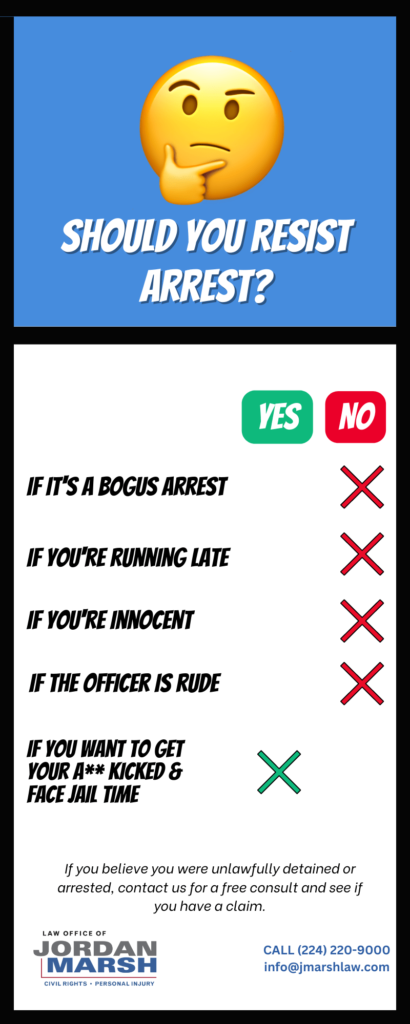
What Happens When You Resist Arrest?
While resisting arrest may feel like the right thing to do in the moment, there are serious long term consequences to doing so.
1. You’ve committed a crime.
In Illinois, as in many other jurisdictions, if you refuse to put your hands behind your back, or resist arrest in any other way, you are committing a crime, even if the arrest you’re resisting is later found to be unlawful (i.e. even if there is no probable cause for the arrest).
Resisting arrest is normally a Class A misdemeanor in Illinois, and subjects you to 48 hours of imprisonment or 100 hours of community service, in addition to any other sentence the court imposes.
If your resistance results in an injury to an officer, it becomes a Class 4 Felony, which may be punishable by 1 to 3 years in prison. However, in the course of resisting, if you offensively touch an officer, even if there is no injury, you may be guilty of an aggravated battery, which is a Class 2 Felony, and may be punishable by up to 7 years in prison.
In short, resisting arrest is a serious offense that can come with significant punishments!
2. You may lose your false arrest claim.
Under federal law, probable cause to arrest will defeat a false arrest claim in civil court, even if that crime is different than the one for which you’re being arrested.
If an officer attempts to arrest you without probable cause, and you resist that arrest, you have just provided the officer with probable cause to arrest you (for the crime of resisting), and you have forfeited any false arrest claim you may have had.
3. You’ve allowed the officer to use force against you.
Police officers are justified in using any force reasonably necessary to effectuate an arrest.
If the suspect resists arrest, the officer may use force to effectuate the arrest. The greater the resistance, the greater the force the officer will use. This may be simply grabbing your arms to get them behind your back to handcuff you, it could mean an emergency takedown (in which you may be slammed to the pavement face first), or it could mean even more severe uses of force, with weapons.
But it may not stop there. We’ve seen too many situations where an officer struggles with a suspect and things spiral out of control, with tragic results. Make no mistake, though: resisting arrest never justifies the use of excessive force on a suspect. Police use of force must always be reasonably necessary to effectuate the arrest. Any more force than that is illegal and unconstitutional.
But these recommendations are not about justification. This is about you putting yourself in the best position to preserve your life, your safety, and your legal rights. And you do that by submitting to arrest, even if you believe the arrest is unlawful.
You deal with unlawful arrests in court. You don’t deal with them on the street, because on the street, you’ll lose every time.
4. Resisting arrest weakens your case in court.
As discussed above, resisting arrest may result in criminal charges and possibly even a conviction. But it will also harm your case if you decide to file a civil rights lawsuit later on.
Whether it’s a false arrest claim or an excessive force claim, the more you resist, the more the jury will be likely to side with the officer. Never forget that most Chicago police officers, and many officers throughout Illinois and the rest of the nation have dash cameras and body cameras that will record everything that happens between you and the officer.
So you should always assume that your actions are being audio- and video-recorded, and that a judge and a jury are likely to see everything that happened.
Two Types of Resisting Arrest: Passive and Active Resisting
There are two categories of resisters: passive resisters and active resisters.
Passive resisters
Passive resisters resist arrest by refusing to comply with an officer’s orders. They refuse to come out of the car, or to put their hands behind their backs when ordered.
Active resisters
Active resisters resist arrest by taking affirmative actions to defeat the arrest. It can be as little as tensing your body so the officer can’t handcuff you. Walking or running away from an officer attempting to arrest you makes you an active resister. Physically struggling with an officer or striking the officer constitutes active resistance, and may even get you charged with aggravated battery to the officer. That’s a felony. Even threatening an officer with harm makes you an active resister.
Resisting arrest, regardless of whether it is passive or active, is a crime.
But the more active your resistance, the worse it will be for you – physically and legally.
There is one more classification you should be aware of: the cooperative subject.
A cooperative subject is a police classification for someone who complies with police directions and orders, and does not resist or obstruct the officer in any way. Any use of force against a cooperative subject is illegal and violates the Fourth Amendment to the United States Constitution.
In fact, it constitutes police misconduct. Learn more about police misconduct in Chicago.
Your goal is always to be the cooperative subject.
Resisting Arrest Is A Crime
Even if you believe you are being wrongfully arrested, resisting arrest is a crime. However, resisting is no excuse for an officer to use excessive force. Let’s review the main takeaways below.
- You have now committed a crime, and can be convicted.
- Even if the underlying arrest was invalid, you have provided the officer with probable cause to arrest you. You have eliminated any false arrest claim you could have made in criminal court or later on if you decide to file a lawsuit. Probable cause for any crime – even if it’s not the crime you were arrested for – defeats a claim of false arrest.
- Depending on the nature of the resistance, the officer is now allowed to use force to make the arrest. If you actively resist, the force will be greater.
- You have undermined any excessive force claim you may want to bring later, because 1) resisting arrest allows the officer to use greater force in order to make the arrest, and 2) it looks worse on video when you’re actively resisting arrest.
However, Resisting Arrest Is Not An Excuse For Police Brutality
An officer can only use force based on the actions of the person they are arresting. Any use of force that is not reasonably necessary is a violation of your constitutional rights, regardless of whether you were resisting at the time. But the place for complaining about excessive force is in court, not on the street.
If you believe you or someone you know has been the victim of false arrest, police brutality, excessive force, or any other legal or constitutional violation, contact Chicago civil rights attorney Jordan Marsh for a free consultation at (224) 220-9000, or at jordan@jmarshlaw.com.
The information provided on this website does not, and is not intended to,
constitute legal advice; instead, all information, content, and materials available on this site are for general informational purposes only. Use of and access to this website or any of the links contained within the site do not create an attorney-client relationship between you and our office.