
Say No To Police Profanity
More tightly-enforced restrictions on officer profanity is a simple, profound way to improve race relations.
A recent documentary on the George Floyd incident includes body cam footage largely unseen by the American public until now. There are some important revelations in this footage that I suspect will enter national discussion gradually. What first struck me was that Officer Thomas Lane, who approached Floyd sitting in his car, addressed him with profanity (specifically, the word “fuck”) very freely. This is a problem endemic to the way cops in the United States speak to people they detain—it goes some way towards explaining what happened with Floyd, as well as countless other incidents—and it needs to be penalized.
Floyd, likely because of the drugs in his system, was confused and anxious about what was happening and resisted putting his hands up. Lane’s response to this was to issue commands, twice using the word “fuck.” One has reason to assume that this is the way Lane addressed people regularly in cases of conflict and that he was not alone on the force in this.
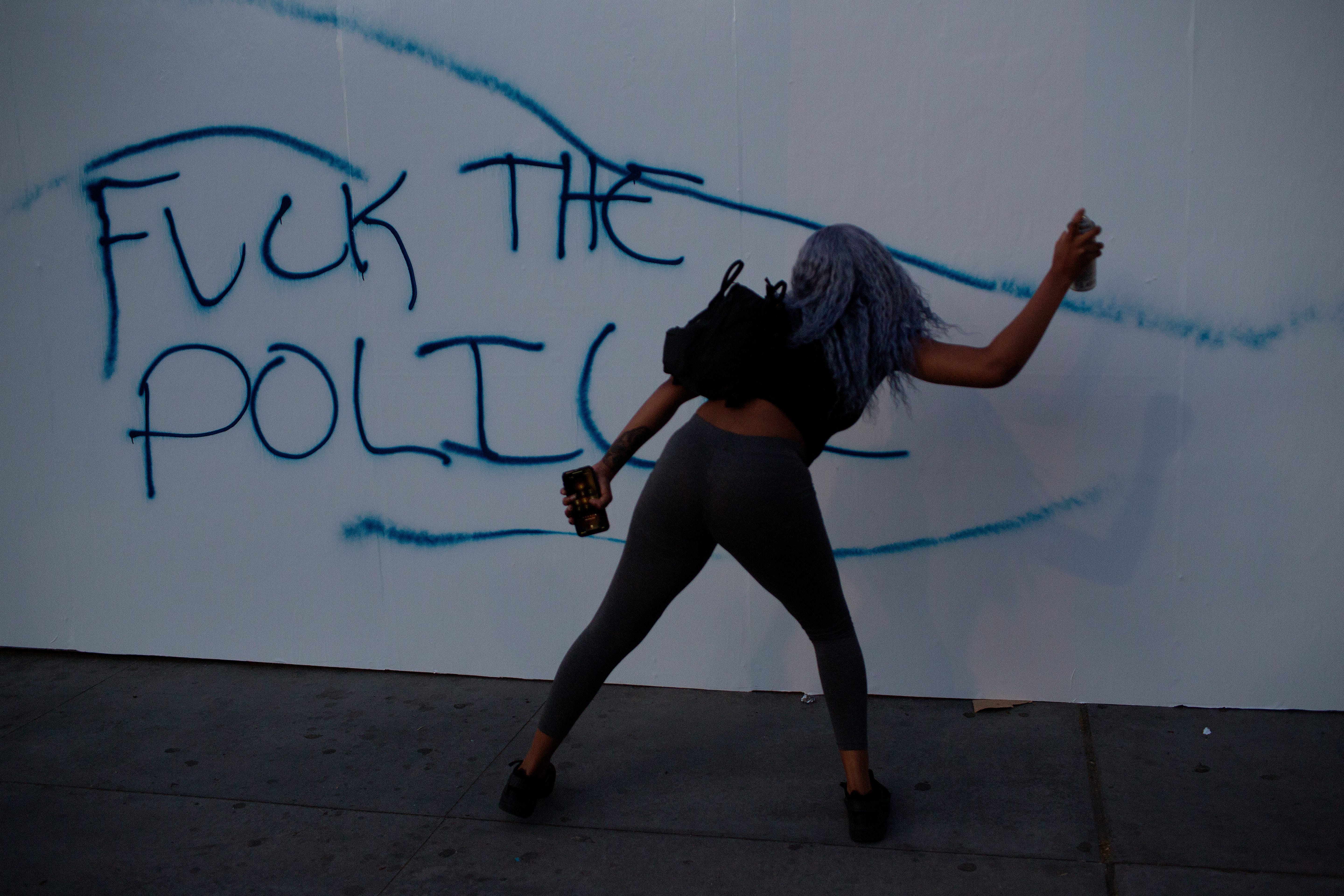
It is in fact documented that it is common for cops to talk to people they detain in this way. Legal literature includes transcripts of encounters in which the officers’ profanity fairly drips off of the page, redolent of disrespect and diminishment. Precincts across the nation do, in fact, have rules against profanity on the job. However, they are barely enforced if at all, as evidenced by behavior like Lane’s. This casual cursing at people is not a mere matter of the informality of our times and it must stop. It is a much more serious matter than it may seem.
Namely, it only helps to poison our national discourse on race. A keystone lesson I have learned in my now 25 years of commentary on race issues is that the main sticking point in the debate, what primarily drives it, what would turn us around a corner in its absence, is the sense of cops as black people’s enemy. Not microaggressions, not how many black people win Oscars, not whether it’s fair to make black people take standardized tests, but the cops. That’s what’s out there on the ground, passed on from generation to generation.
Of course, the main concern in this regard is with shooting deaths. However, while murder by cops—whether of black or other people—happens way too often, it is still rare in the grand scheme of things. A black person is vastly more likely to die at the hands of a fellow black person than a white one, cop or not, for example. However, black people more commonly experience police officers using excessive force than whites do. Gratuitous use of profanity is of a class with this use of force in shaping perceptions of the cops as menaces rather than public servants.
Profanity can be a form of hostility. To be sure, I am skeptical of claims that injurious words always constitute “trauma” (just as I am that “silence is violence”). However, profanity can still be a game changer. In interactions with cops it influences public perception. One study (of many similar) showed that, when presented with a silent video of a person detained by a police officer with captions in which the officers’ profanity was left out, observers judged the interaction as more reasonable than when the profanity was included in the captions. Other studies similarly document that, when it comes to the cops, profanity matters—profoundly influencing how citizens view their interactions with police.
For example, I actually have never been detained by a police officer except for things like minor traffic violations, where I have no friction to report. However, if an officer detained me and the F-word came into play, then that very second would be determinative in how I came away feeling about the incident. The officer cussing at me would come off as someone with authority (and a weapon) feeling entitled to address me however they chose. It would also be a reminder of the weapon. It would be both hostile and demeaning. The schoolyard bully should not be the model for officers’ behavior.
On the other hand, we must not fall for a crude, blanket notion that police officers must never be caught in a recording using, say, the word “fuck” on the job for any reason. This would operate upon an almost willfully uninformed sense of how language actually works. Any word remotely interesting likely has a lot of meanings.
Think of something as simple as the word “go”: we think of it as referring to motion, but we also talk about how a song goes, ask when in the game we get to “go,” and use “and she goes…” to refer to speech rather than locomotion. Words often have several meanings, such as the N-word, used both as a slur and among black people to mean “buddy.”
Fuck—subject of one whole study on police interactions since it seems so fertile within them—has many meanings and functions. Rather a bouquet of them, in fact. It can be a passing, frustrated interjection, in the function of the Peanuts gang’s “Rats.” It can signal joy of a demotic flavor, a lexical kind of camaraderie, as when then-Vice President Biden used it when Obamacare was signed into the books.
We must also allow that speech norms are less formal than they once were. It’s safe to say that, now, most people use four-letter words in work settings in ways that would have been unthinkable in the era of fedoras, camisoles, lawsuits over what got sent through the mail, and married couples sleeping in twin beds on television. We can’t penalize police officers for being caught ever using profanity for any reason on the job.
Yet the issue here is not especially complex or subtle. In interactions with the public, police officers should not use profanity in ways that connote hostility, impatience, or dominance. More economically, the idea is that they should not use it in ways that are mean.
I suspect that this would not lead us into the quagmire of arbitrary evaluations such as Justice Potter Stewart’s famously vague verdict on obscenity that “I know it when I see it.” As human beings of normal cognitive ability living in the same real world, we know the difference between profanity used by a warmly grinning Veep as a verbal pat on the back and profanity used by a cop trying to jolt a detainee into compliance with an “It’s on!” demonstration of dominance. The gray zone between these is something of an abstraction, which would muddy things rather seldom.
Cops shouldn’t be out there cussing at people for sport. It should be classified not as a genuflective no-no tucked away in the books but as a breach of public responsibility subject to fining or even brief suspension. Specifically, police officers should not address people they detain with the words “damn,” “shit,” “hell,” “fuck” or variations thereon. This is not mere 1950’s-style primness: cursing can be a valuable way of letting off steam, bonding with others, and fostering humor—it can be a kind of articulateness. But it has no place in interactions between members of the public and people with weapons.
Anything that could help defuse a general conception of our police officers as “pigs” is something that could help knit us together more as a nation and prepare the ground for the color blindness so many hope we can embrace.
John McWhorter is an associate professor of linguistics at Columbia University, a columnist for The New York Times, and a member of Persuasion’s Board of Advisors. He is the author of, most recently, Woke Racism: How a New Religion Has Betrayed Black America.
Guidance for ethical and professional behaviour in policing
Page contents
Page contents
Click on the links below to jump to the respective piece of content on this page.
- Purpose
- Being a member of the policing profession
- Being open, honest and candid
- Fairness and respect
- Decision making
- Recognising the opportunity to learn
- Challenging unprofessional behaviour
- When behaviour does not meet expectations
- Tags
Code of Ethics guidance to help put the ethical policing principles into day-to-day practice.
First published
24 January 2024
Effective policing is built on public trust and confidence. This depends on a policing profession that is ethical and professional in the way that it respects, listens, responds, improves and serves the public.
The College of Policing has developed a statutory Code of Practice to complement a non-statutory Code of Ethics. Together, they will support everyone in policing to provide ethical and professional policing services. The Code of Ethics includes ethical policing principles to support decision making, as well as guidance on ethical and professional behaviour.
By ‘everyone in policing’, we mean:
- police officers
- police staff
- police community support officers (PCSOs)
- those with designated powers
- members of the Special Constabulary
- police support volunteers and cadets
- police officers and staff on secondment or overseas deployment
- designated contract managers, contractors and staff employed by suppliers providing services on behalf of forces
For ease, the term ‘staff’ is used throughout this guidance to refer to the roles outlined.
Purpose
Policing professionals are more likely to be judged as behaving ethically when their decisions and actions are lawful and consistent with the ethical policing principles.
The policing profession is committed to the highest standards of behaviour. This guidance provides guidance on ethical and professional behaviour for everyone in policing. This is what the public has a right to expect from us, and what we should expect from ourselves and each other. It contains advice on areas of policing that are important to maintaining public trust and legitimacy, as well as additional guidance where experience tells us we could benefit from it, in order to help us do the right thing. It also signposts guidance that is contained elsewhere but not always easily located.
The guidance does not – and cannot – cover every situation that someone working in policing might face, either in the course of their work or when not working. Nor does the guidance replace the need for common sense and professional judgement in how those working across a wide range of policing roles and responsibilities behave. However, the guidance will assist with building a positive workplace culture by spelling out what good policing looks like, and by promoting professional conduct and decision making.
For the avoidance of doubt, the Code of Ethics does not set the standards against which conduct should be assessed. Those standards are set by the Police Conduct Regulations and terms of employment.
Other guidance helps to ensure that assessments against the standards are consistent, including:
- the statutory Home Office guidance(opens an external website in the same tab)
- College of Policing guidance on outcomes in police misconduct proceedings 2023
- Guidance Note 9 to the Police Staff Council England and Wales Handbook for staff employed under its provisions(opens an external website in the same tab)
This guidance is not statutory and does not alter statutory provisions or replace terms of employment or appointment.
As professionals in policing, we will strive to follow this guidance.
Guidance on outcomes in police misconduct proceedings
We aim to update the guidance on outcomes in police misconduct proceedings towards the end of 2025, following revised guidance issued by the Home Office.
Until then, supervisors and line managers should continue to use the 2023 guidance, in line with section 87 of the Police Act 1996.
Being a member of the policing profession
We recognise that, as a result of being part of the policing profession, higher expectations are placed on us compared to the general public. As policing professionals, more attention is likely to be drawn to any misuse of our position or any failure to meet the expectations of our profession.
We uphold and promote the reputation of the police service by acting lawfully and in a way that demonstrates fairness and respect, policing with integrity, trust, confidence and legitimacy (in line with the College of Policing leadership standards).
The public interest and trust
Our high expectations demand that we:
- think about how our actions might be interpreted or perceived by others when taking decisions
- act selflessly and in the public interest
- act in the knowledge that every interaction with the public may influence their own – and other people’s – trust and confidence in policing
- act in a truthful, trustworthy and sincere manner
- do not knowingly make false, misleading or inaccurate oral or written statements, unless it is reasonable and proportionate to do so while pursuing a legitimate and lawful aim
- do not use our position to gain any personal advantage
- only use our police identification or warrant cards for policing purposes and avoid seeking a personal advantage or abusing our position (this does not apply to schemes designed to benefit the public sector or policing profession in general)
- neither solicit nor accept the offer of any gift, gratuity or hospitality that could compromise our impartiality (in accordance with force policies on gifts and gratuities)
- operate within our legal authority, in accordance with accepted good practice, and consistently with the ethical policing principles and this guidance
- do nothing, whether related to work or not, that damages the relationship of trust and confidence with the public
- ensure that our actions are consistent with what we say we will do
- ensure that our behaviour and language are not discriminatory, abusive, oppressive, harassing, bullying or victimising to the general public, our partners in providing services to the public or our policing colleagues – this includes when communicating digitally (including email, SMS and other digital platforms) and when using social media, both inside and outside of work
- recognise when we may not have the expertise or knowledge needed and when issues should be referred, or advice should be sought, from line managers or those with specialist expertise
Doing our best
As policing professionals, we are expected to carry out our responsibilities in an honest and professional manner. This means demonstrating care, attention and diligence, as well as fulfilling our role to the best of our abilities at all times. We:
- always act diligently and efficiently by being conscientious and thorough in our work and in exercising our responsibilities
- promote a positive professional image of the police service at all times
- are conscious of the impact that our behaviour and decisions have on others
- take ownership for resolving problems
- demonstrate courage and resilience in dealing with difficult and potentially volatile situations
- act on our own initiative to address issues
- show a strong work ethic and demonstrate extra effort when required
- remain calm and professional under pressure, defusing conflict and being prepared to step forward and take control when required
- abide by all instructions, policies and procedures set by the police service, where we are reasonably expected to know these, unless we have – and are able to provide – a clear rationale for not doing so
- do not let fear of being criticised divert us from our professional duties
- prioritise the demands on our time and resources where necessary
- are punctual and maintain a professional appearance
- understand that we can seek advice and support from staff associations and trade unions
Being open, honest and candid
We demonstrate candour through our ‘duty to cooperate’. This is a responsibility to give appropriate and timely cooperation during investigations, inquiries and formal proceedings, participating openly and professionally when identified as a witness. This recognises that policing professionals and organisations are accountable and willing to learn from experience.
Our high expectations demand that we:
- are open and truthful in our dealings with the public and our colleagues
- are open and transparent in accounting for our decisions, providing an honest and truthful representation whenever answerable for our actions in policing
- always conduct ourselves with candour, participating openly and professionally when dealing with matters relating to policing, unless we are:
- acting under a statutory legal authority or to meet a legitimate operational policing aim (see examples of statutory authority)
- subject to operational security requirements with colleagues, line management, partners and oversight bodies in the execution of legitimate duties
- recognise that for compassionate reasons, it may sometimes be necessary for policing professionals to withhold information – this action is appropriate where it is deemed, in a person’s professional judgement, to be necessary
- are proactive with our openness and honesty with the public when a policing service to which they are entitled goes wrong and as a result they are adversely affected, by:
- explaining the short- and long-term effects of what has happened
- offering an apology without undue delay, expressing regret and appropriate remedy to put the matter right
- explaining to those affected their entitlement to the police complaints system
- raise issues with line management, ensuring reflection to enable individual and organisational learning when something goes wrong and an immediate remedy is not possible and/or a reoccurrence is likely
- cooperate appropriately with investigations, inquiries and formal proceedings when asked to do so as a witness, being open and professional in the way we participate
- always support and encourage colleagues to be both open and candid, and to raise concerns appropriately
- manage all official documents and records in accordance with the Code of Practice on police information and records management
Examples of statutory legal authority
In policing, there will be occasions when demonstrating candour, through the requirement to cooperate, will be limited by statutory legal authorities subject to existing laws relating to privacy, data protection and national security. This includes the following.
- Preventing the disclosure of relevant material in compliance with the Criminal Procedure and Investigations Act 1996(opens an external website in the same tab).
- Subterfuge in approved firearms tactics or within a live crime-inaction kidnap and extortion investigation, where it is necessary to protect life and prevent suffering in meeting an obligation under Article 2 of the European Convention on Human Rights (PDF)(opens an external website in the same tab).
Covert policing
- The police service operates on the basis of openness and transparency. This is essential to maintaining and enhancing a positive relationship between the policing profession and the community. To achieve legitimate policing aims, it is sometimes necessary to use covert tactics. This is recognised in law.
- Covert tactics must be appropriately authorised. Any deployments must be shown to be proportionate, lawful, accountable and necessary.
- Covert operatives who authorise or perform covert policing roles must keep in mind this guidance, as well as the ethical policing principles and authorised professional practice (APP), at all times.
- Covert operatives can be authorised to create a false legend and persona within an authorised covert policing operation.
- Covert operatives will comply with the Undercover policing APP, which makes it clear that it is never acceptable for an undercover operative to have an intimate sexual relationship with those they are deployed to infiltrate and target or encounter during their deployment.
- Legitimate adoption of a ‘neither confirm nor deny’ response to protect covert policing tactics.
Business interest and associations
Our high expectations demand that we:
- are actively aware of, and identify when, associations with – or advocacy for – any groups or individuals create a conflict of interest or risk to our police work and responsibilities, consequently affecting our ability to discharge our policing duties effectively and impartially
- take steps to mitigate any conflict of interest and notify associations where required in line with policy
- ensure that any business interest we have is reported, is authorised and does not conflict with our police work and responsibilities
- seek clarification on what a conflict of interest is if we are unsure
- report changes in our personal circumstances that could have an impact on our vetting status (including notifiable associations)
Additional professional requirements for police officers only
The actions or associations of police officers can bring discredit and disrepute to the police service and could constitute misconduct. As police officers, we:
- recognise that we must abide by paragraph 1 of Schedule 1 of The Police Regulations 2003(opens an external website in the same tab), which limits our involvement in politics
- know that being subject to any of the following measures could bring discredit on our police service, may affect our vetting status and may result in action being taken for misconduct, depending on the circumstances of the particular matter:
- arrest
- any legal processing in connection with an allegation of criminal conduct
- a summons for an offence
- a penalty notice for disorder
- an endorsable fixed penalty notice for a road traffic offence
- a charge or caution for an offence by any law enforcement agency
- a conviction, sentence or condition imposed by any court, whether criminal or civil (excluding matrimonial proceedings, but including non-molestation orders or occupation orders) – ‘conditions imposed by any court’ would include, for example, orders to deal with anti-social behaviour, a restraining order or a bind-over
- any legal proceedings taken against us for debt recovery, or any other adverse financial judgments
- any known criminal conviction against a member of our immediate family or a close friend, so that appropriate safeguards can be put in place
We will report, as soon as reasonably practical, any occasion – whether in the UK or elsewhere – when we are subject to any of the measures listed above. When we are in doubt as to whether to make such a report, we understand that it is best to seek advice.
Additional professional requirements for police staff, volunteers and others working in policing (not police officers)
As police professionals, we know that being subject to any of the measures listed above could bring discredit on our police service, may affect our vetting status and may result in disciplinary action being taken, depending on the circumstances of the particular matter. For these reasons:
- we will report any caution or conviction against us for a criminal offence
- we must report all convictions, sentences and conditions imposed on us by any court, whether criminal or civil, as soon as reasonably practical
- we may be required to disclose other legal matters affecting us for legitimate policing purposes, such as vetting, depending on the nature of our particular role
When we are in doubt as to whether to make such a report, we understand that it is best to seek advice.
Confidentiality
We understand the importance of managing information that comes into our possession through our police work. We understand that we have the responsibility to share some information when it is needed and to protect other information from misuse. As a result, we will protect:
- police information from being accessed or accessible to unauthorised recipients, either on-duty or off-duty
- police information in line with the General Data Protection Regulations (GDPR) and the Code of Practice on police information and records management
- personal data, with the understanding that by accessing such data without authorisation, we could be committing a criminal offence, regardless of whether we then disclose that personal data
- police information and not ‘gossip’ to colleagues who do not need to know it for a policing or welfare purpose, or to anyone – including friends and family – who could contribute to the misuse of police information
- police information that might prejudice investigations, operations or policing tactics
- our own personal and professional information because we recognise that it might increase our vulnerability to harassment, corruption and blackmail (see APP on undercover policing)
- the quality of the data that we enter on to police systems