Watch Police Force a Fleeing Motorcycle off the Road
During a wild chase, a police officer made a risky decision to end things ASAP.
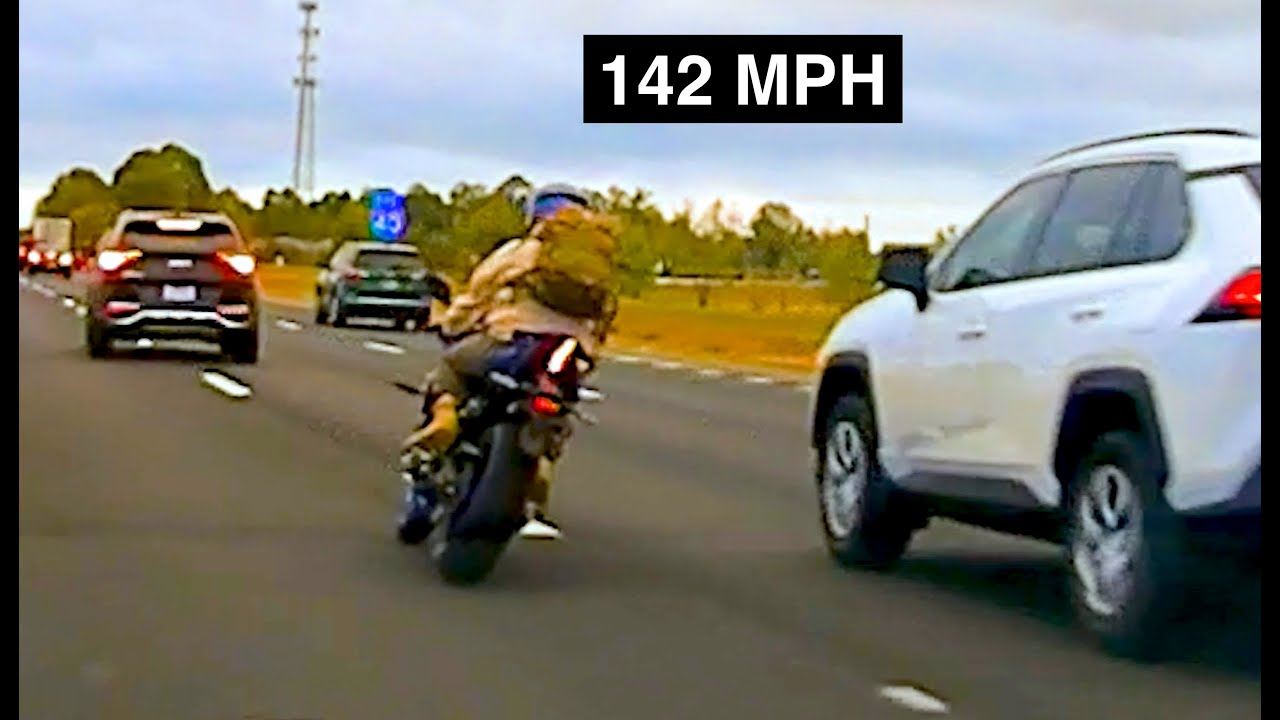
At this point, I’ve watched so many videos of automotive reviews and industry news stories that the YouTube algorithm doesn’t know what to do with me. Today a video popped up titled: “One (Clever?) Way to Stop a Motorcycle Chase.” It is dashcam footage of two Arkansas police officers trapping a fleeing motorcyclist in a sort of pincer maneuver and then making the impromptu–and unorthodox–decision to force him off the road at speed. I have mixed feelings about the incident. Here’s the scoop.
In the fall of 2023, an Arkansas State Trooper saw a motorcyclists weaving in between traffic. “Lane splitting” like this is legal in some places, but not in the state of Arkansas. So the police officer lit up his lights to pull the bike over. But the rider took off.
Over a lengthy chase, the rider wove in and out of traffic to evade the cruiser. The police officer pushed through rush hour traffic, often using the breakdown lane to pass slower cars. This wild chase reached speeds of 140+ mph.
As the first police officer approached an intersection with another highway, he radioed ahead for help. Another officer drove toward the intersection on the other highway. When the motorcyclist decided to switch highways, the second cop drove across the center median and into traffic with his lights going to ambush the rider. Traffic stopped, but the patrol car wasn’t long enough to block every lane of traffic. As the motorcyclist approached the lone officer, the cop moved to intercept him, forcing the bike off road.

The motorcycle immediately went down. The rider jumped up and threw both of his hands in the air. Both police officers tackled him to the ground, swearing angrily. One officer pushed his head into the ground and yelled, “Run from me again, M—–F—–!” while other shouted, “Son of a b—-!”
So here’s the dilemma that police officers face whenever a suspect flee: The speeding motorcyclist was putting other motorists in danger. Speed limits and laws about lane splitting are written with the intent of protecting innocent bystanders. So officers are tasked with pulling over motorists who break those laws. But a high speed chase can put the offender, and other drivers, at even more risk.
Running a motorcycle off the road is especially risky. The driver will come off and hit the ground. It’s miraculous that this suspect wasn’t seriously injured.
Here are a couple more factors: The suspect saw the police cruiser and had time to brake hard. The video shows he was moving between 30 and 40 mph when he finally hit the grass. In addition, the police say a motorcycle fled from them two months previous and they originally suspected it was the same rider. They were ratcheting up enforcement to stop a dangerous pattern.
But after a search the police found the rider had no criminal history, past traffic violations, or drugs on his person. He happened to be concealed carrying a firearm, legally. For the rider’s part he immediately apologized, saying it was his first week with a motorcycle and that he freaked out because he’d never been pulled over in his life. He added, “I don’t have much to say to y’all but I apologize. That was–that was stupid and I shouldn’t of put you all through that.”
WHAT ARE MOTORCYCLE NO-CHASE LAWS AND WHY ARE THEY IMPORTANT?
BY DAUGLAS DENGA FEB. 14, 2025 9:15 PM EST
VIZ UALNI/Shutterstock
Many people view riding a motorcycle as one of the most dangerous activities a person can engage in. Given the limited protection that motorcycles typically provide their riders, it makes sense that this conclusion has become commonplace in today’s automotive industry. Many governments worldwide have implemented regulations designed to ensure the safety of all bikers, whether they are high school students commuting to and from school, or experienced riders speeding down a racetrack. For the most dangerous riders, however, this is where no-chase laws become come into play. These policies are designed to significantly minimize the risks of collateral damage during a police pursuit.
At first glance, you might think the phrase “no-chase” means that a police officer can’t pursue you if you’ve broken the law and are fleeing on your motorcycle. Well, you wouldn’t be entirely wrong to think this. The officer might refrain from pursuing you as they would someone in a four-wheeled vehicle. However, this doesn’t mean they will give up entirely. While some view no-chase laws as restrictions preventing an officer from outright pursuing a lawbreaker on a motorcycle, others see them as policies designed to help officers bring in bikers safely, without endangering themselves or the public. Of course, these rules are nuanced and vary from one jurisdiction to another. Let’s examine them closely to understand how they enhance road safety, and why they are so important.
They provide a framework for decision-making during critical moments.
Artistic Operations/Getty Images
At the core of many road rules and regulations is safety, of course. For motorcycles specifically, these rules and regulations are even more crucial. It doesn’t matter if you’re riding the coolest Honda ever made or one of Indian’s brand-new Sport Chiefs as you cruise down the highway: Following these rules will ensure a smooth experience for everyone on the road, including you. For no-chase laws, officers assess safer alternatives to pursuits, such as using their vehicles to block the road or employing aircraft like helicopters to monitor the individual of interest instead of actively chasing them.
What most people don’t realize is that police pursuits are more akin to chess than checkers. Every decision made in the heat of the moment is crucial, especially since lives are at stake. Suppose an officer successfully arrests someone who has fled with a stolen motorcycle: The pursuit was chaotic, resulting in the destruction of public property and the suspect suffering an injury. The case will have to be reviewed by the Independent Office for Police Conduct, where the officer will need to justify their actions.
What if a chase leads to more than just property damage or injuries? What if it weaves through neighborhoods where children are playing, and they get caught in the pursuit? Every choice made by an officer will require an explanation later on, whether before a superior or in a courtroom. This is why no-chase policies are essential; they offer a framework for decision-making in critical moments. However, they do much more than that.
No-chase policies vary from one jurisdiction to the next
Douglas Sacha/Getty Images
No-chase laws do more than just ensure that an officer can bring someone in without endangering lives. They also shield the police department and local governments from lawsuits, while safeguarding the suspect’s constitutional rights, as they are considered innocent until proven guilty. These laws vary from one jurisdiction to the next. In Chicago, for example, no-chase laws forbid the authorities from outright pursuing traffic offenses — with the exception of driving under the influence or vehicle theft. Officers are also prohibited from engaging in pursuit while operating motorcycles.
In the state of Washington, authorities only pursue bikers believed to have committed serious criminal offenses. Even so, strict rules are enforced during the attempt to apprehend the suspect, with one of the primary priorities in the chase being safety. Local police departments also have specialized pursuit policies designed to minimize casualties during a motorcycle chase.
RECOMMENDED
NEXT UP
CARS
MOTORCYCLES
EVERY MAJOR MOTORCYCLE HELMET BRAND RANKED WORST TO BEST IN NHTSA COMPLIANCE TESTING
BY ERYNN RUIZ OCT. 30, 2024 9:30 AM EST
Shoei Helmets
We may receive a commission on purchases made from links.
A helmet is a helmet, until you’re sliding along the asphalt on your noggin. Sure, most motorcycle helmets on the market today meet minimum safety requirements. But does meeting the minimum make a motorcycle helmet brand the best? It turns out that beyond minimum requirements, some brands put in the work to meet stricter safety standards that exceed minimums. Not only that, but some receive outstanding marks when it comes to government testing.
To determine the best motorcycle helmet brands versus the worst, we’ve taken a look at brand compliance, meaning whether helmets pass rigorous testing standards by the National Highway Traffic Safety Administration (NHTSA) and which safety standards their products meet or exceed, such as DOT, Snell, ECE, and others.
One note regarding the NHTSA’s compliance reporting: NHTSA flags various issues ranging from the failure of a company to file its Manufacturer Identification with the organization to stickers that aren’t permanent enough to catastrophic failures in testing. Thus, we’ve provided an explanation of some noted issues along with the failure rate for each brand, as the nature of the failure determines our overall rankings.
There’s a lot to look for when choosing a motorcycle helmet, so here is every major motorcycle helmet brand ranked worst to best. Stay tuned after the list for more on our methodology.
- HJC Helmets
HJC Helmets
HJC Helmets has been in the industry for decades and prides itself on innovation. It even has a wind tunnel testing laboratory and facilities in the United States, France, Vietnam, and Korea. Despite its promised commitment to rider safety and satisfaction, HJC does not seem to go beyond the minimum safety requirements.
HJC meets DOT (Department of Transportation) standards, DOT FMVSS No. 218, according to its labeling and advertising, but does not specify other safety standards. The F71, for example, is described as “Meets or exceeds DOT approved.”
Based on the NHTSA’s compliance test report database, HJC had an overall failure rate of about 23%. Testing issues included failures that were both labeling and impact related. The latter is more worrisome given that impact relates to safety, whereas a label falling off won’t directly harm a rider.
Given the brand’s lack of additional certifications plus the test failures (and relatively high fail rate), HJC is the worst-rated in our lineup.
- KLIM
Klim
KLIM is a relatively well-known helmet brand, and its helmets are some of the most expensive on the market. With prices starting at around $550, KLIM helmets do offer both DOT and ECE certification. ECE ratings come from the Economic Commission for Europe, which governs traffic safety standards across Europe. An ECE 22.06 rating isn’t legally required in the U.S., but it’s a safety standard in Europe and is often seen as a perk on top of DOT certification. You won’t find a helmet sold in the U.S. that is only ECE, though; DOT is the primary standard.
Despite the fact that some KLIM helmets have both DOT and ECE ratings, the brand only has one test in the NHTSA’s database. Given that the single test identified failures in three of four impact scenarios, that means a 100% failure rate.
The lack of safety data available means KLIM cannot be one of the best helmets among our rankings. However, if you’re interested in purchasing one, you can find KLIM helmets on Amazon.
- Biltwell
Biltwell
Most Biltwell helmets are listed by their product name plus the current ECE standard and DOT certification. At first glance, these relatively affordable helmets (plenty of models are just under $300) seem like a great deal with safety in mind. When you click on a helmet’s details, the DOT compliance is also highlighted.
Unfortunately, the NHTSA’s testing doesn’t instill complete confidence in Biltwell. To date, the NHTSA only has four results for Biltwell in its database, and all four (a combination of complete and full/open-face helmets) resulted in some failures. Granted, the failures were all related to labeling rather than true safety issues. However, the ratings mean a 100% failure rate and seem to hint that Biltwell needs to work on its labeling processes.
Further, four tests (and two out of nearly countless standards) are hardly enough information to recommend a helmet, so Biltwell didn’t score well in our survey. That said, if you’re interested, Biltwell helmets are readily available on Amazon.
- AGV
AGV
A helmet is an essential piece of motorcycle gear the moment you start riding, so you don’t want to take chances. In a disappointing turn of events, AGV, a middling-cost brand, doesn’t appear to have the best-quality helmets on the market.
While most AGV helmets are both DOT and ECE compliant (the K6 S, for example, is denoted as DOT and E2206), not all of them performed well in the NHTSA’s performance testing. A total failure rate of over 47% means AGV ranks low on our list, despite the fact that many of its full-face helmets passed testing with no issues identified. Those that did have issues, such as the OF44H, involved both impact- (vital) and labeling-related (not so serious) failures.
Given the mixed results, AGV helmets don’t perform consistently enough to inspire full confidence. However, NHTSA testing instills more confidence in the full-face helmets, meaning those might be the best option in AGV’s lineup.
- LS2
LS2 Helmets
LS2 helmets appear to meet DOT and ECE standards, with some models also meeting FRHPhe-01 requirements, the FIM Racing standard for road racing helmets. A couple of LS2 helmet models also meet Snell standards, though not all.
However, when it came to the NHTSA’s database, LS2 helmets had an over 45% failure rate, with five out of 11 compliance tests throwing red flags. Some failures involved labeling, but one involved multiple failures across impact and penetration tests, which relate to how well the helmet can handle impact and sharp objects.
While LS2’s full-face helmets tended to fare better in testing, the lack of good marks across the board leaves the brand leaning toward the lower end of our list. Further, most helmets we looked at had an ECE 22.05 rating, while 22.06 is the newer and presumably even safer standard. Even if LS2 did meet the newer standard, the high failure rate would still give us pause. If you do want to check LS2 out, Amazon carries these helmets.
- Icon
Ride Icon
Icon helmets are priced nicely, and Icon doesn’t charge extra for added style. Most Icon helmets are around $300, making safety and flashy looks equally affordable — in theory. Many entry-level helmets from this brand meet various safety standards and come in cool color patterns, including glow-in-the-dark, vibrantly colored face shields, and more. However, it’s not all good news when it comes to Icon’s standards or safety record.
Some Icon helmets, such as the Elsinore Monotype, meet DOT requirements, but apparently do not have any other certifications. Others, like the Airflite, which had an impact failure per the NHTSA, meet DOT, ECE 22.06, and PSC (Japan) safety standards. Because PSC isn’t necessarily applicable in the U.S., it might not be wholly relevant since testing methods vary by country.
Overall, Icon had over a 45% failure rate, meaning despite its DOT and other compliance, it’s not one of the best motorcycle helmet brands on the market for safety or reliability. Other brands performed better according to the NHTSA’s database, including better-known ones.
- Harley-Davidson
Harley-Davidson
Harley-Davidson makes some of the best-sounding motorcycles, but its helmets don’t have such an awesome reputation across the board. While Harley-Davidson helmets like the H-D Velo H34 meet DOT and ECE 22.06 standards, not all of the brand’s helmets have performed well in compliance testing.
The NHTSA reported that three of seven compliance tests had issues, with, at times, some seriously concerning failures related to impact and penetration testing. However, the NHTSA only tested partial helmets, not full-face models. Overall, the lack of data on any full-face helmets is what resulted in Harley-Davidson’s lower spot on our list.
Models like the H-D Velo H34 (this model rolled out at only $150) might very well be some of the most affordable and safest on the market, but we need more data to speak to the latter point. It’s not that Harley-Davidson helmets aren’t safe, just that other brands instill a higher level of consumer confidence given their track records (and extra standards).
- Scorpion
Scorpion USA
Scorpion helmets mark a turning point in our list of the worst-to-best-ranked helmets based on NHTSA testing. While Scorpion’s helmets mostly appear to conform to DOT requirements (some denote ECE approval), a rather low failure rate of just over 22% based on 18 total NHTSA tests inspires some confidence in the brand.
No tests in recent years have flagged any issues, but circa 2014, the NHTSA did note a test issue for Scorpion EXO helmets. That model failed one element of the impact test, while an older version of a similar model had multiple impact failures. Times may have changed, but we’d like to see more data to really be sure.
Given the low overall failure rate, availability of a decent amount of tests, and no new failed tests, Scorpion seems like it’s a middling brand we might take a chance on for motorcycle helmets. It also doesn’t hurt that Scorpion helmets are very affordable, starting at around $110; you can find Scorpion helmets on Amazon.
- Simpson
Simpson Motorcycle Helmets
Simpson motorcycle helmets had the most safety certifications of any of the most popular brands, but it couldn’t quite scale to the top of our list for a few reasons. We bumped Simpson ahead of other competitive motorcycle helmet brands because it offers helmets with DOT, ECE, Snell, SFI, FIA, and CMR standards.
While Simpson doesn’t explain all of its ratings, Snell, for example, is a well-known non-profit certification body. Simpson notes that its helmets are certified to Snell SA2020, which denotes motorcycle helmets suitable for use in competitive automotive sports. Such compliance suggests that Simpson’s helmets could be safer than a range of other helmets on our list.
That said, Simpson’s helmets are not as well-tested as other brands in terms of NHTSA compliance. With only four tests, and all four failing due to issues like penetration and retention tests, and labeling, it’s hard to put 100% confidence in Simpson’s products without further proof of safety.
- Schuberth
Schuberth
Schuberth is another helmet brand with a variety of certifications, depending on the helmet you choose. Most Schuberth helmets appear to meet DOT and ECE standards, while some meet others like S.R.S. and P/J. P/J is of particular interest because this rating means the helmet is certified for safety as both a full-face helmet (P) and an open-face helmet (J). However, the NHTSA declares that “a full-face design is a good indicator of a safe helmet,” suggesting that modular designs are not ideal.
While all brands provide warranty coverage against manufacturing defects, only a few select brands go beyond that minimum and offer replacement coverage if your helmet is in an accident. Schuberth is one of them. The company offers a replacement program where you pay one-third of the cost of a new helmet.
Because Schuberth offers multi-compliant helmets, only had labeling failures in its NHTSA tests, and offers a comprehensive post-accident replacement program, it ranks more toward the best than the worst on our list.
- BILT by Cycle Gear
BILT
There are many places to find motorcycle gear on a budget, and Cycle Gear has a reputation for being one of them. Full-face BILT helmets start at under $100 and range to around $300, making for a decent entry-level option for motorcyclists on a budget.
BILT also makes a commitment to meeting DOT and ECE 22.05 standards, which check the basic boxes. What’s more, BILT performs fairly well in compliance testing, with only one failure related to labeling out of five tests. In terms of penetration and impact tests, BILT’s motorcycle helmets did well.
Note that not all of BILT’s helmets are full-face, so not all of the NHTSA tests were on full-face helmet models. Still, none had performance-related failures noted. While we’d like to see more testing for reassurance, a 20% failure rate solely related to labeling concerns isn’t the worst on our list by far.
- Bell
Bell Helmets
Easily one of the most recognizable names in motorcycle helmets, Bell has a positive reputation overall and did well in our NHTSA results comparison. Not only did the NHTSA run 31 tests on Bell helmets, but the brand performed exceedingly well with a failure rate under 20%.
As far as standards, Bell only confirms that it meets DOT and ECE, but its performance in the NHTSA testing speaks for itself. Most of the compliance test issues were related to labeling failures, with low odds of impact failures given the NHTSA’s data.
In addition to its overall positive track record with performance, Bell is also one of only two big-name motorcycle helmet brands with a discount offer if you get in an accident. The company notes that if your motorcycle (or bike) helmet is involved in an accident, you might be eligible for a discount on a new Bell helmet. While it doesn’t cost a whole lot to buy a brand-new Bell helmet — prices start at around $130 — it’s just one more thing Bell does to set itself apart.
- Shoei
Shoei Helmets
Shoei is a highly ranked motorcycle helmet brand on our list because of its multiple certifications and low failure rate. Shoei helmets are, of course, DOT compliant as a baseline, but the company also has Snell certification on many of its helmets.
While some lower-priced models (the RF-SR at $400, for example) are DOT only, higher-end models like the X-FIFTEEN are DOT, ECE, and Snell M2020R certified. M2020R is Snell’s general motorcycle helmet for public sale designation, but this shows that Shoei goes above and beyond the minimum.
Shelling out $900 or more for a helmet is quite a hefty expense, but based on the NHTSA’s testing, Shoei achieved a failure rate of just under 18%. Relatively few helmets had impact failures, and most test flags were related to labeling. Overall, the odds of any failure are relatively low; Shoei had the lowest failure rating of any motorcycle helmet we looked at. Even better, the brand is available on Amazon.
- Arai
Arai
Based on our review of the NHTSA compliance database and major helmet manufacturer brands’ safety standards, Arai is the absolute best motorcycle helmet brand. Not only does Arai conform to DOT and ECE standards, but hundreds of its motorcycle and motocross helmets are Snell-certified, as confirmed by Snell’s database.
In the NHTSA database, Arai had a failure rate of around 23%, which wasn’t the absolute rock-bottom lowest. Yet combined with Arai’s commitment to improving safety and meeting various industry standards, the figure doesn’t look so bad — especially because most failures were related to labeling.
Arai has the best full-face helmet money can buy, and you’ll need a lot of it for the Corsair-X. That said, most helmets last around five years, but Arai’s can last for seven. Plus, Arai dedicates a lot of energy to improving helmet safety, as the brand explains on its website. Its technical philosophy? “At Arai, safety standards such as Snell and DOT are our starting point, not our end goal.”
It’s still a good idea to wear full gear (and take a motorcycle safety course), but a safe helmet goes a long way toward protecting you on your bike.
Methodology
Ride Icon
Our methodology surveyed two main elements to determine motorcycle helmet brand quality. First, we explored the compliance of each brand as determined by the National Highway Traffic Safety Administration, based on the NHTSA’s compliance database for motorcycle helmet compliance test reports.
We looked at not only the number of failed tests but also the nature of those tests. Helmet brands that had many failures related to safety issues were considered worse, while those with labeling or other cosmetic issues were considered better. No brand has a completely perfect record, and even helmets that had some failures also succeeded in other areas of testing. Because the testing is judged as pass fail with the NHTSA, we do not have specific data relating to the areas in which any one helmet brand succeeded, except to say that it didn’t fail.
Next, we considered each helmet brand’s adherence to various industry safety standards. Brands that went above and beyond were moved up the quality list for having stricter and a variety of safety controls. For example, all helmets in the United States must meet DOT (Department of Transportation) standards. However, Snell (an independent, non-profit standard-determining body) and ECE (a European standard) are not. When a manufacturer goes beyond the minimum, that’s a plus in our book.
Read More: https://www.slashgear.com/1699145/best-worst-motorcycle-helmets-ranked/