Pensacola woman sentenced to life for dousing Circle K clerk with gas and igniting her
The Pensacola woman charged with lighting a gas station clerk on fire after dousing her in gasoline was sentenced to life in a Florida prison Wednesday afternoon.
Betty McFadden entered a no contest plea to attempted first-degree premeditated murder in November 2023, and Circuit Judge Linda Nobles levied the sentence despite hearing expert testimony of McFadden’s severe mental illness.
“While I recognize that you have a mental illness, you are absolutely a dangerous human being,” Nobles told McFadden before sentencing her. “What the family said in their letters, to not let you have an opportunity to do this to another person or another family, is of utmost importance to me.”
One of the letters given to the court was written by Joie Hellmich, the clerk at a Circle K gas station at the corner of North W Street and Massachusetts Avenue who McFadden lit on fire.

Assistant State Attorney Trey Myers read aloud Hellmich’s letter, which said she’s trying to “love herself again” after sustaining second-and-third-degree burns on 33% of her body.
“I used to be happy and outgoing, now, because of what I went through, I’m not the person I was before – I’m shy and self conscious, (and) I don’t know if I’ll ever be the same person again,” Myers said as he read Hellmich’s letter. “Like my emotional scars, I will never be the same again physically.
“The pain I went through was almost unbearable,” Myers continued as he read the letter. “The months I sat in the hospital were filled with surgeries and painful recoveries.”
What did Betty McFadden do to Joie Hellmich in 2022?
On March 30, 2022, McFadden had been panhandling at the Circle K gas station when employees notified her she had to leave, according to Escambia County Sheriff Chip Simmons. She then returned to the store later that day on a mission.
McFadden began asking passersby if they could fill up her gas can since she didn’t have any money. Little did anyone know she had hidden matches in her bra, according to Nobles, and walked into the store where she doused Hellmich with the gasoline.
Covered in gasoline, the Hellmich started to run from McFadden, who then began “throwing lit matches at her, ultimately catching her on fire,” according to the ECSO.
Get the Daily Briefing newsletter in your inbox.
Start your day with the morning’s top news
Delivery: DailyYour EmailIs the ‘(bleep) dead?’: Woman accused of burning gas station clerk showed no remorse, ECSO says
McFadden then walked out of the building and around to the back of the store. An employee who had filled a mop bucket with water to douse the flames also suffered minor burns.
Before McFadden was transported to jail, she was taken to the ECSO headquarters where she was questioned by detectives, according to the report. At the end of the interview, one of the investigators wrote in the report that McFadden asked him two noteworthy questions.
“As I was leaving the interview room, McFadden asked me if the ‘bitch dead,'” the investigator wrote. “McFadden asked if she was burned all over her body, to which I replied she was and she simply replied, ‘ok.'”
Psychologist says Betty McFadden suffers from bipolar and schizoaffective disorder
During the sentencing hearing, the defense called Dr. Stephen Zieman to the stand to explain his psychological evaluation of McFadden, saying she “has a lifetime of treatment needs ahead of her.”
“The severity of her psychosis when she gets to those levels is going to require careful monitoring,” he told the court. “The problem for treatment of schizophrenia, of bipolar, is that when medications used wear off, people don’t usually recognize it, and it’s usually too late (when they realize.)
Currently 32 years old, McFadden may have a decline in the severity of her mania beginning at age 40, Zieman said, which could help in finding suitable treatment, but until then the psychologist said she will likely continue with high fluctuation in her symptoms.
The defense argued that due to her troubled home life as a child and severe need for mental health treatment, she ought to be sentenced to the lowest permissible 90 months in prison so that she has a chance to get specialized help.
Judge Nobles did not agree.
“I know in your (pre-sentence investigation) you said left the home at age 11 and became homeless because your home life was so bad,” Nobles said. “But, there are a lot of people that are dealt bad hands that don’t go on to set somebody on fire.”
‘F*ck you, I have a Porsche’: Woman allegedly steals gas from TikToker
‘I don’t drive a f*cking piece of shit.’
TikTok creator @mypg13acount captured the frantic moment when he caught a woman allegedly stealing gas from his pump and pouring it directly into her own can.
Featured Video
The video has now reached over 400,000 views, and users continue to weigh in on the incident.
The TikTok begins mid-altercation, with the woman hunched over the ground.
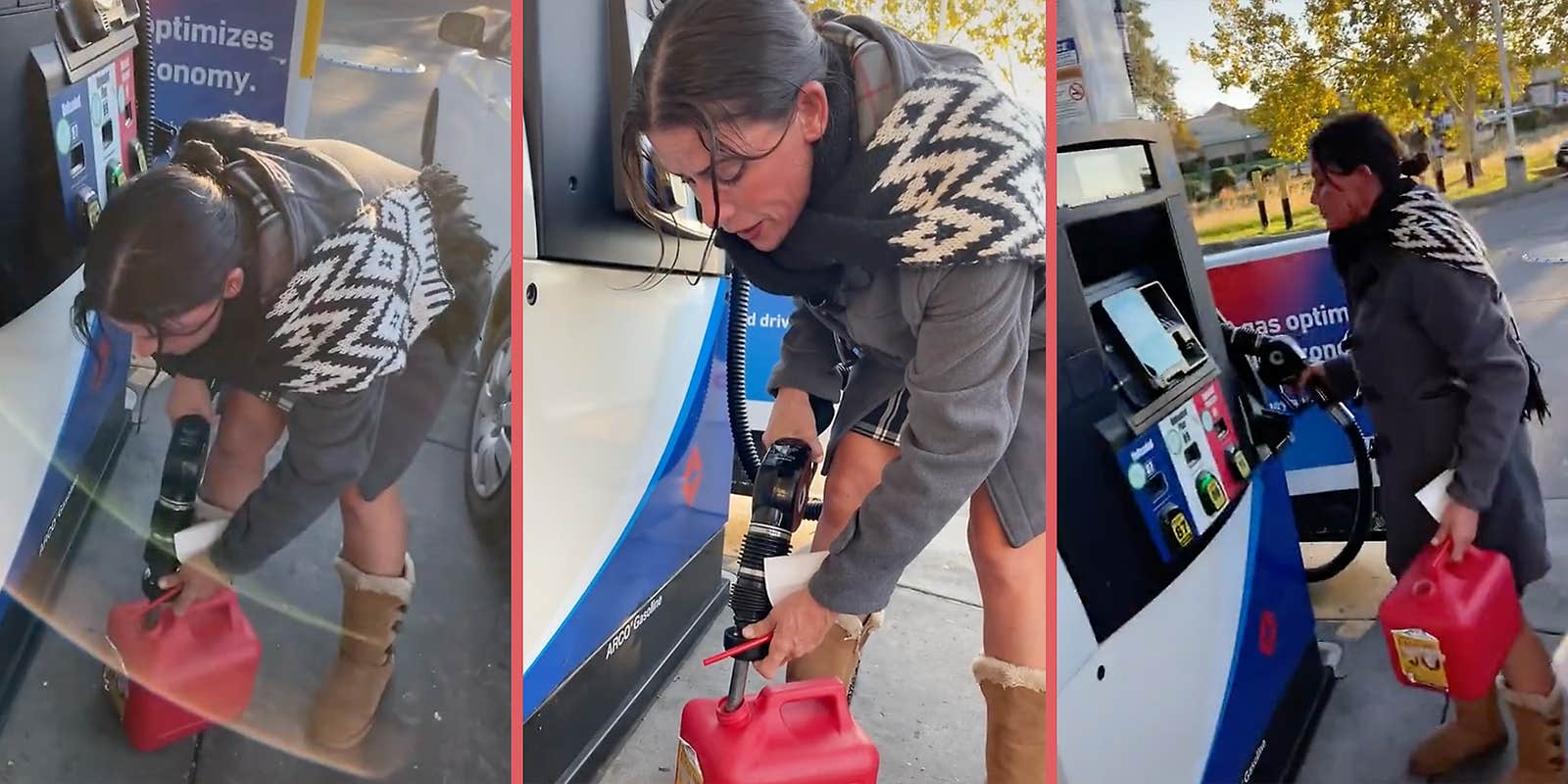
“She’s taking our gas that we literally just parked in front of our gas and just started paying,” @mypg13aacount narrates.
Advertisement
“How much did you put in there?” she barks at the two friends.
“Where’s your car then?” one friend replies.
“No dude,” she says. “You’re a fucking dirtbag.”
Advertisement
Later on, she claims to drive a luxury sports car.
“Fuck you, I have a Porsche,” she yells at them. “I don’t drive a fucking piece of shit.”
“Damn, you must be broke as hell. That’s crazy,” the friend replies.
“No, you must be fucking a total loser,” the woman says storming off.
Advertisement
Throughout the video, @mypg13acount’s camera stays on the woman, but neither he nor his friend approach the woman or attempt to stop her. Commenters have questioned why they didn’t intervene.
“Bruhhh nawww i would of [sic] swung the way these gas prices lookin rn,” user @mar6uapp said.
“How yall just letting her take your gas?” @thegentlemeninparis wrote.
“Y u just standing and not throwing hands??” asked @sand._.dra. “Cause she’s a woman and I would go to jail lol,” replied @mypg13acount
Advertisement
The video ends with the woman walking away, but according to comments it does not appear that the friends tried to get their gas back.
“Please tell me you took that gas back or made her pay,” said boyerboy101. “Nah,” @mypg13acount replied.
@mypg13acount did not immediately respond to a request for comment.
Environment Bill
Volume 813: debated on Wednesday 30 June 2021
Committee (4th Day)
1.30pm
Relevant documents: 3rd Report from the Delegated Powers Committee, 4th Report from the Constitution Committee
The Deputy Chairman of Committees
Sharethis specific contribution
I will call Members to speak in the order listed. During the debate on each group, I invite Members, including those in the Chamber, to email the clerk if they wish to speak after the Minister. I will call Members to speak in order of request. The groupings are binding. A participant who might wish to press an amendment other than the lead amendment in a group to a Division must give notice in debate or by emailing the clerk. Leave should be given to withdraw amendments. When putting the Question, I will collect voices in the Chamber only. If a Member taking part remotely wants their voice accounted for if the Question is put, they must make this clear when speaking on the group.
Clause 29: Advising on changes to environmental law etc
Debate on Amendment 103 resumed.
Sharethis specific contribution
My Lords, the noble Baroness, Lady Parminter, explained her Amendment 103 extremely well. I will speak to my Amendment 109. We have Euro 2020, Wimbledon, the cricket and the Environment Bill—how much better could it be for all of us? There is so much pleasure in such a short time.
My Amendment 109 would introduce a new clause into the Bill that is intended to address some extensive governance gaps in environmental law that have arisen because of the UK’s departure from the EU. Amendment 109 places an obligation on the Secretary of State to report to the office for environmental protection “any information” that was previously required to be reported to the European Commission relating to environmental law and its application. This could include, for example, requirements to report on ambient air quality and pollutant emissions or on the implementation of key fisheries rules, both of which were previously required to be reported to the European Commission but are now no longer required under UK law. These are two helpful examples but reporting requirements were removed through EU exit statutory instruments across the whole spectrum of environmental policy areas. Without such a replacement, there will inevitably be a reduction in transparency and accountability, both of which are crucial to the effective implementation of environmental legislation.
To ensure that the amendment does not place an unnecessary burden on either the Secretary of State or the office for environmental protection, the latter must review these reporting requirements
“no later than two years”
after the Environment Bill has passed into law. If the OEP determines that an existing
“reporting requirement is no longer necessary to contribute to environmental protection or the improvement of the natural environment, it must arrange for a report setting out its reasons to be … laid before Parliament, and … published.”
The Secretary of State is then obliged to
“lay before Parliament, and publish, a copy of the response”
to the report within three months.
Why is this amendment necessary? The reporting of information relating to environmental law is absolutely vital to ensure transparency and accountability in environmental policy-making and ensure that government and stakeholders can identify and address environmental impacts. Continuity over time in the information being recorded and reported can also help to reveal trends and increase transparency.
However, several requirements for the Secretary of State to report information to the European Commission in relation to environmental law have been lost because of the UK’s departure from the EU and the subsequent adoption of new statutory instruments. This poses a serious threat to the effective application of environmental law in the UK—because we all know that there are quite a lot of people who try to evade these particular laws—and the Government’s ability to achieve their stated aim and manifesto promise of leaving the environment in a better state than that in which it was found.
Sharethis specific contribution
My Lords, I will be brief. I put my name down to speak on this group expressly to support Amendment 103—because, given our earlier debates on the office for environmental protection and its independence, I want to test the extreme limits of Defra’s control, if there are any. I would have thought that it is a given that Amendment 103 should be accepted. If it is not, that tells us something about Defra’s controlling nature regarding the work of the office for environmental protection. That is the only point that I want to make.
A subsidiary point is that I also support Amendment 114, and, later today, I will also speak to Amendment 114A, which is effectively a fallback position for the amendment in this group.
Baroness Bennett of Manor Castle
Sharethis specific contribution
My Lords, Amendment 114 operates in close relationship to Amendment 78, which we debated on Monday, to which I had attached my name. Both amendments address the relationship between the Armed Forces and the Treasury in the Bill and certain exemptions provided to them.
Amendment 78 and our debate on it talked about exemptions for action; Amendment 114 talks about removing exemptions for disclosure of or access to information. The arguments for the Government to hold their current position and not include this amendment are even weaker when we talk about information—because we are not talking about actual action.
However, it is worth going back to what the Minister said in the debate on Monday, which can help to inform this amendment. He said that including Amendment 78
“could restrict our response to urgent threats. Policy decisions concerning defence are often made rapidly, or even in real time”—[Official Report, 28/6/21; col. 579.]
due to “urgent … operational imperatives”. In that debate, we talked about a couple of interesting case studies: a new housing estate and, as the noble Lord, Lord Berkeley, mentioned, a pile being driven into a creek because it might assist in the mooring of submarines. Neither of these in any way fits the definition of urgent defence imperative.
However, I acknowledge that there are occasions on which there may be a need to, perhaps, put in some very urgent flood defences or build a pandemic hospital—the kinds of security threats that we are now facing on a regular basis—so it may be necessary to act urgently. However, I come back to that debate on Amendment 78, in which the noble Lord, Lord Krebs, cited some detailed legal material, saying that the precautionary principle, which those who are seeking to amend the Bill desire, “already includes proportionality”. Of course, if something is needed for an urgent matter of national defence, clearly it would be proportionate to act as necessary. It would not be unreasonable to then provide information about what damage had been done in terms of defence. I cannot think what one might conceivably claim regarding why information should not be provided about the damage that the Treasury might have had to do to the environment for whatever reason, if one can possibly imagine such a thing.
We are talking a lot today about openness and informing the public about what is being done to the environment. In that context, Amendment 114—I still stand by Amendment 78 in some combination when we get to Report—is essential.
The Deputy Chairman of Committees
Sharethis specific contribution
The noble Baroness, Lady Boycott, has withdrawn from this amendment, so I call the noble Baroness, Lady Young of Old Scone.
Sharethis specific contribution
My Lords, I support Amendment 103 in the names of the noble Baroness, Lady Parminter, and the noble Lord, Lord Teverson. Clause 27 attempts to delineate the OEP’s scrutiny and advice functions, but it is too tightly drawn. It is much to be welcomed that the OEP can monitor and report on environmental improvement plans and targets, and on the implementation of and changes to environmental law, but, for the avoidance of doubt, the amendment is necessary to enable the OEP to give advice on any other matter relating to the natural environment. It is a sweeping-up amendment so that if there is some environmental ghastliness that otherwise would not be within the OEP’s ambit, this provision would allow it to take up the issue and give advice. It is a sensible provision which enhances the OEP’s independence and flexibility, and I hope that the Minister can simply accept it.
I also support the amendment from the noble Baroness, Lady Jones of Moulsecoomb, requiring the Secretary of State to report to the OEP anything he used to report to the European Commission. I know that the Government do not want to carry on as if Brexit had never happened, and unnecessary reporting could be ceased provided that it was reviewed by the OEP and an adequate reason was given. However, several areas of data and reporting have already been lost as a result of their no longer being reported to the Commission, including issues of ambient air quality, pollutant emissions and the implementation of some key fisheries rules.
The issues lying behind Amendment 114 have already been aired in the debate on Amendment 78, so I shall not labour them. Environmental protection is indeed as vital as defence and security to our well-being and our very existence. The importance of issues of taxation and spending or the allocation of resources for the environment has already been demonstrated. The exclusions listed in Clause 45 cannot go forward without the OEP being debarred from some key areas. Subsection (1) must also be challenged. Environmental law is there defined as
“legislative provision … that … is mainly concerned with environmental protection”.
Many laws would be not be considered to be
“mainly concerned with environmental protection”,
but they have a big impact on the environment. There is a huge list—I think immediately about planning legislation, transport legislation, energy, agriculture, fisheries, housing and food. I could keep on listing, but your Lordships would be here all day. We need to press the Minister on whether he truly believes that the OEP should be able to consider these issues and not just what is in the tightly prescribed provision in the Bill.