Video of woman being arrested in Arcata goes viral, HSU releases statement
ARCATA, Calif. — A series of videos of an arrest taking place in Arcata have gained widespread attention since they were posted on Facebook Sunday afternoon. A woman whose name on Facebook is Samantha Luna posted the video clips, along with the following statement:
“This is a video of me getting arrested yesterday at Oyster Fest by a white female cop FOR NO REASON. She pulled us over for my friend sticking her head out of the sun roof. I am not saying that was ok. BUT WE were NOT BEING RUDE, WE WERE NOT “INTOXICATED IN A PUBLIC PLACE”, we were Passengers in A CAR. Not harming anyone. She arrested my friend first and when I asked what information we needed to get her out this is how she reacted. She told me I was lying about my name. How is it they need 4 grown male cops on ONE female who weighs less than 120 pounds. It’s time for a new system. I’m a law student and this is why. People told me I should have just resisted. The reason this happens is because people would RATHER CONFORM THAN STAND UP FOR THEMSELVES. She had no need to act so unprofessional. She was seeking a reaction out of me when she should have been deescalating the situation. I REFUSE to let MY future be destroyed over a traffic stop. Please do not let this go unnoticed.”

North Coast News spoke with University Police Chief Donn Peterson, who said he is unsure if there is any additional video leading up to the second arrest, adding that, “I don’t think it would be fair to pass judgement,” pending further investigation.

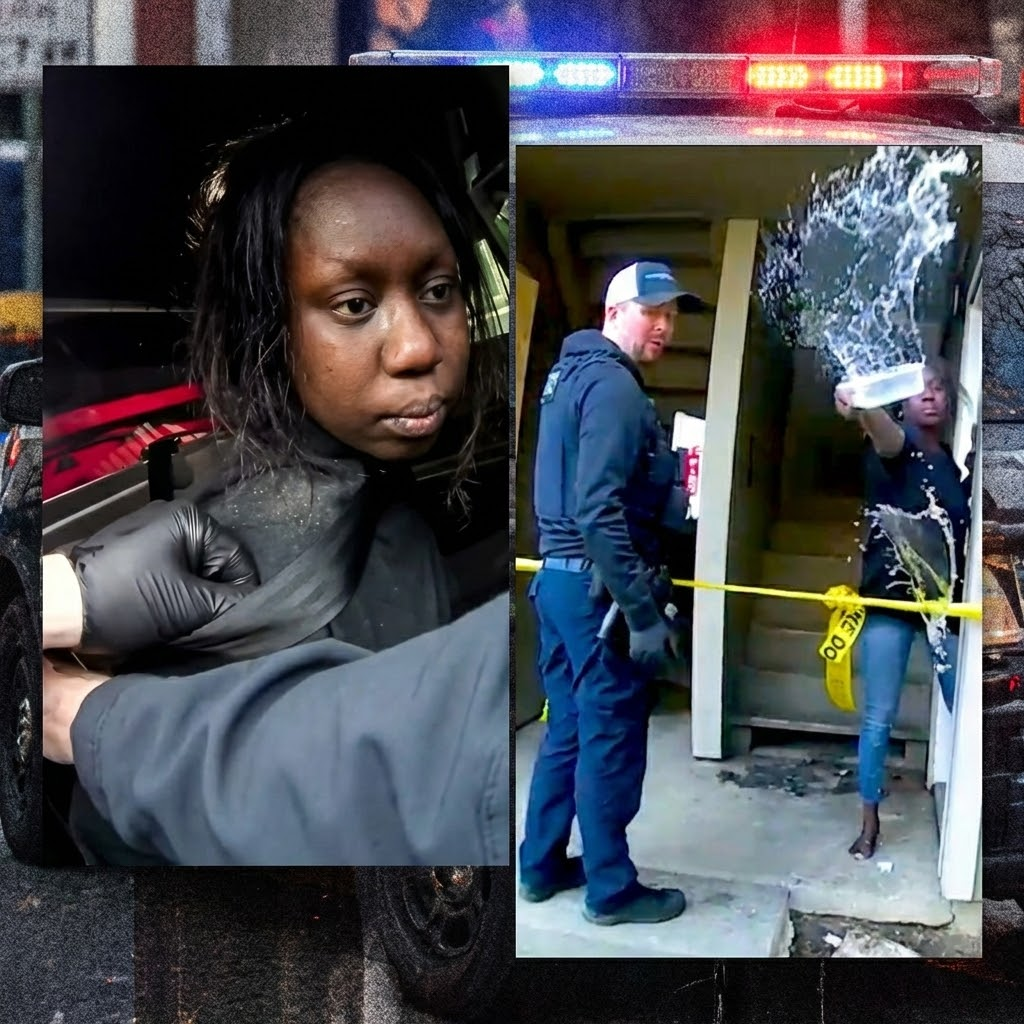
LEFT: Arresting officer Janelle Jackson; RIGHT: Samantha Luna
On Monday just after noon, Humboldt State University released a statement regarding the incident, since the arresting officer was a Humboldt State University Police officer. The statement starts by saying the university is “looking into” the recent arrest.
The following is the statement released by HSU:
On Saturday, June 16, the Humboldt State University Police Department was working a multi-agency operation targeting alcohol violations. In conjunction with this operation, two arrests were made off campus at 9th and F streets in Arcata. The University is looking into circumstances surrounding these arrests, as well as videos that have been shared.
University Police officers made a traffic stop at 8:21 p.m., after seeing the passenger of a vehicle hanging dangerously out of the sunroof. That person, a juvenile, was arrested on suspicion of providing false identification to a peace officer, public intoxication, and battery on a peace officer.
Following that arrest, another passenger in the vehicle, Samantha Alonso Luna, was arrested following an altercation with a UPD officer. Alonso Luna was booked on suspicion of resisting arrest, battery on a peace officer, public intoxication, and providing false identification to a police officer.
HSU President Lisa Rossbacher and UPD Chief Donn Peterson are aware of the incident, and have reviewed video of the arrest. Peterson says that there was reasonable cause to conduct the initial stop and investigate the alcohol violations that were subsequently observed. All video relating the incident is being reviewed and there will be a transparent and independent review of the arrest as well as a full internal review.
“We take underage drinking very seriously,” Peterson says. “The stop and what occurred afterwards will be thoroughly reviewed by the District Attorney.”
“I have seen the video of this arrest, and I have confidence that Chief Peterson and our University Police will conduct a thorough review,” says Rossbacher. “The external review will give our University community the opportunity to understand this incident in a full and fair light.”
Alonso Luna is not an HSU student. The name of the other arrestee is being withheld because the person is a minor.
UPD regularly assists enforcement relating to underage drinking, as well as to keep vendors and establishments in compliance with laws that restrict providing alcohol to minors.
WARNING: Video contains graphic language and may be disturbing to some viewers.
Israeli police repressing anti-war protests with ‘iron fist,’ say activists
Since October 7, Israel’s police have systematically banned, restricted, and attacked protests against the army’s assault on Gaza, instilling a sense of fear among Jewish and Palestinian citizens alike.
 ByOren ZivJanuary 24, 2024
In partnership with

On the evening of Jan. 16, several dozen activists gathered in front of the Kirya in Tel Aviv, home to Israel’s Defense Ministry and army headquarters. It was one of the first Jewish-Israeli demonstrations explicitly condemning the military’s assault on the Gaza Strip since the war began, and the police acted swiftly to suppress it: dozens of officers were deployed in advance, and they refused to allow the protest to take place in its intended location. They confiscated signs reading “Stop the massacre” on the grounds that these offended public sentiment. One activist was arrested, and several others were assaulted by police.
This sequence of events is far from exceptional. Since October 7, Israel’s police have been implementing a consistent policy of preventing or limiting any protest against the war — in contrast to protests in solidarity with the hostages and their families, which have been permitted in certain areas. This policy is still in effect despite Israel’s Supreme Court issuing an interim injunction earlier this month prohibiting National Security Minister Itamar Ben Gvir from interfering with the policing of demonstrations; in large part, police appear nonetheless to be enforcing the minister’s desired crackdown on freedom of expression during the war.
Anti-war activists across the country — Palestinian citizens as well as Jews — who were interviewed for this article all mentioned one word: “fear.” Even veteran political activists say they have never been so fearful of protesting. They are afraid of being arrested, which for Palestinian citizens could spell months in prison. More than ever, they said, it is dangerous to show solidarity with the people of Gaza, and they feel that politicians’ belligerent rhetoric is directly impacting police behavior.
Subscribe to The Landline
+972’s weekly newsletter
Sign up
“From the early days of the war, it was clear that this was the policy,” Maysana Mourani, an attorney with the Haifa-based human rights and legal center Adalah, told +972 and Local Call. “The police have taken on new powers to immediately repress protests, even when a protest permit isn’t required, because of their supposed ‘lack of manpower.’”
Adalah has petitioned the Supreme Court several times since October 7 to challenge such police bans on the right to protest. Despite the Court’s intervention earlier this month, however, it has repeatedly failed to intervene on numerous other occasions, meaning the police have had broad discretion to decide which protests to permit. “It depends on the identity of the demonstrators and the slogans,” Mourani said.
Israeli activists protest against Israel’s war on Gaza outside the Kirya, Tel Aviv, January 16, 2024. (Oren Ziv)
“The courts see danger in every act of protest,” she continued. “People are automatically thrown into detention for a few days, and pretty quickly it turns into an indictment and a decision to keep them detained until the end of the proceedings. It’s completely deranged; this is a new standard.”
“The rule is that the police suppress any protest,” Amjad Shbita, the national secretary of the leftist Hadash party, told +972. On Jan. 9, Hadash attempted to organize a protest in the northern town of Kabul; given that the attendance would have been fewer than 50 people, there was no requirement to obtain a permit. Regardless, the protest was over before it even began: “The police detained the secretary of the local Hadash branch and threatened him, so we gave up. The branch canceled the protest.”
Some of the strictures appear to have relaxed slightly in the past few weeks. In Arraba, another Arab town in the north, an anti-war rally of approximately 150 people took place on Jan. 12, making it the largest Palestinian-led rally inside Israel since the start of the war.
Last weekend, larger demonstrations in Haifa and Tel Aviv — which the police had originally prohibited on the grounds that they didn’t have the manpower to secure them — were allowed to take place following petitions to the Supreme Court. Over 1,000 people took part in the Tel Aviv rally, which was organized by the Jewish-Arab movement Standing Together, while police capped the Hadash-led rally in Haifa at 700.
Nonetheless, there is a feeling among the interviewees that these are changes around the margins. “The police let up a bit,” Shbita said, “but you still feel their iron fist.”
Several hundred Jewish and Palestinian activists protest against Israel’s assault on Gaza, Haifa, January 20, 2024. (Oren Ziv)
‘They are trying to intimidate us’
Suppressing protests, both during war and otherwise, is hardly new for Israel’s police. But the current attack on freedom of expression is being carried out with unprecedented speed and force.
A week after the war began, Police Commissioner Kobi Shabtai announced a ban on demonstrations in solidarity with Palestinians in Gaza. “Anyone who wants to identify with Gaza is welcome to,” he said in a video posted to Israel Police’s Arabic social media pages; “I’ll put him on the buses that are heading there now.”
Police Spokesperson Eli Levy echoed this sentiment soon after, telling IDF Radio: “Anyone who even dares ask permission to hold a demonstration in support of Gaza or the Nazi terror organization that committed a Holocaust here — of course we will not allow it. Whoever holds demonstrations without permission — we will come and deal with the demonstration with all the tools [we have].” He added: “Anyone who dares to go out and say one word in praise of Gaza will be behind bars.”
On Nov. 7, the Supreme Court rejected Adalah’s petition against the police’s decision not to grant a protest permit to Palestinians in the cities of Umm al-Fahm and Sakhnin on the grounds of a “manpower shortage.” The Court did say, however, that “a sweeping and general prohibition banning demonstrations in advance because of their content is not within the authority of the police commissioner,” and insisted that every permit request is given due consideration. Yet despite these guidelines, all but one protest organized independently by Palestinian citizens of Israel since October 7 have been prohibited.
Rula Daood, a Palestinian citizen of Israel and the national co-director of Standing Together, which organized the largest demonstration against the war so far last week in Tel Aviv, explained the extraordinarily difficulties of trying to organize protests in the current climate. “The police gave us a permit, but then they retracted it. At first, they said the march was approved, but the location was not suitable and speeches were banned. Things kept changing.
Over 1,000 people attend a demonstration against Israel’s war on Gaza in Tel Aviv, January 18, 2024. (Oren Ziv)
“Before that, they said that there could be no march, only standing, and no speakers,” Daood continued. “We wanted thousands of people to march in Tel Aviv calling for an end to the war, a ceasefire agreement, and the return of the hostages. We want to strengthen that voice and talk about the day after.”
The police rationale for the prohibitions — that they lack sufficient manpower to secure the protest from counter-protesters — seems to have been unfounded. None of these rallies have generated significant counter-protests, save for a few passersby shouting curses at those protesting.
“They are trying to intimidate us: to create a feeling that the police are sovereign, that they do what they want, and that no one can do anything to them,” Daood said. “It’s political policing, and it’s very scary. When you’re a Palestinian citizen, the fear more than doubles. People are even afraid to attend small rallies, to appear in photographs, to write anything.”
On Nov. 9, the High Follow-Up Committee — an umbrella organization representing Palestinian citizens of Israel — planned to hold a peaceful protest in Nazareth, with the participation of a limited number of invitees. But the police carried out preventive arrests — including former Knesset member Mohammad Barakeh, the Committee’s chairman — effectively banning the protest from taking place.
After his arrest, Barakeh petitioned his case to the Supreme Court, but the justices rejected it. The following day, the commander of the Nazareth police station, Eyal Kihati, sent Barakeh a message, warning him against holding the protest: “As stated, the message is clear and unequivocal. We will not tolerate violations of judicial decisions or local decisions of mine as station commander, and any organizing by you or representatives of the High Follow-Up Committee will be met with zero tolerance and in accordance with the tools that the law gives us.”
Police confiscate signs during a protest against Israel’s war on Gaza, Tel Aviv, November 18, 2023. (Oren Ziv)
In December, Barakeh was trailed by police vehicles. The protest was ultimately permitted to take place later that month, without further arrests.
‘There is a sense of helplessness’
On Oct. 19, an anti-war demonstration was held in Umm al-Fahm. The fierce police pushback — the demonstration was dispersed with stun grenades, clubs, and sponge bullets, and the police arrested 12 of the protesters — made it a symbol of police repression since the start of the war.
The police requested that 11 of the detainees, including four minors, be remanded in custody, and the Magistrate’s Court approved the request without a hearing for the detainees because Shabbat had already begun. After a hearing on Saturday night, nine of the detainees were released on conditions, and two others — Ahmad Khalifa and Muhammad Jabarin, whom the police considered the organizers of the protest — remained in detention.
The pair were indicted for shouting political slogans that the Court deemed to constitute incitement, and their detention was extended through the end of the proceedings — possibly the first time this has happened purely on the grounds of slogans. Mourani, the attorney with Adalah, represents Jabarin. “They claim it’s about incitement and slogans and not about the demonstration, but you can’t separate one from the other,” she said.
“This is a change of policy,” Mourani continued. “When we discussed an alternative to detention, they argued that house arrest and remote monitoring were impossible because [the detainees] would theoretically be able to violate it and leave the house to demonstrate. So, it really is about the demonstrations, ultimately. It’s political persecution. These are not new slogans, and it’s not anything specific to October 7.”
Israeli activists protest against Israel’s war on Gaza outside the Kirya, Tel Aviv, January 16, 2024. (Oren Ziv)
Theirs is not a singular case. Since October 7, the State Prosecutor’s Office has encouraged investigators in dozens of cases to ask the court to extend detention until the end of proceedings, including cases centered on “incitement” on social media.
In one of the hearings, Khalifa — one of the pair who were indicted — described the conditions at Megiddo Prison, where he is being held as a security detainee, to a judge: “People are being held in handcuffs … They are being dragged around as if they were animals. If you lift your head, you get hit on the head. I saw it on a daily basis. If one of the guards catches someone smiling, they take him away; there’s an area there with a ‘blind spot’ [out of view of security cameras] that the whole prison knows about.”
Khalifa also testified that a detainee in the cell next to his was beaten and later died of his wounds, echoing testimonies that +972 reported on last month.
According to Shbita, people are afraid to protest because of stories like these that they hear from those who were arrested. “Political activists have said to themselves in the past, ‘We’ll be detained for a day or two, it’s not the end of the world,’” he said. “But now there’s a feeling that this is the end of the world, even among people who are regulars at protests, because of the physical violence during the detentions.”
While small protests in Arab localities in the north have taken place in recent weeks, there have been no such demonstrations in the Naqab/Negev in the south. “It pains me that all over the world people are demonstrating for us — in Europe people are out in their hundreds of thousands — but that here we are unable to demonstrate for ourselves,” said Huda Abu Obeid, a political activist from the Naqab. “There is a sense of helplessness. The only thing we could do before the war was protest, and now we can’t even do that.”
Activists protest against Israel’s war on Gaza in Tel Aviv, November 11, 2023. (Oren Ziv)
According to Abu Obeid, there were initially no protests because people were so taken aback by the events of October 7. “It was a real shock,” she said. “We are used to Israel attacking, but this was the first time that the Palestinians are the ones attacking in such a massive way. We didn’t know how to react.”
Abu Obeid also links the lack of protests to the chilling effect caused by the mass arrest campaign against Palestinian citizens of Israel in the wake of the “Unity Intifada” of May 2021. “The Shin Bet succeeded in frightening everyone,” she said. “They summoned activists [for interrogations], they intimidated them, they came to places of political activity. The feeling is that no matter what you do, even if it’s not related to demonstrations, you’ll always be persecuted.”
‘We are silenced from all directions’
In the absence of larger protests, most anti-war activity has consisted of small, local vigils for which permits are not required — but even these have been attacked by the police and passersby. The vigils tend not to be advertised publicly on social media, but rather in closed groups. In order to avoid the formation of a right-wing counterprotest, they usually last less than an hour, and activists arrive and leave together fearing that they will be attacked on the way.
The latest such action to be forcibly dispersed by police was a small gathering last week in the Arab town of Al-Batuf, near Nazareth. Earlier in the month, activists in Tel Aviv held a street exhibition of recent photographs from Gaza; passersby, some of them armed, attacked the activists and ripped the pictures away while the police watched on.
While the international and local Arabic media have shown great interest in these protests and vigils, the events are almost completely ignored by mainstream Israeli outlets. “Our voice is barely heard in Israel,” said Michal Sapir, an activist with the “radical bloc,” which organized the street exhibition. “We are silenced from all directions. The state is not showing what is happening in Gaza, so it’s important for us to stand up and say that the killing of civilians in Gaza that is being done in our name must end, and that there is no military solution.”
Activists protest against Israel’s war on Gaza in Tel Aviv, December 16, 2023. (Oren Ziv)
When the war began, the activists had to figure out how to circumvent the ban on demonstrations. “We did it gradually,” Sapir said. “We didn’t know what the reaction would be. At first, we just joined the families of the hostages. We tried to see if it was possible to stand there with signs calling for a ceasefire, and we saw that we could. Slowly, we switched to more radical slogans and marches from HaBima [a large public square in downtown Tel Aviv]. We noticed what could be said, and what would be met with [police] violence.
“Until the crackdown on the signs [at the Jan. 16 protest outside the Kirya], the police didn’t really bother us, but now they have a new policy,” Sapir continued. “They’re tired of us being near the military headquarters.”
From time to time, Sapir added, the activists are attacked by passersby. “A delivery man threw eggs at us. But there is usually tolerance, and sometimes support.”
Activists in Jerusalem have held several small demonstrations against the war in recent weeks, including some in front of the U.S. Consulate. One of those, a vigil for those killed in Gaza which took place in early January, was forcibly dispersed by police, with two demonstrators arrested and photographs of those killed in Gaza confiscated. Last week, another protest vigil in Jerusalem was attacked by police, who confiscated signs and pushed demonstrators away.
“Everything is scary,” an activist with the left-wing group Free Jerusalem, who preferred not to be named, told +972 and Local Call. “The stakes are higher. Unlike in the past, when we would advertise events openly, now we are more careful. Public opinion and statements by Israel’s entire political leadership have shifted to the right, and this has raised the level of fear and anxiety.”