



Alberta’s transgender ban in women’s sports won’t apply to out-of-province athletes
Province can’t regulate athletes from other places, says tourism and sport minister
Social Sharing
Alberta is rolling out new regulations this fall banning transgender athletes from playing women’s sports, but the province will still welcome out-of-province transgender competitors.
Tourism and Sport Minister Andrew Boitchenko said the discrepancy is out of his hands.
“We don’t have authority to regulate athletes from different jurisdictions,” he said in an interview.
In a followup statement, ministry spokeswoman Vanessa Gomez added it’s due to outside sporting organizations being bound by out-of-province or international guidelines.

She added the rules allow the government “to do what is best for Albertan athletes, while also showcasing Alberta as a premier destination for national and international sport events.”
Starting Sept. 1, the province will block transgender athletes from Alberta who are 12 and older from competing in female amateur sports. It’s one of a suite of changes surrounding transgender health, education and sport introduced last year by Premier Danielle Smith’s United Conservative Party government.
- Birth records will be key in Alberta’s new ban on female trans athletes, regulations show
- Alberta premier intends to ‘battle’ injunction on transgender health-care law in court
The laws sparked polarizing debate.
Proponents, including Smith, say it’s about fairness on the playing field, so girls are not battling opponents with biological advantages. Detractors say it’s about stigmatizing and punishing those in the transgender community.
Hannah Pilling, a track athlete who petitioned in favour of restricting transgender people in female sports, has welcomed the new regulations. She said in an interview she hopes Smith’s government takes it further.
“It’s kind of hard to enforce that on other athletes that are coming to compete in Alberta, but it’s definitely still not completely fair,” Pilling said.
She added that she would like to see future rules apply to men’s divisions.
Skiier says she’d move if she could
Transgender athlete Allison Hadley said the exemption for out-of-province athletes suggests the legislation is not really about fairness or safety.
“If I had the resources to [move], honestly, I probably wouldn’t be in Alberta now,” she said. “We’re here in a province that doesn’t want us to be in the public or exist in many ways.”
Hadley said she didn’t pick up cross-country skiing to win medals. She said she was in it for the health benefits, the motivation that competition brings to her training and the camaraderie on the trail.
“It really sucks to have that taken away,” she said.
- Trans skier worries Alberta legislation would ban her from competing
- Alberta ban on trans women in female sports advances as athletic association questions need
Mark Kosak, head of the Alberta Colleges Athletic Conference, said a restriction preventing transgender athletes from coming to Alberta to compete might have stopped the organization from ever hosting a national championship again.
“So there’s some relief from us,” Kosak said.
He said the conference hosts more than 1,000 events a year and, of those, between 40 and 50 host out-of-province competitors.
He said he’s unaware of any transgender athletes competing in the conference.
Kosak added that the sporting community didn’t ask for the government’s new rules.
“This is not a priority. This is not a concern,” he said. “It’s not an issue.”
The rules will be enforced through a complaint-driven process. Female athletes subject to complaints need to prove their sex registration at birth.
For those who were born elsewhere but live in Alberta and can’t retrieve documents that clearly state their sex at birth, Boitchenko said the government will look at “alternative documents.”
“We’ll be looking at [it] case by case, making sure that nobody feels that they can’t compete just because they lost certain documents,” he said.
Possible sanctions for bad-faith complaints against athletes could result in written warnings or code of conduct violations.

Bennett Jensen, legal director at LGBTQ+ advocacy group Egale, said the validation process alone is a “gross violation of the privacy of all women and girls.”
He said the government is introducing a complaint-based “snitch line” for complaints that will spur even more public policing of women’s bodies and gender presentation among young girls — whether they’re transgender or not.
He said a 12-year-old, at a vulnerable stage of her life, could be subject to scrutiny and humiliation based on her physical appearance.
Jensen also said the government’s biological advantage argument falls apart in many instances, including for those athletes receiving hormone replacement therapy.
Boitchenko said inclusion is the goal, and the government is planning to expand grants to encourage sporting organizations to create coed divisions where numbers allow.
Pilling’s father, Dave Pilling, said he sits on the board for the Southern Alberta Summer Games, where they introduced open categories in all sports this year.
But for the Alberta Colleges Athletic Conference, Kosak said creating coed divisions across the majority of sports is “totally impractical and unrealistic.”
Alberta’s ‘Fairness and Safety in Sport Act’ criticized as misogynistic, transphobic

By Ken MacGillivray & Jayme Doll Global News
Posted September 5, 2025 11:14 am
Updated September 5, 2025 12:49 pm
4 min read

Leave a comment
Share this item on FacebookShare this item on XSend this page to someone via emailSee more sharing optionsDescrease article font sizeIncrease article font size
The start of the school year also means the start of another season of school sports for many Alberta school children.

But female athletes who are hoping to try out for the school team will need to pack something extra in their gym bag this year.
Parents of girls age 12 and older who want to play sports will also need to fill out a government form declaring what their child’s sex was recorded as at birth.
The new provincial rules — called the Fairness and Safety in Sport Act — that came into effect Monday also provide a way for people to challenge a player’s gender.
According to the Calgary Board of Education’s new policy, if a written complaint is made against an athlete, the minister would need to be notified and the parent or guardian would need to provide a copy of the child’s birth certificate or birth “registration documents.”
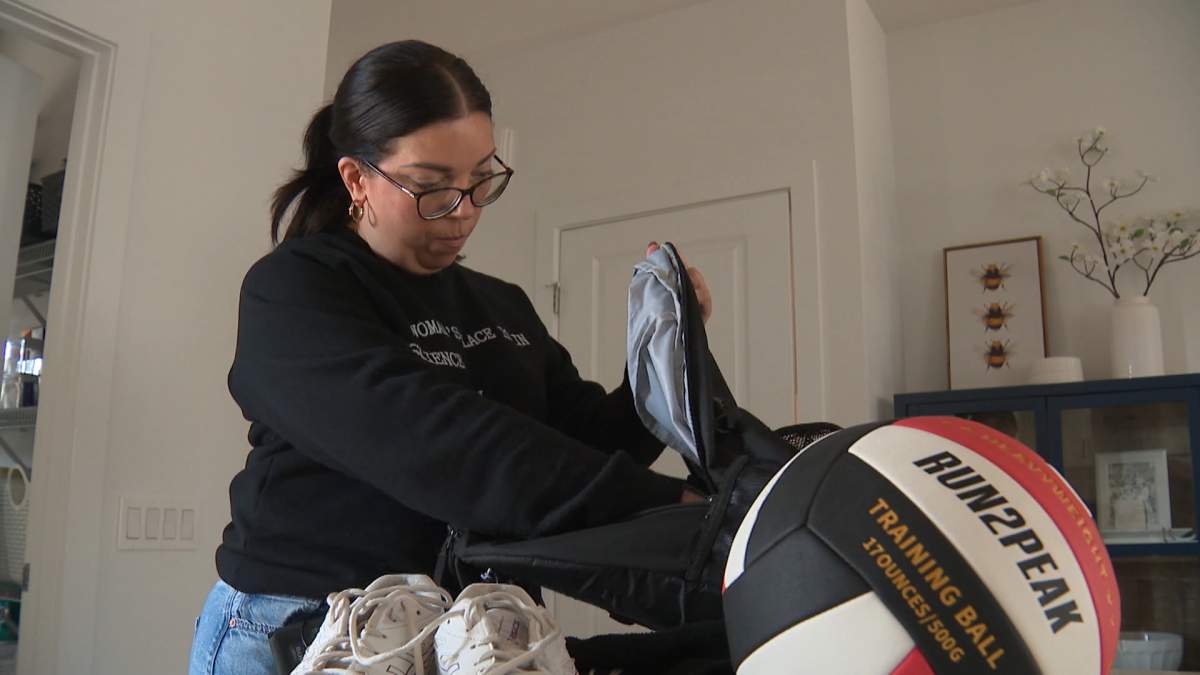
Leah Elzinga, who has two daughters involved in school sports in Edmonton, called the new policy “crazy.”
Her 20-year-old daughter, Samantha, is coaching high school volleyball this year for the first time.
“She messaged me and said, ‘Mom, you’re never going to believe what the girls have to fill out,’ so they have to fill out a form that declares that they were born female at birth — they absolutely cannot opt out of it,” Elzinga said.
“If everybody on the team doesn’t sign it, the whole team can not only not play games or tournaments, they can’t even practice together. So it’s an all or nothing.”

1:40New regulations for women and girls participating in female-only sports leagues
“We had one girl stand there as soon as our vice principal was done talking about it and immediately (she asked) does this apply to the boys’ players, and it doesn’t. To me that just speaks volumes that it’s not about fairness in play — it’s not — that’s not what it’s about,” said Samantha Elzinga.
“It’s not about fairness in play — because if it was about unfairness in play, it would apply to all players.”
Get weekly health news
Receive the latest medical news and health information delivered to you every Sunday.Sign up for weekly health newsletterSign Up
By providing your email address, you have read and agree to Global News’ Terms and Conditions and Privacy Policy.
“This whole fairness in play thing is a guise to hide transphobia and misogyny, and it’s ridiculous,” she added.

Victoria Bucholtz of Queer momentum, a 2SLGBTQIA+ advocacy group, called the policy “incredibly sexist.”
“These are very invasive laws that violate the privacy of these children,” said Bucholtz. “And this doesn’t just affect transgender children. This is targeting every child that has been assigned female at birth.”
She accuses the provincial government of “punishing girls,” and yet, “it’s happy with boys doing what they want.”
On the streets of Calgary, the policy gets a mixed response — especially because it only targets female sports.
“I don’t think it’s right,” said Kim Monastersky.
Dale Dobson said the policy should apply to both girls’ and boys’ teams.
Related News
- New Alberta rules around gender identity and amateur sports take effect
- Alberta’s transgender ban in sports exempts visiting out-of-province athletes
“Rules are rules, so it should apply to both sexes,” said Dobson.
But he also supports some parts of the policy.
“If you’re born a female, my attitude is you should stay a female and if you want to go into the sports, you should be on the female team,” said Dobson.
But that’s an argument that doesn’t sit well with Leah Elzinga.
“I think that people that argue that a 14-year-old boy is bigger and stronger…than my girls is ridiculous and hasn’t been inside a junior high or a high school in a long time. I think they’ve also never seen female athletes. They haven’t seen a 6-foot-8 volleyball player with legs the size of tree trunks that could destroy you. Girls are plenty strong. They’re doing just fine. This is a non-issue. It’s ridiculous. It is so insulting to female athletes,” she added.
In an email to Global News, the Calgary Board of Education said, “all school boards in Alberta—including the CBE—are required to align their practices and policies to comply with the new legal framework.”
“Our primary goal is to ensure full compliance with the law while continuing to support the well-being, inclusion, and development of all students participating in school sports.”
Global Calgary reached out to the province for a response to concerns over the policy, but didn’t hear back.
However in an email to an inquiry by Global Edmonton earlier this week, Alberta’s Ministry of Tourism and Sport responded with a statement.
“Sport is for everyone, which is why Alberta’s government is working to make sport safe, fair and accessible for all Albertans,” the statement read.
“Questions on how specific in-scope entities, such as school authorities, are implementing the new legislation should be directed to the individual organizations,” the statement added.
The province also said it supports the expansion of mixed-gender leagues or divisions to ensure transgender athletes can participate.

2:02Alberta transgender female sport policy raises questions
Leah Elzinga said she’ll sign the form — for now.
But she will continue to “get loud” to advocate for her children and for all those who are unable or afraid to advocate for themselves.
“We have a number of non-binary kiddos in our lives that it’s really going to hurt them to have to declare themselves as something other than what they are just to be able to keep doing what they’re doing,” said Elzinga.
“I never thought I would have to declare my kid was anything,” added Elzina. “You know. What’s between her legs — it’s between me, her and her doctor and it should stay that way.”
-with files from Global News’ Kabi Moulitharan
