



When the Mission Is Over, Who Am I Outside the Army?
I was never late. Not once. In a place where the rhythm of the day is dictated by minutes and uniformity, being dependable became more than a habit. It became my identity.
I was the guy you called when things got messy. When inspections were looming, when warehouses were disorganized, when soldiers needed direction, I was there with a checklist, a plan, and an intensity that left no room for failure.
On the surface, I was everything the Army expected. But inside, I was running on fumes. Burnout did not look like me slowing down. Instead, I would speed up, forcing myself to push harder so I would not have to feel how empty I was becoming.
My world outside the gates had grown quiet. Family calls turned into missed calls. The friends I had outside the Army drifted away until all that remained were people wearing the same uniform.
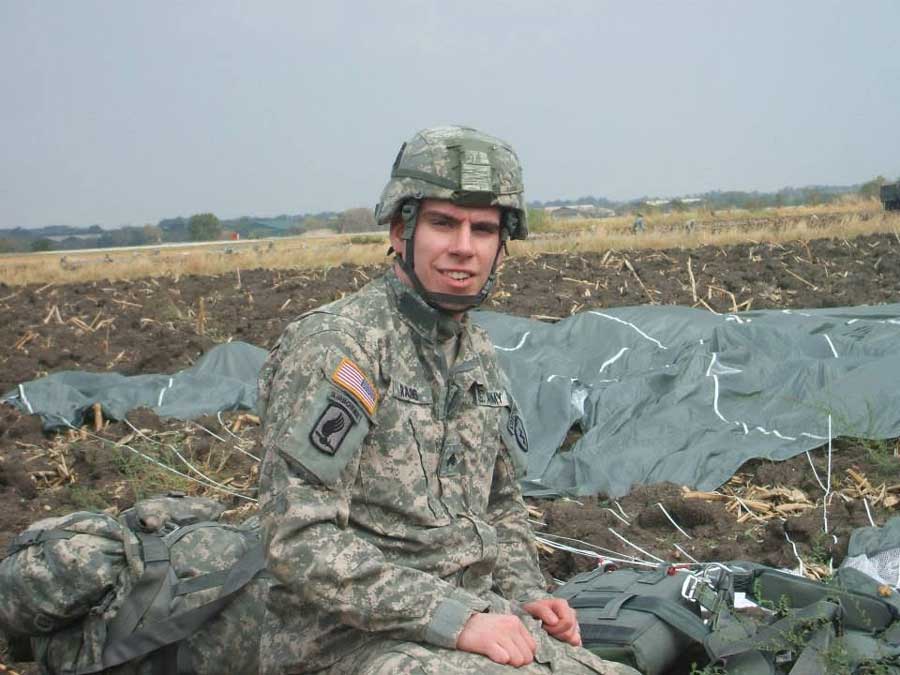
The author after he parachuted into Thailand during the Operation Cobra Gold exercise in 2014. (Photo courtesy of Kevin Rasins)
I had built my entire life around being needed, but somewhere along the way stopped asking what I needed. I mistook the motion for meaning, thinking that being essential would be enough to make me feel whole.
I was good at my job, and for a long time, I thought that was enough.
The Army gives you all the structure you could ask for. It tells you when to wake up, how to speak, how to lead, and how to think inside a mission box.
But it doesn’t tell you what to do when the mission pauses. It doesn’t prepare you for the stillness after a successful operation or for the quiet that comes when no one needs your checklist anymore.
I Had the Best Squad Leader in the Marine Corps. He Showed Us Kindness Is Not Weakness.
No one tells you how to handle the creeping thought that maybe your worth has become tied to how well you wear the uniform, how precisely you execute a plan, how quickly you solve someone else’s problem.
It took a young soldier to make me realize how far I had drifted from my own humanity. He was quiet, but not in a good way. You start to notice those things the longer you’re in. The difference between focus and retreat.
He was sitting across from me, and I asked the usual question, the one we all ask without really meaning it: “How are you doing?” To my surprise, he actually answered. He told me he felt like he didn’t matter. That outside of his job, he wasn’t sure who he was.
And without even thinking, I said, “Me too.”
That moment hit me harder than I expected. Because I meant it. I’d spent years pouring everything I had into being reliable, capable, and efficient.
I managed the supply chain for a sustainment brigade supporting deployments to Europe and the Middle East. I reorganized two major warehouses ahead of division-level inspections. I trained incoming soldiers during field exercises at Fort Campbell, Kentucky, making sure they could carry the mission without me.
I knew how to manage a supply chain, optimize a warehouse, train soldiers, and exceed expectations.
Award-Winning Journalism in Your Inbox
- Subscribe to Award-Winning Journalism*
But I’d forgotten how to feel like a person outside of all that.
I had no hobbies anymore. Before the Army, I spent hours writing stories and getting lost in video games. Both had given me a way to explore new worlds, to imagine something bigger than myself. Somewhere along the way, I stopped.

The author, right, with his team leader and a Thai paratrooper in Thailand. (Photo courtesy of Kevin Rasins)
After almost 16 years in uniform, I realized I had let go of the things that once made me feel alive. I could not remember the last time I did something purely because I loved it, not because it was expected of me.
So I started writing again. I had written a lot before I enlisted. Stories, thoughts, even poems I’d never admit to now. Writing had always been a way for me to understand what I was feeling. I realized I hadn’t really felt anything in a long time. I had reacted, I had responded, but I hadn’t sat with my own emotions in years.
So, I wrote. At first, it was just notes in my phone. Thoughts during field exercises. Half-sentences I would scribble during late-night charge of quarters shifts, when everything was still except my mind. The fog I had been carrying for years, a heavy mix of exhaustion and numbness, slowly began to lift.
Writing helped me find the emotions I had buried under all the schedules, checklists, and expectations.
And with that came clarity. I realized I wanted more—not more rank or responsibility, but more of myself back. I wanted to grow in ways that weren’t listed in a Noncomissioned Officer Evaluation Report.
I joined the Army at 19, full of energy and certainty. Somewhere along the way, I had stopped asking what else I could become. Maybe it was when the Global War on Terrorism had finally come to an end, signaling the closing of a major chapter in my military career and personal investment.
Needing a new goal to drive toward, I enrolled in an MBA program. I did not know exactly what I would do with it. I just knew I needed to stretch beyond the boundaries I had accepted for too long. It was not about leaving the Army. It was about rediscovering a version of myself I had put on the shelf.
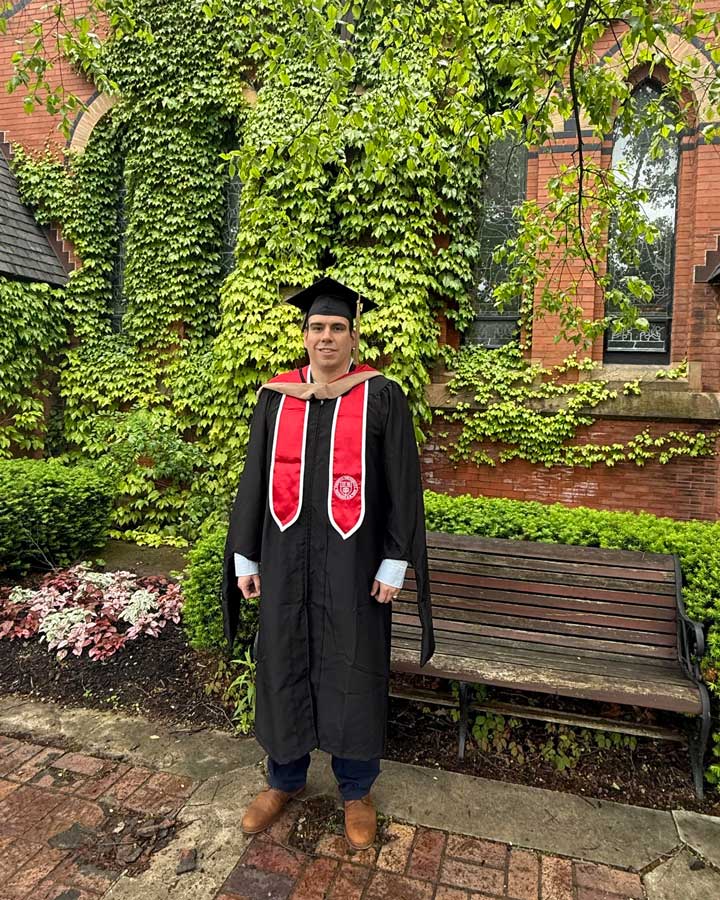
The author earned his MBA from Cornell University in May 2025. (Photo courtesy of Kevin Rasins)
Telling my boss and fellow soldiers about the program was hard. There’s an unspoken rule that if you’re already thinking about the next chapter, you’re not fully committed to the one you are in. That mindset is part of what keeps the machine running, but it also keeps us trapped. However, to succeed, I would need their support.
Preparing for life after service does not mean you love the Army any less. For me, it meant I was finally honoring all the parts of myself I’d been suppressing in the name of the mission.
As I approach retirement, I realize that my commitment has not weakened. If anything, it has grown stronger. It is no longer about proving myself or chasing rank—it is about leading with purpose.
Something shifted once I made that decision. I became a better leader. I was not just teaching my soldiers how to do inventory or manage warehouse reports. I was teaching them how to think about the future, how to recognize burnout, and how to take pride in what they did while still building toward something greater.
Recall and Regress, Battling to Redefine Identity When Military Service Ends
I stopped seeing them as just parts of the system, and I stopped seeing myself that way, too.
There are still days when I hear that voice telling me I need to go faster, be sharper, stay ahead of everyone else. But I’m learning to challenge it. I’m learning that sometimes the bravest thing I can do is slow down. Writing helped me see that. It became a way of asking for help without even realizing it. It was how I started to tell the truth, first to myself and eventually to others.
Our Journalism Depends on Your Support
The Army taught me how to lead, how to endure, how to sacrifice. But it didn’t teach me how to be whole. That part, I had to learn for myself. And I’m still learning. Every day I choose to show up not just as a leader, but as a person. I choose honesty over perfection. Humanity over performance.
There’s no field manual for that. No ribbon, no award. Just the quiet satisfaction of knowing I’m more than the job. I always was.
Man convicted of wife’s 1987 murder shares first days with family outside of prison
“20/20” looks at Leo Schofield, paroled 37 years after his first wife’s death.
June 7, 2024, 5:58 PM

1:21
The last time Florida man remembers speaking with wife before she vanishedOn Feb. 24, 1987, Leo Schofield was waiting to get picked up by his wife Michelle Schofield. After she called to say she was on her way from a work shift, hours passed without any sign of Michelle.
ABC News
Leo Schofield has spent the last 35 years behind bars, convicted of the 1987 murder of his wife Michelle. Schofield filed four appeals while in prison, amidst new forensic evidence and a confession from a convicted killer. Each time he was denied.
But in April Leo Schofield was granted parole by the Florida State Commission on Offender Review.
Leo Schofield spoke with ABC News’ John Quiñones following his release on parole, saying he is now learning to “be in the moment and just enjoy” the time he is living outside prison.
MORE: A killer confession: How a detective’s unusual tactics led to uncovering the truth

“It doesn’t take long in prison before you realize that you were taking a lot of things for granted,” Leo Schofield said to Quiñones, “and then you’re fighting for the next 36 years to get them back.”
A new “20/20” airing Friday, June 7, at 9 p.m. ET on ABC Network and streaming the next day on Hulu, features the latest details of Leo Schofield’s case and examines what happened to Michelle Schofield.
Leo Schofield, now 58, has maintained his innocence from the very beginning.
“I love Michelle with all my heart to this day,” Leo Schofield said in a prison interview with “20/20” in 2022. “She was a victim of a cruel and heinous crime, but not one committed by her husband.”
On Feb. 24, 1987, 21-year-old Leo Schofield was waiting to get picked up by his then 18-year-old wife, Michelle Schofield. Hours passed without any sign of Michelle. Two days and a massive search later, police found her car, abandoned and missing its stereo speakers, along a highway exit ramp. The following day, her body was found underneath a plank of plywood in a drainage canal. She had been stabbed 26 times.

Leo Schofield recalled the flood of emotions he felt in the moments after Michelle’s body was recovered.
“I was so angry at God at that moment,” Leo Schofield said. “I ripped my shirt off. I punched a tree, punched the ground. I was pulling grass out of the ground.”
Leo Schofield was arrested fifteen months later, in June 1988.
During his trial in 1989, the prosecution argued that Leo regularly acted violently towards Michelle throughout their relationship. They brought in 21 character witnesses who testified about incidents of physical abuse by Leo towards Michelle, including slapping her and pulling her by the hair.
While on the stand, Schofield denied the claims made by the witnesses but admitted to slapping his wife twice.
Despite there being no forensic evidence linking Leo Schofield to the crime, the jury returned their verdict in two hours. Leo Schofield was found guilty and sentenced to life in prison.
About four years into his life sentence, Leo Schofield met Crissie Carter, a former state probation officer. The two married in 1995.

While researching Leo Schofield’s case, Crissie Schofield couldn’t stop thinking about the discrepancies in timelines presented at trial and the set of unidentified fingerprints found in Michelle Schofield’s car, both of which Leo Schofield’s defense attorney raised in court. Due to a lack of forensic technology, the fingerprints couldn’t be matched… until 2004.
The prints belonged to Jeremy Scott, a convicted murderer who was serving prison time for an unrelated crime. Scott lived less than 2 miles from where Michelle Schofield’s body was recovered.

Leo’s appellate attorney made a request for a new hearing based on this evidence. The court denied their request, arguing that Jeremy Scott’s fingerprints alone would not likely have led to an acquittal on retrial, and ruled there were no issues with the trial evidence that would have led to Leo’s exoneration.
Popular Reads

Minneapolis ICE shooting live updates: Over 3,000 arrested in Minnesota, DHS says

GOP Rep. McCaul says a US invasion of Greenland would mean ‘war with NATO itself’
State Department warns US citizens to leave Venezuela
In 2005, two detectives from the Polk County Sheriff’s Office interviewed Jeremy Scott. He denied any role in the murder of Michelle Schofield.
In 2017, Leo Schofield’s defense attorney, Andrew Crawford, enlisted an investigator to interview Scott again.

It was during this interview that Scott claimed that Michelle Schofield offered him a ride, and there was a struggle after a knife fell out of his pocket. The details recorded during this conversation led Leo Schofield’s legal team to request a retrial, which led to an evidentiary hearing.
At a 2017 evidentiary hearing, Jeremy Scott testified to the court that he murdered Michelle Schofield.
During cross-examination, the prosecution pointed out multiple times over the years where Scott denied any role in Michelle Schofield’s murder, as well as certain details that he could not recall or got wrong in his testimony, such as the clothes she wore that night.
Ultimately, Leo Schofield was again denied a new trial. The court ruled that the evidence did not meet the legal threshold for a new trial and made a finding that the testimony of Jeremy Scott was not credible.
In 2023, Leo Schofield became eligible for parole again. He was denied but was given an extension for his case to be reviewed again in 2024.
In the year leading up to his review, Leo Schofield was transitioned to a minimum-security facility in South Florida, one with a transitional program that helps prepare inmates for a life outside of prison walls.
“We’ve been walking in a tunnel in utter darkness for 35 years,” Leo Schofield told Gilbert King, a Pulitzer-prize winning author who is the host of a podcast about the case, “Bone Valley,” after the 2023 parole hearing. “We have never had a light at the end of this tunnel, ever… Yesterday, a big, bright light was lit.”
In April 2024, a parole board voted to release Leo Schofield. Now, more than three decades later, he’s being given a taste of freedom.
Leo Schofield was released on parole from a medium security correctional facility in the Everglades on April 30, 2024.
“I saw him come around the building,” Crissie Schofield told “20/20” about the day Leo Schofield was paroled. “After all these years and dreaming and hoping and waiting, it was just the most glorious, magical experience of my life.”
Leo Schofield’s legal team said he must reside in a halfway house for a year, enter a community outreach program and undergo mandatory mental health, substance abuse, anger and stress evaluations. He also has 18 months of curfew restrictions and is not allowed to contact Michelle Schofield’s family.
Leo Schofield told John Quiñones that he still thinks about his first wife Michelle Schofield “every single day.”
“This is not yet complete justice for her, and she deserves justice. She deserves better than this,” Leo Schofield said.
According to Crissie Schofield, the next step for her husband is exoneration. He is still technically a guilty man in the eyes of the law. The members of his legal team, many of whom come from the Florida Innocence Project, are fighting for full exoneration.”It’s wonderful that he’s out, but he’s not free. This isn’t over,” Crissie Schofield said.
Former Florida Judge Scott Cupp is another of Leo’s many supporters. Cupp made headlines after he stepped down from the bench in 2023 to focus on Leo’s fight for freedom.
“I finally made the decision that I’m going to step off and go back to being his lawyer and represent him at the parole hearing,” Scott Cupp told John Quiñones. “… because this guy’s innocent.”
Leo Schofield recently celebrated his 29th wedding anniversary to Crissie Schofield, played guitar for her at her birthday party and held one of his grandsons, the son of his daughter Ashley Schofield, for the very first time. Quiñones asked Leo Schofield how the future looks to him, to which he replied, “very bright.”
“I’m not going to ever take that for granted again,” Leo Schofield told Quiñones. “I’m missing 36 years’ worth of moments. I’m not going to miss another 36 years.”
ABC News’ Kaitlin Amoroso, Gail Deutsch, Jonathan Leach, Brian Mezerski, Emily Moffet, Lydia Noone, Jeff Schneider, and Brooke Stangeland contributed to this report.
