Florida police under fire as video of Black man punched, dragged by deputies during traffic stop goes viral
Incident under review after video shows officers punching driver who questioned why he was pulled over
A cell phone video showing a White police officer in Jacksonville, Florida, striking a Black man in the face during a February traffic stop before officers dragged the driver from his car has sparked outrage online as conflicting accounts of the incident have emerged.
The video, which 22-year-old driver William McNeil Jr. took from inside his car, is a clear depiction of brutality, say his civil rights lawyers, Ben Crump and Harry Daniels, and comes as law enforcement officials – from masked ICE agents to local police officers – have been scrutinized for their use of force, particularly against people of color.
“I just really wanted to know why I was getting pulled over and why I needed to step out of the car,” McNeil, an undergraduate student and church musician, said at a news conference Wednesday. “I know I didn’t do nothing wrong.”
The Jacksonville Sheriff’s Office argues the video doesn’t show the full context of the incident. “Yes, there absolutely was force used by the arresting officers, and yes, that force is ugly,” Sheriff TK Waters said Monday at a news conference. “Just because force is ugly does not mean it’s unlawful or contrary to policy.”
The sheriff said he wouldn’t stay silent while “facts and information are buried to advance an anti-police agenda.”
McNeil, along with his family and legal team, are calling on the sheriff to immediately terminate the officer who struck the young man, in what they describe as a case of racial profiling and excessive force, Crump said Wednesday.
“The sheriff cannot justify this. He cannot condone this. You must condemn this,” Crump said. “I mean, there is no way you can say this reflects your policies, your training, your values. This is very disturbing on every level.”

Here’s what we know:
What videos show
Police bodycam video released Monday shows McNeil opening his car door to speak to an officer, who tells him he was pulled over for driving without his headlights or seat belt on. Florida law states drivers must use seat belts while operating a car and use headlights from sunset to sunrise and in cases of rain, smoke or fog.
“It’s daylight, I don’t need the lights. And it’s not weather – it’s not raining,” McNeil says in the video.
McNeil asked the officer to call his supervisor, refused to give him his license, and closed his door. He locked it as the officer asked him to step out of the vehicle, bodycam video shows.
“Open the door and exit, or we are going to break the window,” the officer says as another patrol car pulls up in front of McNeil’s vehicle.
McNeil was warned seven times he was under arrest and needed to open his door, Waters said.
The video from inside McNeil’s car begins with him sitting in the driver’s seat, talking to another officer through the passenger side window. He asks the officer to show him the law stating that he must have his headlights on.
One officer then says he’s going ahead with breaking the window, according to body camera footage. “All right, go for it,” a second police officer is heard saying.

Seconds later, the driver’s window is smashed in, McNeil is punched in the face, and officers open the door and pull him to the ground next to his car, striking his face again, McNeil’s video shows.
McNeil’s “only crime, allegedly, was he didn’t have his headlights on and he didn’t have his seatbelt on – things that most people would get a notice to appear. He got punches in his face, head beat against the concrete and a gun drawn on him. That that is excessive,” Crump said Wednesday.
“This is about driving while Black. We don’t believe they ever would have done that had this been a young White citizen,” Crump said.
McNeil’s lawyers say he sustained a tooth fracture, concussion and a traumatic brain injury. He also had cognitive impairment and short-term memory deficits after the traffic stop, they added.
The body camera footage released Monday didn’t show the initial strike between the arresting officer and McNeil, Waters said.
McNeil was arrested following the incident on February 19 and charged with resisting a police officer without violence, driving on a suspended license and possession of less than 20 grams of marijuana, Waters said. The next day, he pleaded guilty to the resisting and suspended license charges.
Thrown punches and a large knife
D. Bowers, the arresting officer who pulled McNeil over, made no mention of McNeil being punched in his police report. He wrote that the suspect, McNeil, refused to comply, which led him to break the window to open the driver’s door.
“Physical force was applied to the suspect and he was taken to the ground,” Bowers continued.
A second officer, however, described in a separate report six punches to McNeil’s leg before he stopped resisting, according to the Associated Press.
“He simply asks for a supervisor and then they break his window and beat him yet, somehow, the report failed to mention that,” McNeil’s lawyers said in a statement.
Bowers’ report also claimed McNeil was “reaching for the floorboard of the vehicle where a large knife was sitting,” as he was removed from the car. Deputies found a knife while they searched McNeil’s vehicle after taking him into custody, according to police reports.
The knife in that car was not a weapon, “because he did not weaponize it,” McNeil’s lawyers said Wednesday, reiterating their stance that the young man never reached for the knife.
McNeil kept his cool throughout the interaction, at one point calmly taking a punch to the face without retaliating, his lawyers noted.
When asked Monday about what he saw in the footage, Waters, the sheriff, said he couldn’t see where McNeil’s hands were.
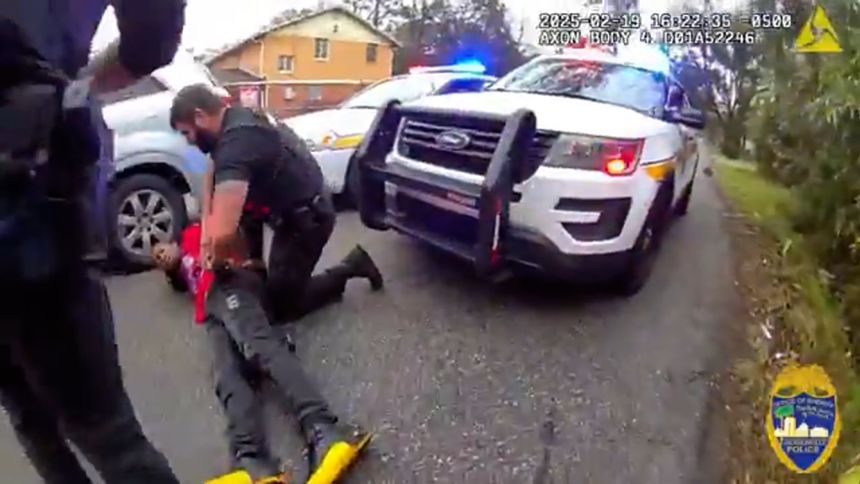
An image taken from video released by the Jacksonville Sheriff’s Office show’s McNeil on the ground. Jacksonville Sheriff’s Office
An investigation five months later
Waters said McNeil hadn’t filed a complaint or shared his video with the department before it was released on social media. Had he done so, he said, the department would have started an investigation.
The sheriff said the cell phone footage showed there were aspects of the arrest the department needed to investigate, but said he assumed the video was “intended to inflame the public.”
“The context of this video should tell you everything you need to know,” he said.
A criminal investigation at the sheriff’s office began Sunday, as soon as it became aware of the viral footage, Waters said, adding the State Attorney’s Office determined Monday no officers involved in the arrest violated any criminal laws.
An administrative review over whether the deputies violated department policies is also ongoing, Waters said.
The arresting officer has been “stripped of his law enforcement authority” pending the outcome of the administrative review, according to the sheriff.
McNeil’s lawyers called Wednesday for an independent investigation, separate from the one conducted by the state attorney’s office, which they say never attempted to interview McNeil.
“We do not believe that is an independent investigation,” Crump said.
The legal team also called on the sheriff’s office to release the names of the officers in the video. “If they’re proud of the conduct on the video, then they should release the officers’ names,” Crump said.

‘De-escalation is key.’ Why traffic stops like Tyreek Hill’s are sometimes dangerous
McNeil’s attorney Daniels said he was disgusted but not surprised by the actions of the officers.
“The Jacksonville Sheriff’s Office has a long history of this kind of needless violence and brutality,” Daniels said in a news release.
“It should be obvious to anyone watching this video that William McNeil wasn’t a threat to anyone,” Crump added. “He was calmly exercising his constitutional rights, and they beat him for it.”
‘He mastered the talk’
McNeil did everything right during the incident and was still brutalized by police, his lawyers said.
“We all give our children the talk, and he mastered the talk,” Atlanta civil rights attorney Gerald Griggs said Wednesday.
Many Black parents say they feel they have to have a conversation with their children about systemic racism and how to handle encounters with police in the US.
McNeil’s stepfather, Alton Solomon, spoke about a similar experience he had with law enforcement years ago.
“I’ve been through what he’s been through,” he said. “To see that video made me go back to the moment when I was 22. It hurts.”
“The day I seen that video, I couldn’t finish it past the window breaking,” McNeil’s mother, Latoya Solomon, said. “It wasn’t until maybe a few months ago, I finally finished the whole video.”
McNeil is a self-taught musician – having mastered the trombone, keyboard and drums – who plays music in church, Latoya Solomon said.
“He is a really, really good man of God,” she said. “He’s a mentor of all the children in the neighborhood.”
McNeil is a biology major and member of the marching band at Livingstone College, a historically Black school in North Carolina, the university’s President Anthony Davis said Wednesday.
Davis noted McNeil often volunteers his time on the weekends to give back to his community, commending the college student for the restraint, resolve and resilience he has shown during and after the incident.
Mesquite city manager admits racial slurs, can’t remember using ‘N’ word
By:Dana Gentry-April 8, 20254:50 am

(Photo courtesy of Travel Nevada/Sydney Martinez)
A divisive and protracted years-long quest to terminate Mesquite’s police chief is causing collateral damage in the executive offices of City Hall over allegations of racist remarks by the city manager.
In an audio recording obtained by the Current, Mesquite City Manager Edward Owen Dickie tells several residents that he notified police union officials last year that if Chief MaQuade Chesley were fired, he’d replace him with a “6 foot 5 Black woman…”
“…Early on, I said ‘guys, I’m going down to Louisiana, I’m going back to the back parishes and I’m going to find me a 6 foot 5 Black woman chief…’” Dickie is heard saying in the recording from February.
The statement echoes another by Dickie recorded in late 2024, according to sources, in which he repeats a similar assertion made to the Mesquite Police Officers Association, which was seeking Chesley’s ouster.
“I told them I’d like to go down to Louisiana with the biggest Black Aunt Jemima. I was careful how I said it cuz…. But I said ‘(unintelligible) would love that and come back and just flippin’ whip you guys into shape,’” Dickie can be heard saying. “I brought this up. I’ve heard things and if the Chief doesn’t come back you guys, it’s not going to be, you’re probably going to hate the next Chief more than him.”
Dickie goes on to say he’s “heard there’s racial issues” in the department.

Dickie, during a phone interview, called the statements “poor taste of humor. I didn’t know I was being recorded. I own it. I learned you just don’t say things that you really shouldn’t be saying. The City Council is aware and they’re going to hand down a reprimand.”
Dickie says the residents who recorded him were alleging racism against police officers and suggested he hire a Black chief.
“‘Maybe what we need is diversity,’ I was telling them. ‘Maybe it’s an African-American woman, you know, that is qualified,’” Dickie said of the recorded conversations.
“Those comments are inappropriate for anybody to be using, especially in a work environment, especially in a position of power, where you’re picking the next police chief,” says Wes Boger, who was re-elected in November to serve on the city council, but resigned after a month, citing a desire to spend more time with family.
“I don’t blame Wes for leaving, because this is not worth it,” Councilwoman Patti Gallo, the only member of four who voted against terminating Chesley, said at a special meeting in March that was called to investigate Chesley and ratify his termination.
Last month, Judge Nadia Krall ruled the city failed to comply with the law in its investigation of Chesley, and granted the former chief’s request for a restraining order and injunction, prohibiting the city from holding a public investigation into Chesley’s termination.
Dickie’s statements should preclude him from “any role in the recruitment and/or appointment of the next Chief of Police,” Mesquite resident Bob Muszar wrote in an emailed complaint last week to Mesquite Mayor Jesse Whipple.
Federal law prohibits hiring based on race. Dickie says the city has scrapped its search and will stick with a successor from inside the department.
Whipple, in a reply to Muszar, defended Dickie, suggesting he “was trying to express to them that he would like to make sure that racism was not acceptable within our city or department,” and “was using that example as an illustration that our department could use some diversity within its leadership. I do not believe that he intended it literally.”
“At some point, the City Manager’s intended message becomes irrelevant,” Muszar wrote back. “Throwing race, gender, size and point of origin all into a single statement generates just too much fodder for anyone wanting to challenge the recruitment/appointment process.”
While Dickie’s recorded statements indicate he was defending Chesley, the relationship at some point became more antagonistic.
When Dickie’s statements prompted a flood of public record requests from residents seeking his text messages and emails, Chesley says he asked the city manager how he was coping with the requests.
Dickie, in response, defended his earlier comments.
“I didn’t say anything like ‘I hate n——, I hate Mexicans,’” Dickie can be heard saying on the recording provided by Chesley.
Dickie, asked to authenticate the recording, said he didn’t remember saying the ‘N’ word, adding he never uses it. “If I said it, it would be that I was saying ‘I didn’t say this.’”
Chesley suggests Dickie could have conveyed the thought without using the actual word.
Dickie alleges Chesley may have altered the recording. “I know he learned how to do that at the FBI academy.”

“I have the entire conversation and it is easy to prove it wasn’t doctored,” Chesley responded, adding he would sign a court affidavit stating as much.
Dickie also suggests he was baited by residents Nick Alfonsetti and Mike Benham to repeat the assertion he made to the police union about finding a female Black chief.
“It’s sad,” he said, adding he “didn’t know there are people really like that out there.”
Alfonsetti and Benham say Dickie was not baited. The discussion, they say, was in response to Dickie’s earlier assurances that he would not fire Chesley.
“That’s when the whole thing came up about hiring somebody outside Mesquite, because the police didn’t like anybody that was in the department,” Alfonsetti said.
Dickie said he is good friends with Chesley, though he acknowledges they never socialized together. Chesley says Dickie, who was hired by the city last summer, “is not my friend and never has been. I don’t associate with people who make racist comments or jokes. In the short time I’ve known Owen he has repeatedly done both.”
Dickie, who initially cited a no-confidence vote by the Mesquite Police Officers’ Association as one of the factors to be considered in Chesley’s termination, was unable to say how many members voted or how many expressed no confidence in Chesley.
The MPOA did not respond to the Current’s request for the information.
“As a labor attorney who represents labor organizations, I would never recommend doing a vote of no confidence unless you can have almost 100% if not 100% of your members voting,” says Reno attorney Ronald Dreher, who is representing Chesley in a lawsuit against the city, adding “it’s odd not to put up the numbers.”
The wrongful termination lawsuit filed by Chesley against the city alleges the city violated Nevada law, which requires any investigation of a police officer be conducted by law enforcement. The city has commissioned several investigations, Dreher said, but none were conducted by law enforcement.
Fall from grace
Mesquite, a small city about 80 miles northeast of Las Vegas, was founded by Mormon pioneers in the 1880s. The population was predominantly Mormon until a building boom in the last 15 years brought thousands of retirees to the Virgin Valley community.
“Every police chief that’s ever been promoted in the City of Mesquite has been a white Mormon,” says Chesley. “I fit the bill in 2019 when I became the police chief.”
A turning point came, Chesley says, when he began getting calls from individuals who expected favors, such as making traffic tickets disappear. “My response was always ‘we have court proceedings for that.’”
His fall from grace with the Mormon community, he says, was cemented on the heels of rumors allegedly circulated by former City Attorney Bob Sweetin. Sweetin was appointed last year by Gov. Joe Lombardo to the Real Estate Division’s Common Interest Communities Commission, which regulates homeowners’ associations.
“Bob had spread rumors that I was having affairs and getting people pregnant and having sexual relationships with minor females, and so I filed a harassment complaint with Human Resources,” says Chesley. “I’ve been a police executive for the past 14 years. I’ve always held myself to a higher standard. I don’t have locker room talk. I don’t have sexual discussions like most guys do. No one will ever say ‘MaQuade is talking filth.’ I just don’t talk that way. I don’t like to be around it. To be accused of these things floored me. It destroyed me and my family.”
Sweetin says an investigation cleared him of spreading rumors. He says his termination was purely political.
Sweetin also alleged financial crimes against Chesley. Attorney General Aaron Ford investigated and found no evidence of criminal violations, according to Chesley’s lawsuit against the city.
The final straw for Chesley may have been an internal investigation Mesquite Police initiated under Chesley’s watch into allegations leveled against Officer Ryan Hughes.
“Ryan had applied multiple times for the police department, but he never passed any background checks,” says Chesley. As a police officer, Chesley assisted on Hughes’ background investigations and quickly learned Hughes had a reputation as a bully.
Hughes was eventually hired by former Chief Troy Tanner.
In June of 2024, Mesquite Police launched an internal investigation of Hughes. Chesley says the officer went on leave for twelve weeks, mounted a campaign against Chesley, and won assurances from two council members, Karen Fielding and Brian Wursten, that they’d vote to fire Chesley if the police union could deliver a vote of no confidence.
Hughes, Fielding, and Wursten did not respond to requests for comment.
In January, Hughes was terminated because he never passed a background check, a psychological exam, or a polygraph examination, according to Chesley, but was rehired three days later by Dickie.
“Ryan Hughes was terminated, through no fault of his own, due to the City’s discovery of an incomplete background investigation performed by a previous police administration,” Dickie told the Current via text. He says Hughes was rehired “due to the fact the discrepancy was not due to any action or inaction on his part.”
“They wouldn’t allow me to be involved at all,” says Chesley, adding Hughes “painted a picture that I retaliated against him and placed him on administrative leave and investigated him” because he was vocal in his opposition to Chesley in union meetings.
At the January 14th city council meeting following Hughes’ rehiring, text messages from Hughes’ police department cell phone obtained through a public records request were read during public comment by a detractor, Daniel Miller.
“Watching this battle between the Dallas little dicks and buff daddies feels like I’m watching two severely Down Syndrome kids see who can lick more windows on the short bus on their way to school,” read one text attributed to Hughes.
“I could not stop envisioning beating the shit out of both of those kids last night. I had to open the Corona app and do some breathing exercises,” says another text.
In another text, Hughes decries a city law that prohibits drinking alcohol in the park. “The government can’t tell us when and where we can drink. I’ll bring an ice chest.”
In another text, Hughes writes he hasn’t “been very good about logging” his K9 training. “I may or may not be copying and pasting my logs from a different time period and just changing the dates.”
The revelation could prove perilous for the city should Hughes’ arrests involving a K9 be challenged in court, say experts.
Whipple, the mayor, said the text messages and K9 log falsification were investigated internally by Mesquite Police, who deemed Hughes could not lose his job for the offenses under the union contract.
“There were two officers who had an issue with the K9 logs,” Whipple said during a phone interview Monday. “Both were disciplined by loss of pay for that, and Hughes had more” sanctions as a result of the offensive texts.
Just weeks after Hughes’ termination and rapid rehiring, Chesley was summoned to a meeting with Dickie, the city manager, and the mayor.
Chesley, who says he was at a doctor’s appointment at the time, informed the city that he was unable to go to work, based on his doctor’s order.
Dickie says Chesley’s failure to attend the meeting amounted to insubordination and terminated him.
“It was just weird,” Dickie said of Chesley’s failure to make the meeting. He declined to say whether it’s city policy to terminate individuals who take leave on doctor’s orders.
Chesley is suing the city for wrongful termination in both state and federal courts.