



TeapotOne: From the Force, to Around the World
“Look after your loved ones, do what you have to, but live your life”Bruce aka TeapotOne
One of the most distinct voices on the evermore crowded motorcycle podcast and vlogging circuit is Bruce TeapotOne, otherwise known as Bruce Smart. With a down-to-earth persona and round-the-world overland adventure riding experience he is a motorcycle enthusiast that people respond to. Based in Kent in the UK, you could say that his no-nonsense way comes from his background as a Scotsman.

Before diving headlong into the world of motorcycles, Smart lived a life as a police officer, specialised in the area of diplomatic protection. Originally from the north east of Scotland, born and raised up near a town called Peterhead, north of Aberdeen, he went to university in Glasgow before 2000, when he moved to London to join the force. He’s still there.
While the responsibility, discipline and self-reliance learned in his nearly 20 years as a police officer stood him in good stead. Smart feels it was the right time for him to get out, retiring just before Covid and has since dedicated himself fulltime to his passion.
“It really takes a toll on you and I don’t think I really appreciated that until I left,” says Smart about the police. “Then you realise how mentally knackered you are. It’s nice to be out.”
It was a very natural calling for Smart, he says. It just seemed like something he would be good at, but he also wanted to help people.
“Growing up, I always liked structure. I liked organisation and rules. I believed what was right was right and what was wrong was wrong, it was always very cut and dried for me. I’m a reasonably big guy, six feet, twenty stone, so I was always somebody that people came to when they needed help. Helping people just felt like a natural thing to do.”
The motorcycle came into his life relatively late. Life events and a push in the right direction from his mum saw a transformation in everything. It started him on a new two-wheeled path that saw him circumnavigate the globe, but also to bring a positive message to his community about seizing the opportunity when life affords it. To follow you passion and ‘live your life,’ is his mantra.
“I grew up with motorcycle posters on my wall, thinking they were cool, but my family and my mum especially were against bikes,” says Bruce. “So it was just never really on my radar growing up. I always thought that when I’m older I’ll get one, and then once I was older, well I always had other things going on, other things to spend my money on. I just kept putting it off.
“It all changed for me because of my mum. In ‘98 she got diagnosed with cancer. She eventually got the all clear, so my parents emigrated to Spain in 2004/05 but within a year her cancer had returned, so she would come back to the UK, go through treatment, and that would work and then she would go back to Spain, this happened two or three times,” he says.
“Then in 2008 it came back and I could see she was really tired by that point and I had bought a flat so I said to her that when she was coming back form treatment she should stay with me. She wasn’t responding to treatment this time, she was getting more and more unwell. We spent a lot of time just sitting and chatting on the couch.”
It was a difficult time, but one that provided a crucial moment that proved to be the catalyst from dramatic change.
“One day ‘The Long Way Round’ came on the TV. I’d seen it all before, my mum had bought me the box set when it came out. I had watched it and thought ‘that is so cool, I would love to do something like that’. But again, I had a job, I had a son, I had all these excuses not to do it. So it came on the telly and I started moaning again saying ‘ah it’s alright for Charlie and Ewan, A-list celebrities,’ etc., and mum said ‘you’ve always spoken about buying a bike, but you’ve never done it, you always spoken about doing a trip like that, but you’ve never done it. Don’t get to my stage and you regret what you’ve not done. Look after your loved ones, do what you have to, but live your life’.
“It still gives me the chills. It was a real epiphany moment for me, the thunder bolt flashed in front of me. So I picked up my laptop there and then and googled how to pass a bike test and I booked it. By the time I did my test, mum was really bad, she’d decided she wanted to be in a local hospice. I passed my test, went straight to the dealership, took up my new GLSR600 got the outfit and rode it to St. Christopher’s Hospice, walked in, saw my mum, showed her the keys and said, ’I’ve done it’. She gave me a big hug and said ‘promise me you’ll do your trip’. Five days later she passed away. I had to do it then.”
Grief, especially for the loss of a parent, at any age, is a traumatic event, but one that often brings a period of change, transformation and growth. For Bruce the first steps were a motorcycle test it was to take him around the world and on a path he continues on today.
“Although my mum had lived with me for 8 or 9 months and I don’t think that I ever really accepted that she was going to die. Even a week before she died, I remember the doctor bringing us in and saying ‘we’re close now’. And I was like ‘nah, she’ll pull through like she always does’. Because of that, I always felt like I wanted the one last conversation to say all the things that I didn’t get to say. I really wish I had spent more time with my mum getting all that out before it was too late. But how do you do that?
Travelling put me on path, it changed everything for me.
Having made a promise to his dying mother that he would travel the world on his bike, he had to go and do it. The option of taking an unpaid sabbatical from the police force was there, and it gave him the chance to plan for the trip of a lifetime.
“I had done Europe,” says Bruce. “From the second I passed my test I pretty much lived on a bike. I was doing 35-40 thousand miles a year, all over the UK. I would get up early and go for ride, I ‘d go to work, finish work and go for a ride, then on my days off I rode my bike, That was all I did and I wasn’t interested in anything else. But I had never done the overland adventure travel, either on a bike or with a back pack that was all new”
Perhaps because of his profession, Bruce meticulously planned every aspect of his trip. With the benefit of hindsight, he probably wouldn’t do it that way again.
“I always say, that if I was to it again, as long as I had a couple of grand in the bank, I would just pick up my phone, my passport, credit card and I’d get on the bike and go,” says Bruce. “That’s all the prep I would do, but it’s easy to say that once you’ve done it. For the first stage of the journey I had everything mapped out, I had visas, I knew where I was going what I was doing, and I met so many people who were just winging it. They had forged visas, they had no plan, they were just winging it, and they did fine.”
Of course a trip like that will change you, it has to. So what did Bruce learn along the way?
“One of the biggest things that I learned is that the Media is full of shit,” he says. “The news that you see on the television, what we’re fed is utter bollocks. It’s always in some form shaped by somebody and it’s not real. Once you get out into the world, you see things with your own eyes, you experience it, you meet people, you realise that we’re all just the same. It doesn’t matter where you’re from, what language you speak, who you call god, none of that matters. Everyone is just out to look after their family and they’ll help you if they can. There are a few ‘wrong’uns’ out there, obviously, but most people are just good. The warmth, kindness and generosity I experienced all over the world was really humbling. It has changed me massively. I was a bit guarded before, but now I’m much more open.”

TeapotOne is the brand that came out of that round the world adventure, and he vlogs, podcasts and organises road trips with his community. The podcast has taken a backseat for now, but it is one of the better ones out there and Bruce plans to resume in the near future. His overland adventure riding trips sell out in just an hour, so he has plenty to keep him going.
“Some people think I’m very blunt, because I don’t believe in bullshit. I say what I think and I think it’s the right thing to do. I don’t believe in kowtowing. If I get myself behind something it’s because I believe in it. It’s been a long process to get to where I am within the industry and I’m fully aware there are people who may not like my approach, and I’m ok with that, but I know that my community, people who follow my channel, they know I have that integrity, they know I’m not going to bullshit them. I like that position”.
A big thank you for Bruce for talking to us about his incredible adventures
Please check out his website below to listen to his Podcast, watch his videos, buy merchandise and take part on his tours.
The No-Nonsense Guide to What Makes a Good Police Officer
By Brianna Flavin on 01/28/2019
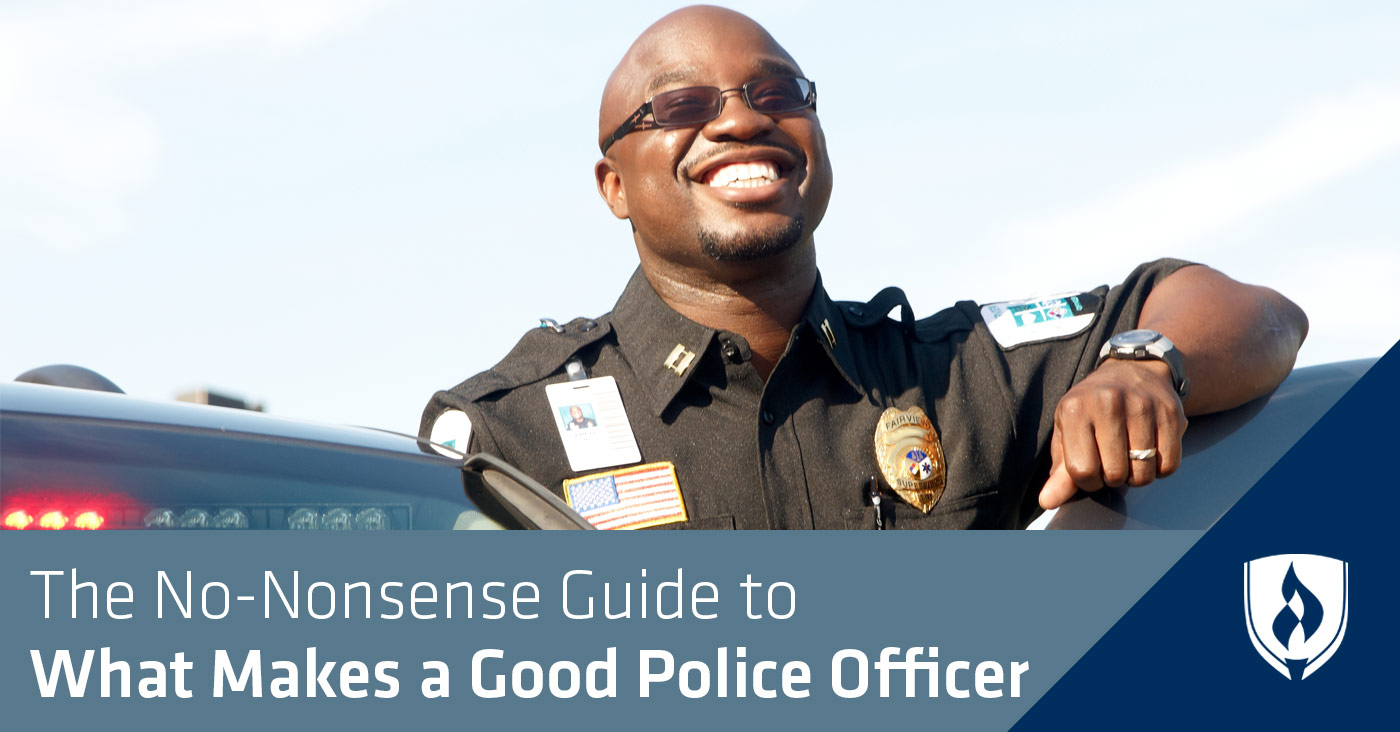
If you reflect on TV or movie portrayals of police officers, you might have a picture in your head of what a “bad cop” looks like. But since most people only interact with police officers when something has gone wrong, it can be hard to see qualities that make a truly great police officer shine.
Like any career, there will always be some professionals who are much better at their jobs. But unlike most careers, in law enforcement being good at your job can mean life and death for you or for someone else. “Police officers have an important role in the community—to keep the community safe,” says criminal defense lawyer, Tony Sun. “But being a police officer is the most stressful job in any city.”
Police training and education will help you develop the tools you need to thrive in the job. But truly great cops have more than just solid training in their corner. What makes a good police officer? We asked former law enforcement officials and the professionals who work with them for some of the qualities the best officers they know have in common.
What skills do police officers need?
A police officer’s area of jurisdiction and specialization can have a huge impact on the technical skills and knowledge they’ll need. That being said, there are several technical skills and abilities that are commonly sought after. We used job posting analysis software from Burning-Glass.com to identify some of the most frequently requested technical abilities of law enforcement officers.1
Commonly required technical skills for police officers
- Public health and safety training
- Prevention of criminal activity
- CPR
- Warrants
- Surveillance
- Traffic laws
- Investigations
- Crowd control
- Prevention programs
These areas of skill do not represent everything police officers need to know. Most law enforcement programs and police academies will offer courses and training in line with state and federal requirements for officers. To learn more about what police officers learn, check out “Police Training: A Deeper Look at Tactics, Weapons and Human Relations.”
Important soft skills for police officers
But technical skills are only part of the mix in making a good police officer. The best police officers also bring an array of traits and soft skills to the table. And employers know these baseline skills are extremely important.
Communication
For law enforcement officers, communication, people skills and emotional intelligence play a hugely important role in being effective at the job.
“Emotional intelligence is essential for defusing a potentially volatile situation and keeping things from escalating,” says attorney Matt Pinsker. “This also goes to maintaining a professional and respectable demeanor with the public that fosters good relations.”
Pinsker explains that every interaction from a simple traffic stop or responding to a crime victim to confronting a criminal requires reading people and knowing how to respond in a way that maximizes the chance of a peaceful exchange.
Relationship building
Beyond the skill of communicating and relating to people, the best police officers also know how to build effective relationships. Sun says that simply being friendly to people and showing your good intentions can go a long way toward helping your community trust you.
“Whenever the police get called to a scene, people are intimidated,” Sun says. “They know they could get in trouble.” But if officers act with courtesy and work at keeping people calm, they are likelier to get cooperative and honest results. Over time, even small relationships in the community can change situations that might otherwise be stressful or adversarial.
Critical thinking
“No other single person in society can decide who to arrest and who to take to jail.” But police officers make these choices every day, Sun points out. “That’s why good police officers need to have a strong desire to seek the truth. Other people’s lives are in your hands.”
In the jumble of a criminal investigation, not everyone tells the truth. Sun says people who aren’t even suspects can get nervous around officers and lie about what happened. Police officers need to have a real desire to get to the bottom of things, and the critical thinking skills to sift out the truth.
Rushing to conclusions is definitely not OK for police officers, Sun says. “There are two sides to every story, and every police officer needs to decide what the truth is. It doesn’t need to be perfect every time, but the process of investigating needs to be done every time.”
Physical fitness
While there might be exceptions based on location and the specifics of the role, many police officers have to meet certain physical requirements. The Bureau of Labor Statistics (BLS) reports that police officers monitor regular patrols and respond to emergency and nonemergency calls. Some officers have specialized units like horseback, motorcycle, canine corps, and special weapons and tactics (SWAT).2
Officers are often expected to be able to pursue a suspect on foot, perform CPR and assist people in accidents or disaster situations if needed. But going beyond that, police officers who take their physical fitness seriously will have a better chance of thriving in the line of duty.
Some of the traits commonly associated with physical fitness—such as discipline and self-control—are also very helpful. And as Pinsker points out, sometimes just having a strong command presence can get more done. “The best officers will, upon arrival at a scene, put out an aura that they are in control,” Pinsker says. “It also helps get people to cooperate.”
Self-control
“The best police officers excel at keeping calm,” Sun explains. “Situations get out of hand, suspects are desperate to not get caught, and people get emotional.” When officers need to de-escalate a situation, the habit of keeping their own emotions and reactions in check makes a big difference. There might be a million concerns running through an officer’s mind, but they’re best served to be like a duck in water—visibly calm and collected while working hard out of sight to keep afloat.
“Keeping calm will calm suspects down, buy you time until backup arrives, and will help keep you and everyone else safe,” Sun says.
Would you make a good police officer?
On paper, these traits and skills can all add up to a good police officer. But success for a police officer can also come from the unique combination of experiences and attributes that you bring to the table. If you could see yourself serving and protecting your community, this career choice might be right for you.
If a career in law enforcement sounds appealing, you’re probably wondering what it takes to become a police officer. Check out our article, “How to Become a Police Officer: Your Step-by-Step Guide,” to see what it takes to reach your first patrol.
Interested in different types of law enforcement? Check out our other article about conservation officers.
