
Meth consumption still high, no evidence of related spike in crime
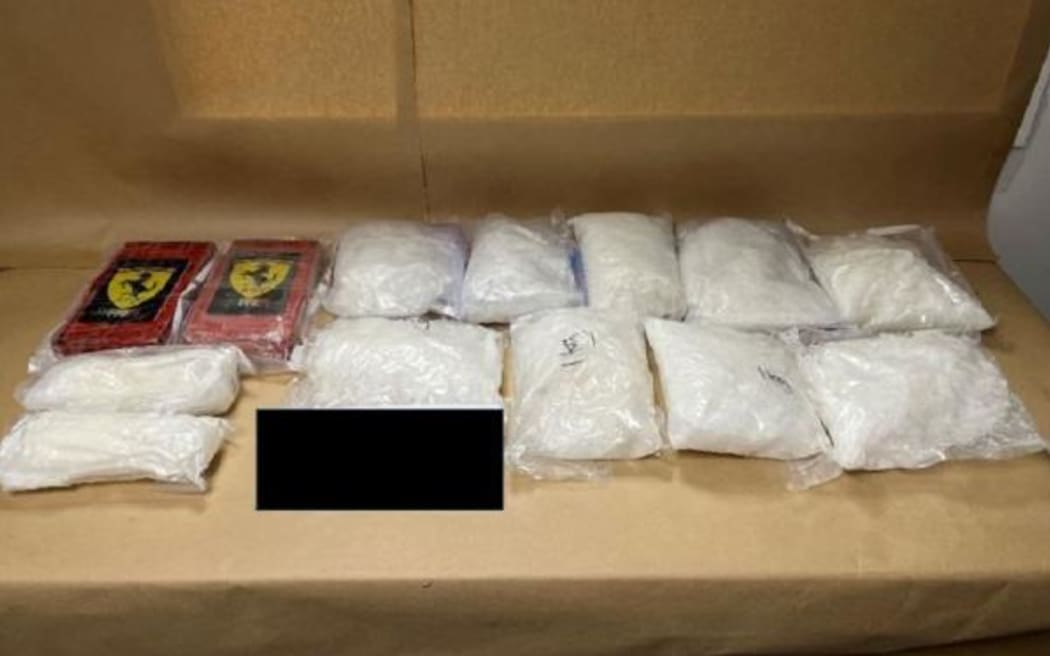
Packets of methampetamine seized at Auckland Airport last month. Photo: Supplied / NZ police
A huge spike in meth use last year shows little sign of shrinking, but police data suggests it has not meant a big increase in crime.
Wastewater data shows meth use remains elevated, which Detective Superintendent Greg Williams said was “gutting” and could mean a rise in crime and social harm.
But police data shows there is no evidence yet of a significant spike in crime following the significant spike in methamphetamine use.
It comes as the Ministerial Advisory Group on Organised Crime releases its most recent report, highlighting the need to ‘remove the customers of drug crime’.
Wastewater testing
Wastewater testing showed a 96 percent increase of consumption of methamphetamine in 2024, compared to 2023, which has been referred to as a “doubling” in meth use.
Fifteen kilograms of methamphetamine was consumed every week in the March 2019 quarter. In the December 2024 quarter, about 36kg was consumed on average each week.
The latest data from nationwide wastewater testing taken from January to March this year shows an average of 33 kg consumed per week.
Casey Costello, the Minister of Customs and Associate Minister of Police, who is in charge of the Ministerial Advisory Group on organised crime told RNZ in a statement it was good meth use was down, but it remained “far too high”.
All districts continued to record above average use when compared to the respective consumption rates over the previous four quarters, the report said.
“Methamphetamine use across sample sites in Q1 2025 equates to an estimated weekly social harm cost of $34.6 million.”
It was not clear yet whether more people started using, or whether the same people were using more.
“We’d expect a massive increase in the population use. It doesn’t seem that that’s the case,” Williams said, and more testing was being done to understand what happened to cause the uptick last July.
Regardless, Williams said it was “gutting to see” meth use was still in the range of that top level, “honestly, seriously concerning.”

Detective Superintendent Greg Williams. Photo: RNZ / Samuel Rillstone
He could not say whether the increase in meth use had directly caused an increase in crime, but said “meth is a massive driver of crime, social harm and social deprivation in communities”.
“So regardless of whether it’s more people using or people using more it’s still creating significantly more social harm and also seeing significantly more money going to the hands of gangs across the country, who are the ones selling this into the community.”
Williams acknowledged the price of meth had dropped, but it was still relatively high compared to the rest of the world.
“You’ve still got to find the money to pay for that right?
“That’s the concern.”
Increase in meth use:

Data from the National Drugs in Wastewater Testing Programme / NZ Police. Photo: Supplied
Victimisations data
To consider whether there had been a jump in crime related to a jump in meth use, RNZ looked at the Recorded Crime Victims Statistics, which shows how many times Police receive reports of crimes that have a victim – or “victimisations” such as assault, burglary, theft.
According to Police data from the RCVS, there was not a significant and continuous spike in crime that directly aligned with the spike in meth use which began in July 2024.
Over a period of two years, between the start of July 2023 and the end of June 2025, the nationwide trend was relatively steady in terms of the number of victimisations.
Here’s a breakdown nationwide by month over those two years (up to the latest data available) which shows the number of victimisations after the spike in meth use stays relatively consistent with the period before the spike.
Nationwide victimisations:
Made with Flourish • Create your own
– Data from Police RCVS
According to wastewater data, the police regions of Northland, Eastern, Waikato and Tāmaki Makaurau saw the highest methamphetamine consumption per capita.
Here’s the breakdown of victimisations in those police districts by month for the past two years, where you can see a marginal increase in some cases, but a relatively consistent trend.
Victimisations by region:
Made with Flourish • Create your own
– Data from Police RCVS
Asked whether he was seeing a correlation between the increase in meth use and an increase in crime, Detective Superintendent Williams said he did not have that data in front of him but referenced research which showed a cohort of meth users who had a conviction were committing five times more offending than a non-meth-using cohort.
Williams said it was hard to say what the long-term impacts would be and when they might start to be seen, but in the meantime, gangs were getting significantly more money as a result of the increased use.
“So, inherently, you have to see an impact out there in communities.”
Data based on reported crime can sometimes hide what goes unreported, so a victimisation survey – which asked people about their experiences of crime – was typically considered the gold standard measurement.
However, New Zealand’s version – the Crime and Victims Survey – is run annually, so that data was not available.
Ministerial Advisory Group on Transnational, Serious and Organised Crime (TASC)
The group provides monthly reports to the minister with findings and recommendations regarding New Zealand’s response to organised crime.
The latest report published this week, for June, was titled ‘One Team Against Organised Crime’, and specified the need for a sustained and concerted strategy and action at government and community levels to break long term, intergenerational cycles and address the symptoms and root causes of organised crime.
It specified a need for a national strategy with local implementation to fight TASC, as well as a focus on prevention, stating “we agree that building community resilience to organised crime” should be part of the strategy.
“This is consistent with the foundational objectives for national drug policies: problem limitation, demand reduction and supply control.
“These principles have informed the work recently undertaken by the meth sprint team commissioned by the Prime Minister.”
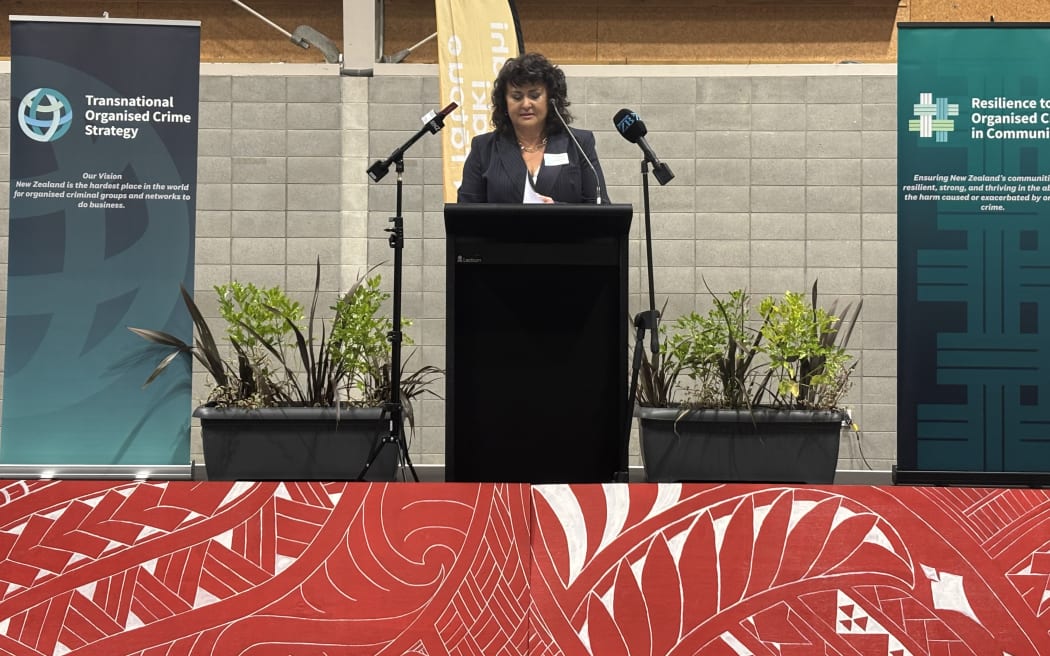
Minister of Customs and Associate Minister of Police Casey Costello speaks about an organised crime programme that targets the causes of drug use in communities. Photo: RNZ / Ellen O’Dwyer
A section titled ‘Removing the Customers of Drug Crime’ outlined the current situation where Customs was seizing far more illicit drugs than ever before, while there had been a substantial increase in the consumption of methamphetamine.
It noted, even before the spike in meth and cocaine, there were real pressures on addiction services in New Zealand. For example, in 2023/24:
a. New Zealand spent around $235 million on specialist alcohol and other drug services
b. 44,850 people accessed AOD services
c. Wait times into specialist addiction services within 3 weeks were 75.8 percent.
The report raised the question of whether the costs of organised crime were paid for through “increased efforts to reduce demand or through enforcement, or through the longer-term costs of social harms, including, for example, the costs of imprisonment”.
“We have heard from community leaders that it would be helpful to see drug use as a health issue rather than a criminal issue to enable addicts to access treatment.”
Part of this could be increasing support for confidential drug testing services; encouraging police to refer people who use drugs to local treatment options; continuing support for community-based meth reduction programmes like Te Ara Oranga in Northland; and meeting other health needs like undiagnosed neurodiversity (such as ADHD) so illicit drugs were not being used to control those symptoms.
Key recommendations from the group to prevent drug crime included:
a. Reducing the stigma around being a drug user to encourage users to seek help
b. Investing in the availability of effective addiction treatment services to remove the customers of drug crime
c. Considering wider rollout of alternative treatment models and criminal justice pathways for users, such as Alcohol and Other Drug Treatment Courts.
A response from the government’s ‘meth sprint team’ to the increased meth use is expected in due course, and could be as soon as this month.
Meth contamination: a hidden hazard that could cost your home

Kate McIntyre, Property Journalist


The manufacture of meth leaves dangerous residue in a property for years. Picture: iStock.
Burning eyes, a toxic smell, raging kids – the dark signs of a property’s past that could be putting your family’s future at risk.
When it comes to the hidden dangers sometimes found lurking in homes, meth contamination is not commonly thought about, however, the Australian Institute of Health and Welfare states methylamphetamine is the second most consumed illicit drug after cannabis across the country.
It is also the most commonly produced illicit drug in Australia, according to a 2017 report by enHealth – with only one in 10 clandestine labs thought to be detected. The majority of clan labs are either in or adjacent to domestic properties.

Moving into a home contaminated with high levels of meth is a nightmare scenario.
LIVING IN A METH HOUSE
Research by Flinders University shows residue from cooking meth amphetamine stays present in a property for up to five years. It sits on surfaces and inside porous materials, leaking into the air and contaminating other objects brought into the home, like clothes, kids’ toys and furniture.
MORE: Grim detail in rental listing horrifies tenants
Unfinished home’s jaw dropping price
Director of Environmental Risk Sciences and Adjunct Academic at Flinders University Dr Jackie Wright says this poses a nightmare scenario for new homeowners or renters.
“If you buy a house and you bring your own possessions into it, they will become contaminated,” she says. “There are some things like bedding that you have to dispose of.”
Both cooking and smoking meth leaves dangerous residue in a home. The difference is in the level of contamination present, with manufacturing and large groups of people smoking likely to cause a higher amount compared to a single person smoking, she says.

Dr Jackie Wright. Picture Craig Hughes
HEALTH EFFECTS
Meth contamination tends to cause respiratory problems such as asthma and an exacerbation of pre-existing medical problems like auto-immune conditions, Dr Wright says. It also causes sleep issues, fatigue, eye and skin irritation plus headaches and aggressive behaviour in kids.
“In general, kids are the ones who are most at risk,” she says. “Some older adults are also more susceptible.”

Meth testers used to check the levels of the drug in a house.
WHAT YOU CAN DO
You can test for the presence of meth residue using a DIY rapid test kit however this won’t show the extent of the contamination, Dr Wright says. If you return a positive result, you should engage a forensics company for further testing.
“That tells you what sort of levels are actually present,” she says. “It could be a low level contamination or a really high level contamination. That tells them how much work needs to be done to make it clean and inhabitable.”

The cost of remediation could put you in a very difficult position.
You should then hire a different company if the property needs to be remediated, to avoid a conflict of interest, and a different company again to test the levels after the work has been done.
There is a health-based guideline that sets out the safe level of contamination where no remediation is needed.
“The Australian guidelines have a threshold for residential homes which is 0.5 micrograms per 100 sq cm meth amphetamine on surfaces,” she says.

You can get very ill from living in a home contaminated with meth. Picture: Naomi Jellicoe
REMEDIATING METH
While low level contamination may be remediated by surface cleaning, carpet cleaning and HEPA vacuuming, high level contamination is much harder to fix.
More from News

‘Hot’: Doctor donates proceeds from $7.5m Clovelly sale to charity
2 hours ago

New Year, new financial goals and how to make them happen
3 hours ago
“It goes into the gyprock, it goes into timber, it gets all through the carpets,” she says.
Some properties need to have all carpet and soft furnishings as well as anything porous replaced.
“I know of a number of properties that have been demolished because the cost of remediating it is much higher than the value of the house,” she says.

Landlord Connie Cicchini had to demolish her rental property because of meth contamination. Picture: David Clark
IF YOU ARE A RENTER
Since tenancy laws across the states and territories vary, it’s always best to check with your relevant authority if you suspect meth contamination.
REIQ CEO Antonia Mercorella says Queensland tenants should raise any concerns of contamination with their property manager as soon as possible.
“Lessors are required to ensure the rental premises are fit to live in, are in good repair, and abide by all health and safety standards, including Queensland’s minimum housing standards,” she says. “Appropriate remediation works may be deemed necessary.”
REIV president Sam Hatzistamatis says in Victoria any known contamination must be disclosed to the renter before the lease is signed.

Only one in 10 clan drug labs are thought to be detected in Australia. Picture: Dean Martin
“I’ve been in the industry for a long time and I’ve never had one or come across one in an agency I’ve worked with,” he says.
Tenants in NSW must be told if a property has been used to manufacture or cultivate illegal drugs in the past two years. An REINSW spokesman issued the following statement.
“A landlord has an obligation to provide a property that is fit for purpose. Therefore, if a landlord is of the opinion that the property was exposed to meth, then they should have it remediated by a cleaner specialising in removing meth from a property.”