
Sean O’Casey
The post-World War II British period began with yet another major work by Sean O’Casey (1880–1964), “Cock-a-doodle dandy” (1949).
“Reminiscent of the fantastic comedies of Aristophanes, this play features a life-size apocalyptic cock who comes to banish religious bigotry and puritanism from the small Irish village” (Angyal, 1994 p 1767). “The wild festivities are presided over by the apocalyptic figure of an enchanted cock, a merry lord of misrule in the form of a man-sized dancing creature out of the beast-fable tradition, the mythic cock, with his Aesopian shrewdness, Dionysian spirit and Celtic magic, with his beautiful young women and allies, and the aid of such folk figures in the Irish village of Nyadnanave, which in Gaelic means ‘nest of saints’, but with O’Casey’s ironic pun becomes a nest of knaves” (Krause, 1976 p 84). “The cock- with his look of a cynical jester- is also a symbol of the sexual instinct, which has been thwarted by the puritanism of priest and politician…The ferocious puritanism of Father Domineer has not so much killed the sexual instinct in the villagers as frustrated and misdirected it.
His parishioners can never react naturally and joyously to sex. The rough fellows lust after Loreleen and see her as transformed into the cock, for them the embodiment of the devil. Shanaar also has sex on the brain in an evil and stupid way with his tales of nude women seducing holy brothers who end up on the gibbet. Even Mahan, the most sympathetic of the older men, tries to use money badly needed by Loreleen to coerce her into intimacy. The consequence of Father Domineer’s attitude is that he, albeit unintentionally, kills a worker who refuses to give up a woman with whom he is living in sin” (Darin, 1976 pp 139-140). “The cock, the central symbol of the play, broadly signifies vitality, the life force, fertility. The play itself chiefly seems to be a conflict between a morality which is symbolized by the cock and a view of life which is promulgated by Father Domineer and acceded to by most of the men in the play. Father Domineer’s view principally concerns itself with keeping women dowdy, drab, subservient, sexless. The cock, Robin Adair, Jack the lorry driver, and the three women of the play- Lorna, Michael Marthraun’s young second wife, Loreleen, his daughter by his first wife, and Marion, a maid- have, on the other hand, a lusty and vital O’Caseyan world-view…There is conflict throughout between earth life and religious life. Instead of miracles appearing on behalf of the church, miracles appear against it” (Hogan, 1960 p 118).
“The satire in this play is thus directed against the dictatorial ways of parish priests, the pernicious superstitions of some of their flock, and the avarice of moneyed men in rural Ireland. These influences try to kill joy and they force such characters as Lorna, Loreleen, and the Messenger to emigrate to England, which is twice described as ‘a place where life resembles life more than it does here’. To emphasise the failure of the forces of reaction and repression, O’Casey again makes vivid use of symbolism. The life-force in the play, with its endorsement of dancing, imaginative literature, and the freedom of the sexes, is symbolised by the Cock, with its brilliant crimson crest, green wings, yellow ankles and feet. Significantly, the Cock survives all attempts to hunt it down and shoot it, and its enemies only make themselves ridiculous when they try to do so” (Armstrong, 1963 p 90).
O’Casey “created, if not the sturdiest, surely the most entrancing and incisive of his non-realistic plays. This folk comedy, enlivened with breezy fantasy, pokes glorious fun at provincial philistinism and constitutes a high-hearted, if also rueful, affirmation of love of life and freedom of spirit. The wholesome young exponents of a full life wage war in Cock-a-Doodle Dandy against calculating and superstition-ridden middle-aged proponents of village puritanism. The latter, forming a vigilante group under Father Domineer to oppose ‘the onward rush of paganism’, finally score a victory by driving out a spirited girl, Loreleen. She is joined by Lorna, the young, life-loving wife of one of the girl’s persecutors, and together they go away ‘to a place where ‘life resembles life more than it does here’. One by one, the representatives of life depart the village, leaving it to desiccated provincials, among whom are a pair of dimwitted and blustering codgers worthy of O’Casey’s earlier imperishable booze-companions ‘Captain’ Boyle and Joxer” (Gassner, 1954a p 728). “Cock-a-doodle dandy” “seems to me an incomparably vivid and powerful play, a really tremendous hymn to the joy of life and the perdition of its enemies” (Allen, 1957 p 164).
“When the play is read as a loose reversal of the Fortunate Fall…Michael Marthraun becomes an ingenious character creation in his ironic contrast to Archangel Michael in ‘Paradise lost’. For whereas in Milton’s explanation of Adam’s future, how man’s fate is decided and the prophecy of the Second Coming so overwhelm Adam that he explains the essence of the Fortunate Fall, O’Casey’s Michael causes the Lovers of Joy to be banished from a false Paradise, leaving himself, not them, to ponder the paradox. He learns from those whom he banishes what it means to live; and he realizes that he, alone, is left in his ‘priest-ridden domain’, fully aware that the undefined Green World to which his adversaries are going will bring them more happiness than he can ever find in his False Paradise” (Daniel, 1969 p 138).
“Cock-a-doodle dandy”
.jpg)
Time: 1940s. Place: Fictional town of Nyadnanave, Ireland.
Text at at ?
Michael Martbraun, a farmer, argues over the cost of moving turf with Sailor Mahan, owner of a fleet of lorries. Michael is equally frustrated about the light ways of Loreleen, daughter of his first wife. When Sailor’s lorry drivers arrive to find out whether a deal has been struck between the two men, they are frightened away on seeing Loreleen transformed into a cock before their very eyes. Michael is all the more perturbed when his servant, Marion, comes running out of his house in a panic over the disturbance caused by the cock on a rampage inside. When it appears at the window, Michael and Sailor lay flat on the ground in fear. It is eventually lassoed by a messenger who leads him off. As the cock crows, thunder strikes. More relaxed with the cock away, Michael and Sailor flirt with Marion until they see her headgear rise in the form of a devil’s horn. Michael is even more alarmed after hearing her say that she is ready to offer the cock a wreath of roses. Michael and Sailor turn to the comforts of whiskey, but the liquid stays in the bottle. “You’d think good whiskey would be exempt from injury even be th’lowest of th’low,” a bemused Michael comments. He buys a new hat to replace the one destroyed during the cock’s rampage inside his house, but a porter informs him that it was shot through by the civic guards aiming at the evil spirit in the shape of the cock. When a sergeant shows up to hunt it down, there is a flash of lightning and the hat is transformed into the cock. Even worse, the whiskey bottle turns hot in the sergeant’s hand so that he is unable to drink. When Michael’s wife, Lorna, tells him his new hat arrived an hour ago, he wants no part of it. Along with Loreleen and Marion, Lorna drinks to the cock and entices the men to join them until Father Domineer interrupts the party to insist that Sailor dismiss from work a lorry driver living with a woman outside the bonds of marriage, but Sailor refuses. The incensed priest strikes the lorry driver, but is then stunned on discovering him dead. Before leaving the village as the result of the murder, the priest conducts an exorcism of Michael’s house and is confident of its success. He next attempts to shame Loreleen into leading a more virtuous life after she had been pelted with stones by a crowd angry at her wayward life and had her money stolen, borrowed from Sailor when she attempted to leave the village forever. On her way out of town conducted by the hostile crowd, she is joined by Lorna and Marion. While Michael glumly murmurs over the loss of his wife, her sister returns on a stretcher from Lourdes, still suffering from the same chronic illness.
Robert Bolt
Another work of importance is the history play, “A man for all seasons” (1960), by Robert Bolt (1924-1995), based on the life of Thomas More (1478–1535).
”The style of the play is determined by the author’s confidence in his hero’s ability to win our admiration without rhetoric…It is epic in the narrow sense of being a chronicle unified by an idea- here, the idea of a humane man trying to retain his integrity in a world of opportunists and hyenas” (Gassner, 1968 pp 508–209). “The play has considerable stature beyond the nobility of More’s character. It is written with remarkable virtuosity. The literary style is formal; the characters address one another in plain sentences that express social stratifications rather than individual personalities” (Atkinson and Hirschfeld, 1973 p 275). The play is “a study in a stand of conscience against political expediency. The intellectual as distinct from the emotional appeal of the play lies in the astute fencing with which More defends himself, as his enemies try this way and that to catch him out in a legally treasonable admission. As he is pressed harder and harder he falls back on the refusal to commit himself on the one question where an honest answer would destroy him, until finally he is undone by the deliberate perjury of the venal Richard Rich and, all being lost, can speak his mind at last” (Stout, 1962 p 120). “When Rich first appears, he is arguing with More, maintaining that ‘every man has his price’, an opinion that his own subsequent career aptly illustrates…Rich undergoes something of an interior struggle when he finds himself drifting toward betrayal of his king, but he soon sheds any semblance of self-respect to become a useful tool to Thomas Cromwell. Unlike More, who will not compromise himself by a false oath that is a mere formality, Rich boldly perjures himself in a capital case to help Cromwell secure More’s conviction” (Hamilton, 1994 p 276).
“Bolt interprets [More]…as a melancholy intellectual aristocrat, desperately trying to preserve some corner of private conscience while preserving his at the same time. Unlike some rasher spirits who surround him, More is prudent and discreet, [saying] ‘our natural business lies in escaping’, and inclined to protect himself behind legalistic subterfuges” (Brustein, 1965 p 185). “More, employing every resource of his canny legal brain, patiently reminds his inquisitors that silence is not to be equated with treason, and that no court can compel him to reveal or defend his private convictions…Our attention is focused on the legal stratagems whereby More postponed his martyrdom, and distracted from the validity of the ideas that got him into trouble to begin with. The play contains some muscular period writing, especially in the scene where More deliberately insults his old crony, the conformist duke of Norfolk in order to absolve him from the responsibility of breaking off their friendship” (Tynan, 1975 p 285).
Bolt “dramatizes the heroism of the man who refuses to yield to the dictates of expediency, and he exposes the common man (most of us) who fails to fight in defense of such a person as More…What emerges from all this, artistically speaking, is a certain probity- spare, sober, honorable” (Clurman, 1966 pp 49–50). “Despite the religious vocabulary and tone of discourse…Bolt is not concerned with the historical issue of belief…he is concerned with ‘morally accountable individuals, trying to hold true to their [humanistic] beliefs against the mindless violence of ideological genocide or religious fanaticism’. So…the demands of church and state are not the opposite their functionaries proclaim, but equal threats to the protagonist’s integrity” (Innes, 2002 pp 116–117). More “is a canny and reluctant saint who chooses to hide from the eyes of God and kings in the ‘thickets of the law’ where he knows his agile mind can serve him best. He is a lover of the good things of the world without being worldly, he is a man of inflexible conscience who would go to almost any length to prevent his conscience being called to the test. The real excitement of the play derives not from the conflict between More and the king or More and Cromwell but from the noble manner in which More takes his stand upon conscience. His words in the last scenes have a ringing authority that seem to echo far beyond the confines of the play…[But by borrowing the words of the historical More], Bolt admits inconsistency into his language” (Lumley, 1967 pp 299-300). “The single scene with King Henry is excellent…Henry’s abrupt shifts of mood and changes of subject characterize him very well and we get a good impression of a mutual admiration between the two men which counterpoints the head-on clash” (Hayman, 1969 p 49).
PAST SCREENINGS
Some Like it Hot
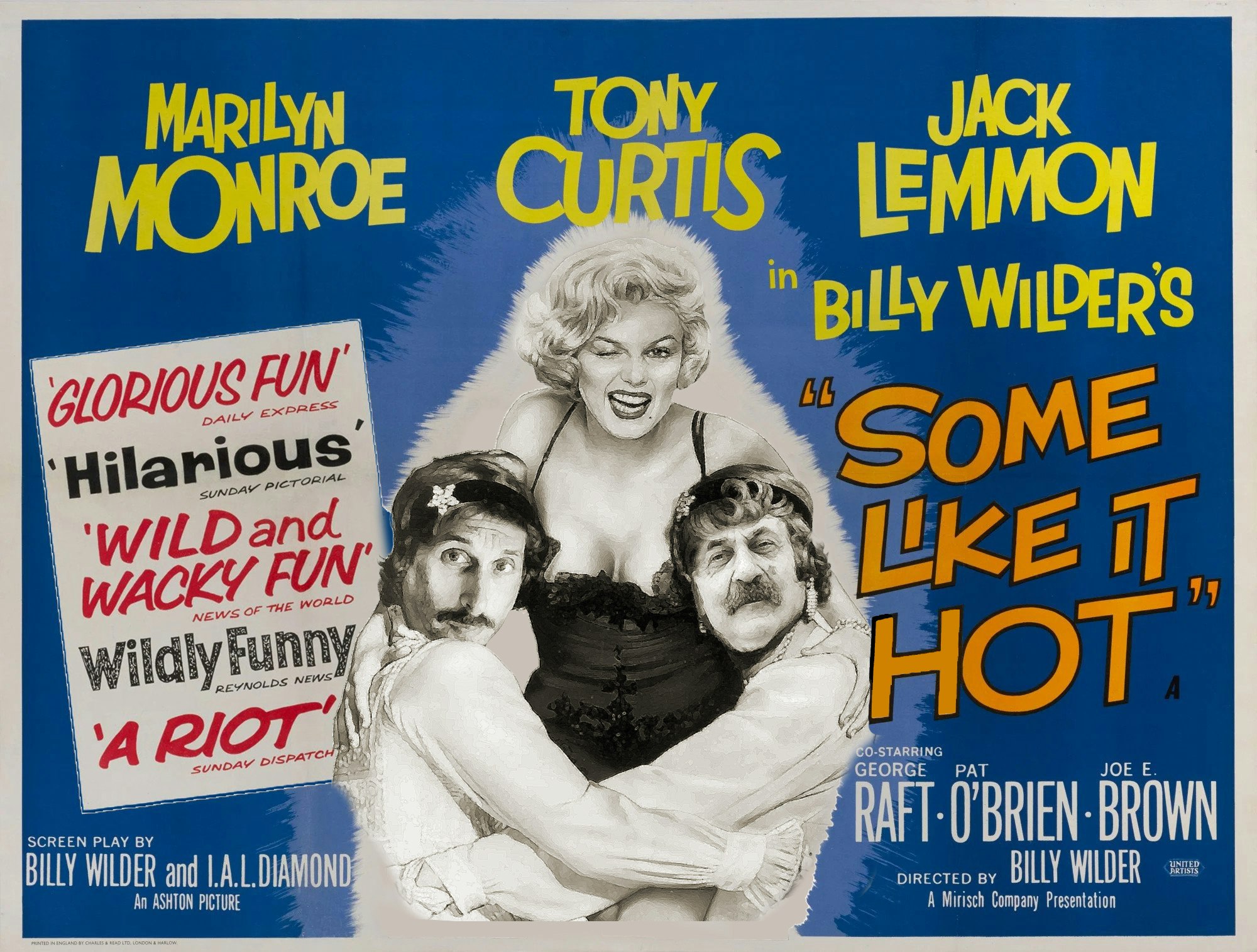
What a work of art and nature is Marilyn Monroe. She hasn’t aged into an icon, some citizen of the past, but still seems to be inventing herself as we watch her. She has the gift of appearing to hit on her lines of dialogue by happy inspiration, and there are passages in Billy Wilder’s “Some Like It Hot” where she and Tony Curtis exchange one-liners like hot potatoes.
Poured into a dress that offers her breasts like jolly treats for needy boys, she seems totally oblivious to sex while at the same time melting men into helpless desire. “Look at that!” Jack Lemmon tells Curtis as he watches her adoringly. “Look how she moves. Like Jell-O on springs. She must have some sort of built-in motor. I tell you, it’s a whole different sex.”
Wilder’s 1959 comedy is one of the enduring treasures of the movies, a film of inspiration and meticulous craft, a movie that’s about nothing but sex and yet pretends it’s about crime and greed. It is underwired with Wilder’s cheerful cynicism, so that no time is lost to soppiness and everyone behaves according to basic Darwinian drives. When sincere emotion strikes these characters, it blindsides them: Curtis thinks he wants only sex, Monroe thinks she wants only money, and they are as astonished as delighted to find they want only each other.
The plot is classic screwball. Curtis and Lemmon play Chicago musicians who disguise themselves as women to avoid being rubbed out after they witness the St. Valentine’s Day Massacre. They join an all-girl orchestra on its way to Florida. Monroe is the singer, who dreams of marrying a millionaire but despairs, “I always get the fuzzy end of the lollipop.” Curtis lusts for Monroe and disguises himself as a millionaire to win her. Monroe lusts after money and gives him lessons in love. Their relationship is flipped and mirrored in low comedy as Lemmon gets engaged to a real millionaire, played by Joe E. Brown. “You’re not a girl!” Curtis protests to Lemmon. “You’re a guy! Why would a guy want to marry a guy?” Lemmon: “Security!”
The movie has been compared to Marx Brothers classics, especially in the slapstick chases as gangsters pursue the heroes through hotel corridors. The weak points in many Marx Brothers films are the musical interludes–not Harpo’s solos, but the romantic duets involving insipid supporting characters. “Some Like It Hot” has no problems with its musical numbers because the singer is Monroe, who didn’t have a great singing voice but was as good as Frank Sinatra at selling the lyrics.
Consider her solo of “I Wanna Be Loved by You.” The situation is as basic as it can be: a pretty girl standing in front of an orchestra and singing a song. Monroe and Wilder turn it into one of the most mesmerizing and blatantly sexual scenes in the movies. She wears that clinging, see-through dress, gauze covering the upper slopes of her breasts, the neckline scooping to a censor’s eyebrow north of trouble. Wilder places her in the center of a round spotlight that does not simply illuminate her from the waist up, as an ordinary spotlight would, but toys with her like a surrogate neckline, dipping and clinging as Monroe moves her body higher and lower in the light with teasing precision. It is a striptease in which nudity would have been superfluous. All the time she seems unaware of the effect, singing the song innocently, as if she thinks it’s the literal truth. To experience that scene is to understand why no other actor, male or female, has more sexual chemistry with the camera than Monroe.
Capturing the chemistry was not all that simple. Legends surround “Some Like It Hot.” Kissing Marilyn, Curtis famously said, was like kissing Hitler. Monroe had so much trouble saying one line (“Where’s the bourbon?”) while looking in a dresser drawer that Wilder had the line pasted inside the drawer. Then she opened the wrong drawer. So he had it pasted inside every drawer.
Monroe’s eccentricities and neuroses on sets became notorious, but studios put up with her long after any other actress would have been blackballed because what they got back on the screen was magical. Watch the final take of “Where’s the bourbon?” and Monroe seems utterly spontaneous. And watch the famous scene aboard the yacht, where Curtis complains that no woman can arouse him, and Marilyn does her best. She kisses him not erotically but tenderly, sweetly, as if offering a gift and healing a wound. You remember what Curtis said but when you watch that scene, all you can think is that Hitler must have been a terrific kisser.
The movie is really the story of the Lemmon and Curtis characters, and it’s got a top-shelf supporting cast (Joe E. Brown, George Raft, Pat O’Brien), but Monroe steals it, as she walked away with every movie she was in. It is an act of the will to watch anyone else while she is on the screen. Tony Curtis’ performance is all the more admirable because we know how many takes she needed–Curtis must have felt at times like he was in a pro-am tournament. Yet he stays fresh and alive in sparkling dialogue scenes like their first meeting on the beach, where he introduces himself as the Shell Oil heir and wickedly parodies Cary Grant. Watch his timing in the yacht seduction scene, and the way his character plays with her naivete. “Water polo? Isn’t that terribly dangerous?” asks Monroe. Curtis: “I’ll say! I had two ponies drown under me.”
Watch, too, for Wilder’s knack of hiding bold sexual symbolism in plain view. When Monroe first kisses Curtis while they’re both horizontal on the couch, notice how his patent-leather shoe rises phallically in the mid-distance behind her. Does Wilder intend this effect? Undoubtedly, because a little later, after the frigid millionaire confesses he has been cured, he says, “I’ve got a funny sensation in my toes–like someone was barbecuing them over a slow flame.” Monroe’s reply: “Let’s throw another log on the fire.”
Jack Lemmon gets the fuzzy end of the lollipop in the parallel relationship. The screenplay by Wilder and I.A.L. Diamond is Shakespearean in the way it cuts between high and low comedy, between the heroes and the clowns. The Curtis character is able to complete his round trip through gender, but Lemmon gets stuck halfway, so that Curtis connects with Monroe in the upstairs love story while Lemmon is downstairs in the screwball department with Joe E. Brown. Their romance is frankly cynical: Brown’s character gets married and divorced the way other men date, and Lemmon plans to marry him for the alimony.
But they both have so much fun in their courtship! While Curtis and Monroe are on Brown’s yacht, Lemmon and Brown are dancing with such perfect timing that a rose in Lemmon’s teeth ends up in Brown’s. Lemmon has a hilarious scene the morning after his big date, laying on his bed, still in drag, playing with castanets as he announces his engagement. (Curtis: “What are you going to do on your honeymoon?” Lemmon: “He wants to go to the Riviera, but I kinda lean toward Niagara Falls.”) Both Curtis and Lemmon are practicing cruel deceptions–Curtis has Monroe thinking she’s met a millionaire, and Brown thinks Lemmon is a woman–but the film dances free before anyone gets hurt. Both Monroe and Brown learn the truth and don’t care, and after Lemmon reveals he’s a man, Brown delivers the best curtain line in the movies. If you’ve seen the movie, you know what it is, and if you haven’t, you deserve to hear it for the first time from him.
PATHS OF GLORY (1957) – NOV 2023
In 1945, a teenage Stanley Kubrick was given a job as staff photographer at Look magazine, where he published more than nine hundred striking images, most of them in the realist style of New York School street photography. By the end of the decade, he had taught himself to make movies, and with financial help from relatives, he became a pioneer of extremely low-budget, independent production. His first two features were the allegorical war picture Fear and Desire (1953) and the noir thriller Killer’s Kiss (1955), on both of which he served not only as producer and director but also as photographer, editor, and sound engineer. Then, in 1955, the preternaturally gifted Kubrick became a low-budget Hollywood director, joining forces with his contemporary the producer James B. Harris to make The Killing, a stylish heist film that was glowingly reviewed and much talked about within the industry but dumped into grind houses by its distributor, United Artists. His second film with Harris, a return to the theme of war, was even more impressive; Paths of Glory (1957), a scathing depiction of the murderous, face-saving machinations of an officer class, secured the young Kubrick’s reputation as a major talent.
The film originated when, on the strength of The Killing, Harris and Kubrick were briefly hired by MGM, where they proposed several projects that were rejected by the studio. Among these was an adaptation of Humphrey Cobb’s 1935 novel Paths of Glory, which Kubrick remembered having read in his father’s library as a teenager. Inspired by a New York Times story about five French soldiers in World War I who were executed by firing squad, the novel provided a harrowing account of trench warfare and an appalling picture of how generals treated their troops as cannon fodder. Playwright Sydney Howard had authored a Broadway adaptation in 1938, but by the mid-1950s, the book was virtually forgotten. Despite Kubrick’s enthusiasm, MGM turned the idea down, chiefly because it feared such a film would have difficulty getting distribution in Europe. Undeterred, Kubrick continued to develop a screenplay, aided by pulp novelist Jim Thompson, who had worked on The Killing, and playwright and novelist Calder Willingham, who had contributed to other unproduced Harris-Kubrick projects at MGM. This document ultimately came to the attention of a powerful and intelligent star: the muscular, dimple-chinned, intensely emotional Kirk Douglas, who was so impressed by it and by Kubrick’s work on The Killing that he offered to take the leading role and to pressure United Artists into financing the film under the auspices of his own company, Bryna Productions. With Douglas’s support, Paths of Glory went before the cameras on locations near Munich, Germany, budgeted at $1 million, more than a third of which went to the star. Harris and Kubrick agreed to work for a percentage of the profits, if profits ever came.

The completed film is strongly marked by what came to be known as Kubrick’s style and favored themes: a mesmerizing deployment of wide-angle tracking shots and long takes, an ability to make a realistic world seem strange, an interest in the grotesque, and a fascination with the underlying irrationality of supposedly rational planning. World War I was a particularly apt subject for Kubrick: generated by a meaningless tangle of nationalist alliances, it resulted in more than eight million military deaths, most caused by benighted politicians and generals who arranged massive bombardments and suicidal charges over open ground. Significantly, the concept of black humor, which is central to Kubrick’s work, was first articulated by the protosurrealist Jacques Vaché, a veteran of trench warfare in World War I, and yet of the several major films about the war, only Paths of Glory depicts the conflict in all its cruel, almost laughably absurd logic (All Quiet on the Western Front, Grand Illusion, The Dawn Patrol, and Sergeant York are humanistic, romantic, or patriotic by comparison). No wonder Luis Buñuel was among its passionate admirers.
To find anything similar to this attitude toward war, we need to consult Kubrick’s other films on the subject. In most cases, he underlines war’s absurdity by making the true conflict internecine and the ostensible enemy either semi-invisible or nearly indistinguishable from the story’s protagonists. In Fear and Desire, the paradigmatic instance, the same actors play both sides in a mysterious battle, as if the film were trying to illustrate a famous line from Walt Kelly’s Pogo: “We have met the enemy and he is us.” On the rare occasions when Kubrick’s soldiers have a close encounter with an Other from behind the lines, that person is either a doppelgänger or a woman. In Paths of Glory, the enemy is almost unseen, consisting mainly of lethal gunfire emanating from the smoke and darkness of no-man’s-land. The film differs from Kubrick’s normal pattern only in that, when French soldiers encounter a female German captive, she’s less an object of perverse desire and anxiety—as in Fear and Desire and Full Metal Jacket (1987)—than a maternal figure, producing a flood of repressed emotion and a momentary dissolution of psychic and bodily armor.
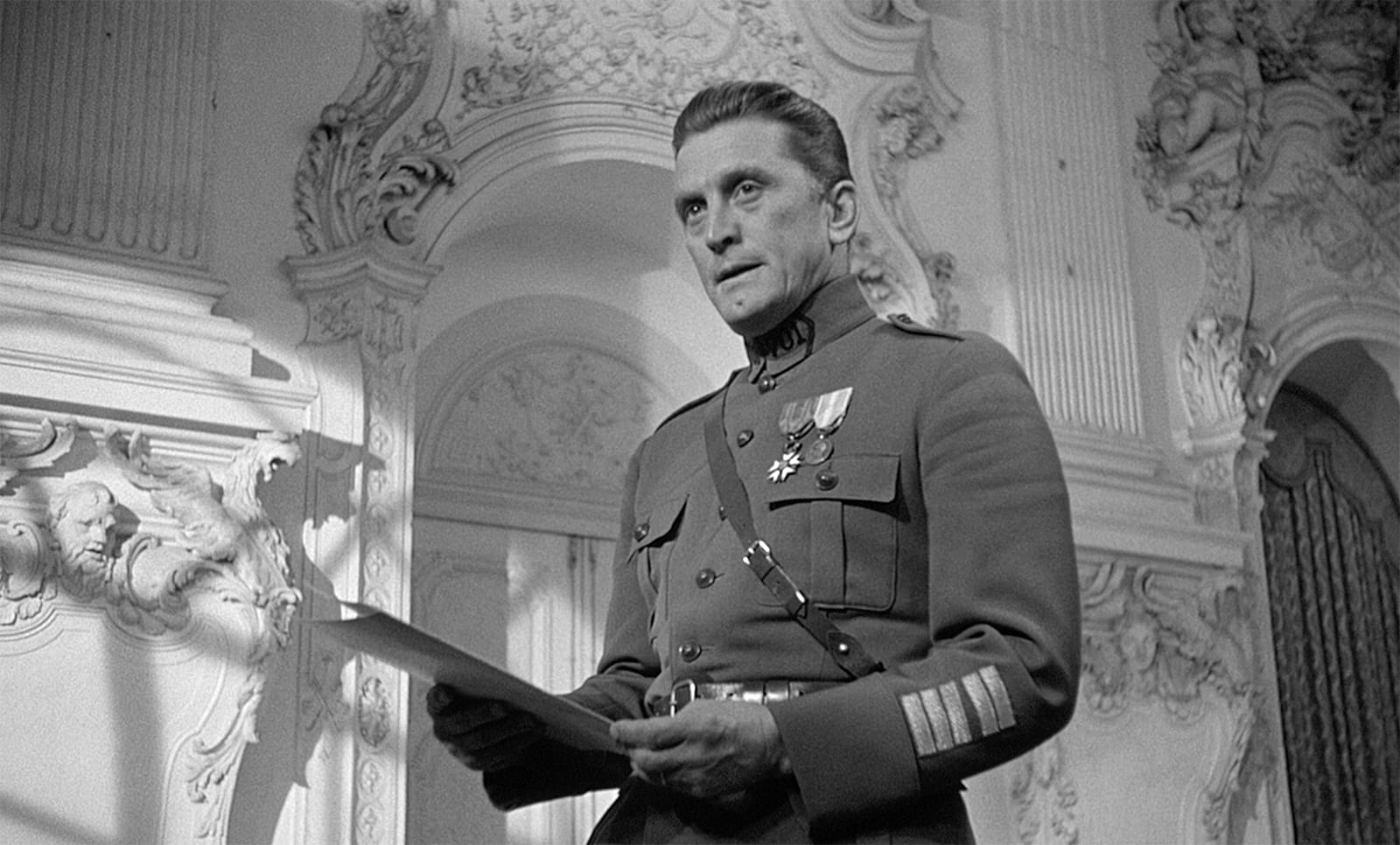
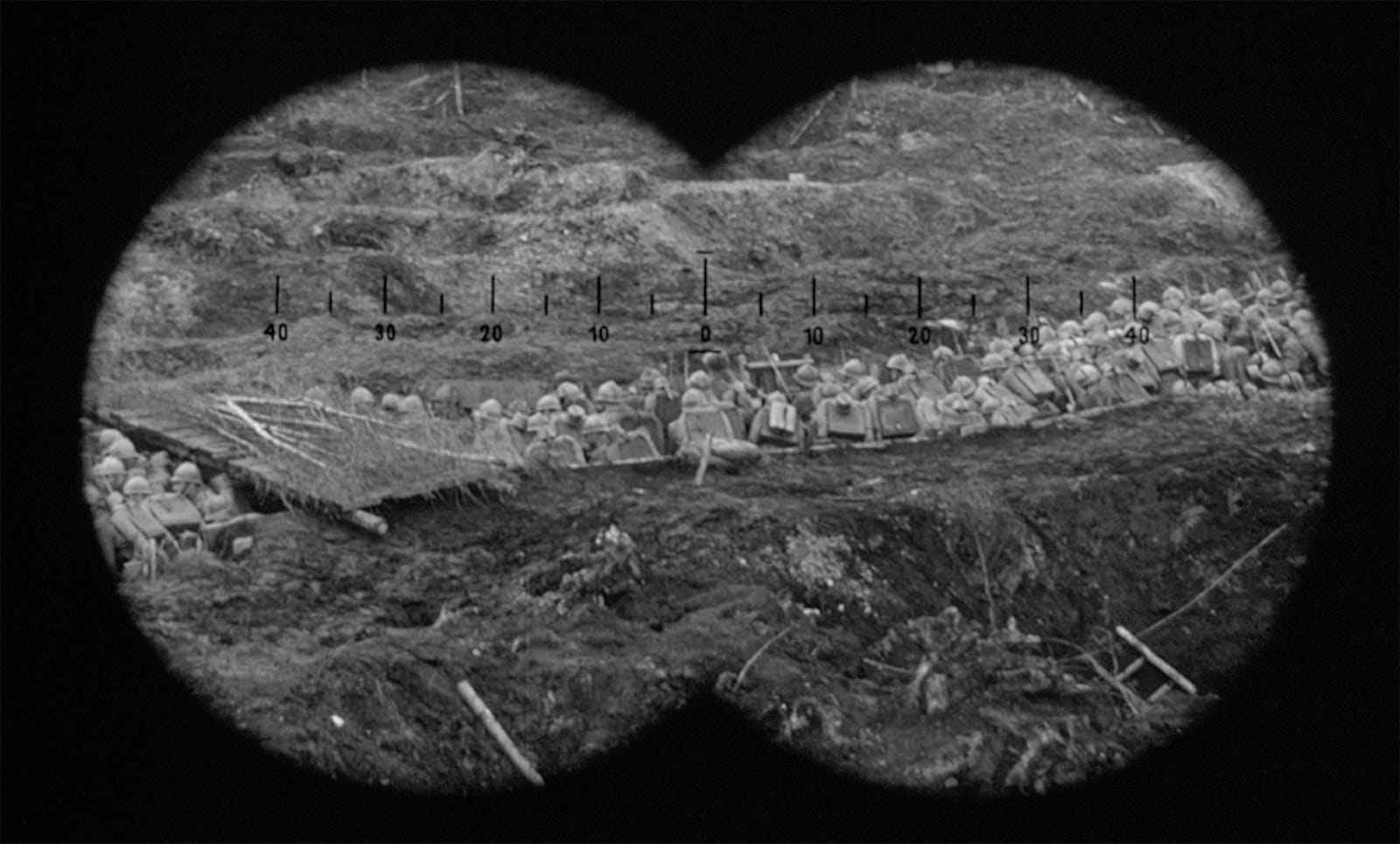
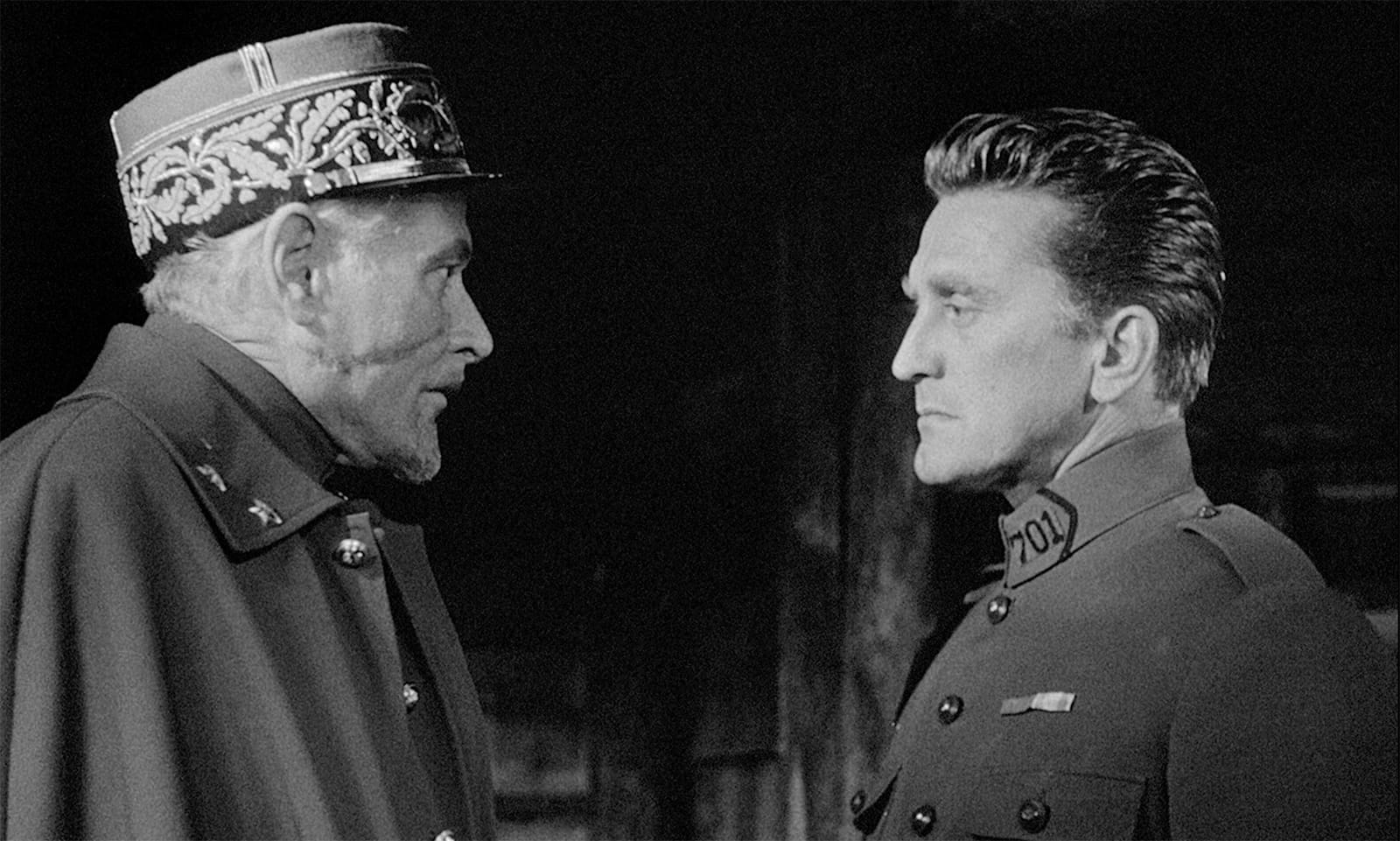
In one important way, however, Paths of Glory is quite atypical of Kubrick. Apart from Spartacus (1960), which also stars Kirk Douglas and over which Kubrick had relatively little control, it’s the only film he directed that has a protagonist with whom the audience can feel a straightforward, unproblematic identification. Colonel Dax, as portrayed by Douglas, is a loyal officer of a corrupt regime, but in most other ways he’s a paragon of heroic virtue. Handsome and brave, he takes the lead in a useless charge on the heavily fortified “Anthill,” picking his way through a withering storm of gunfire, crawling over casualties, and returning to the trench to try to rally reinforcements. Before the war, he happens also to have been “perhaps the foremost criminal lawyer in all of France.” When three enlisted men are arbitrarily selected to be executed for cowardice, he passionately and eloquently comes to their defense. After the executions, he denounces the general in charge in patented Douglas style, body and face contorted and voice pitched somewhere between a sob and a shout: “You’re a degenerate, sadistic old man and you can go to hell before I ever apologize to you again!”
Neither Cobb’s novel nor the theatrical adaptation by Howard is so much like a melodrama—a form Kubrick usually avoided but one basic to the liberal social-problem pictures in which Douglas was interested. Both earlier versions end abruptly with the executions (presented offstage in the play), and in neither does Dax lead a charge across no-man’s-land and serve as defense attorney at the court-martial. Cobb’s description of the attack on the German position, which he calls “the Pimple,” lacks even a trace of heroic spectacle. The film, on the other hand, is a star vehicle, giving Douglas the opportunity for derring-do. It even obeys the unwritten rule of most Kirk Douglas movies after his breakthrough role in Champion (1949): at some point, he will be seen without his shirt, as in his opening scene here, which has no equivalent in the novel or play.
At one stage, the screenplay was even more melodramatic. In his autobiography, Douglas says that when the production moved to Munich, Kubrick tried to reinstate the earlier version of the script by him and Thompson, which ended with a last-minute reprieve of the three condemned soldiers. Douglas flew into a rage and insisted on the version he had originally read. This contained revisions by Willingham, who, before his death in 1995, claimed that he was the author of “99 percent” of Paths of Glory. Actually, the final screenplay retains a good deal of Kubrick and Thompson, plus many important lines from Cobb’s novel. Thompson’s biographer, Robert Polito, shrewdly suggests that in momentarily proposing the other version, Kubrick may have been playing “ego chess” with Douglas, hoping to avoid further buildup of the star’s role. (In an unpublished 1962 interview with Terry Southern, Kubrick admitted there had been a discussion about reverting to the earlier screenplay—which, in addition to saving the three men, makes Dax a more ambiguous character—but denied that he ever seriously intended a happy ending: “There were some people who said you’ve got to save the men, but of course it was out of the question . . . It would just be pointless. Also, [the executions] really happened.”)
Whatever the case, there was a productive conflict between Douglas, who in print has called the director a “talented shit,” and Kubrick, whose lifelong motto might have been “silence, exile, and cunning.” Douglas was a flamboyant personality whose acting style and worldview lent themselves to melodramatic effects, whereas Kubrick was a dark, reclusive satirist who tended to parody or “quote” melodrama, as in such later films as Lolita (1962), Dr. Strangelove (1964), A Clockwork Orange (1972), and Barry Lyndon (1975). Between them, they fashioned a dark, emotionally disturbing film in which Douglas serves as the voice of reason and liberal humanism, tempering Kubrick’s harsh, traumatic view of European history.
The film received extraordinarily favorable reviews and gained Kubrick considerable cultural, if not financial, capital. (Unfortunately, MGM had been right about the European market. Paths of Glory was such a powerful indictment of military arrogance that the French government managed to have it dropped from the Berlin Film Festival and banned in France and Switzerland for two decades.) In a sense, Kubrick had won his battle for authorship, because what most people remember about the film is not so much the heroism of Colonel Dax as the grim photographic grisaille of trench warfare and the execution of three innocent men in the name of patriotic honor.
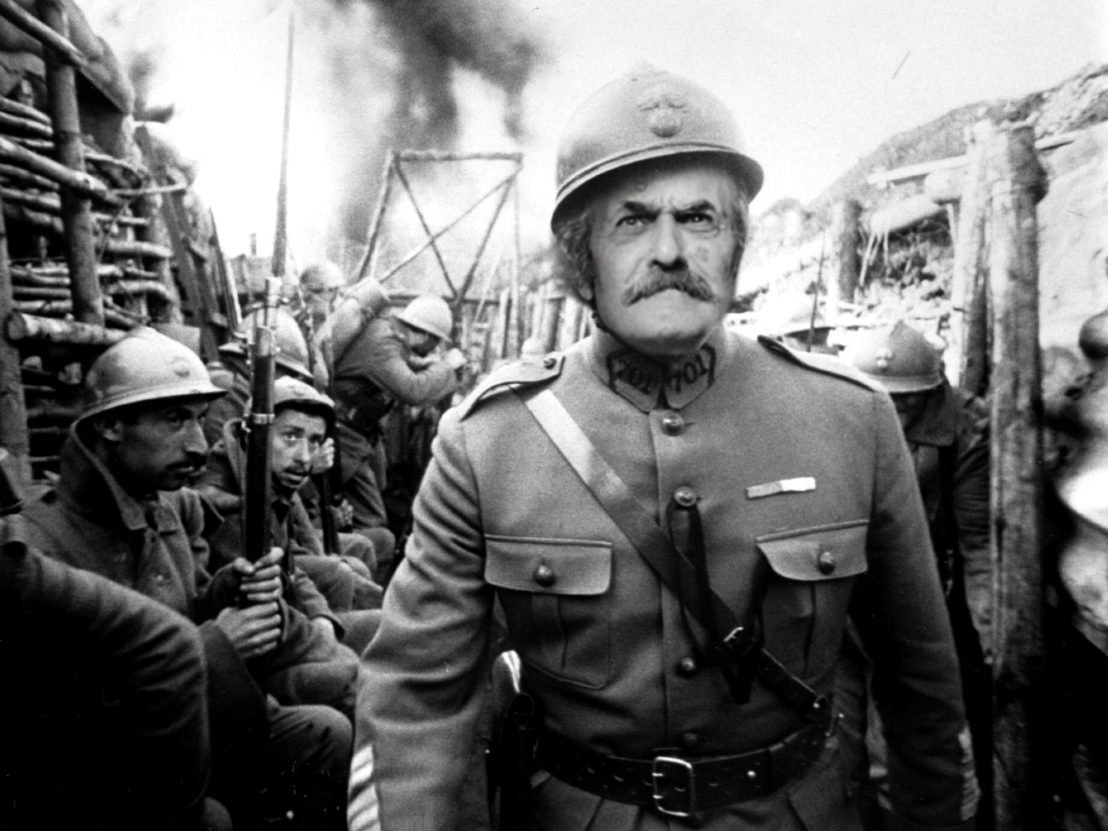
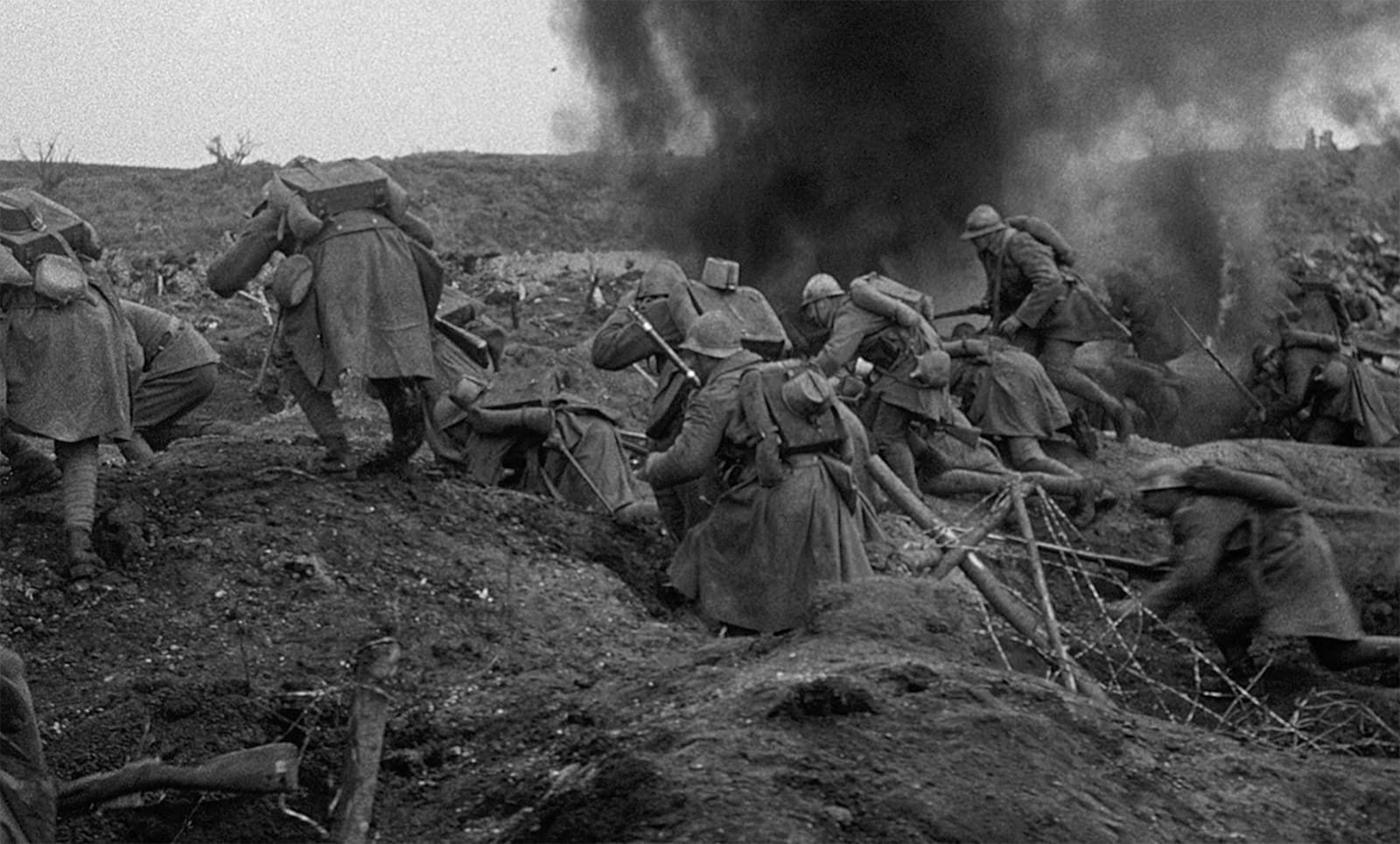
Kubrick is especially good at drawing sharp visual and aural contrasts between the château where the generals plan the war and the trenches where the war is fought. The Schleissheim Palace outside Munich, where much of the action takes place, later became a location for another film that depicts upper-class intrigues amid the architecture of a decadent past—Alain Resnais’ Last Year at Marienbad—and the opening sequence in the palace interior, where Adolphe Menjou suavely manipulates the ramrod stiff but insecure George Macready, was influenced by one of Kubrick’s favorite directors, Max Ophuls, who had died on the day it was staged. The camera dollies around a large room filled with artifacts of empire, engaging in a perversely Ophulsian choreography, while Kubrick, with the aid of cameraman George Krause, draws on his news photographer experience, making good use of natural light, deep-focus compositions, and sonic reverberations. In contrast, the trench warfare involves a signature Kubrick effect: wide-angle, almost phallic tracking shots down a sinister corridor or demonic tunnel. Dax’s march through the trench in preparation for an attack, lasting approximately two minutes and containing eight cuts, is an iconic moment for both the film and the director. Everything is in shades of gray, and the weary men along either side of the trench (played by a German police unit) have a sharply individuated, almost documentary authenticity. Dax walks grimly forward amid the rushing, high-pitched screams of inbound shells and earsplitting explosions that scatter shrapnel. In the penultimate shot, the camera, assuming his point of view, moves through a cloud of smoke in which only a few ghostly figures are visible, as if it were journeying into an underworld where the men are already dead.
The ceremony of execution, seen against the background of the château, gains impact from Kubrick’s deliberate pacing and dynamic manipulation of wide-angle perspectives. The camera advances slowly and inexorably toward the three stakes where the men are tied, and the elaborately drawn-out ritual, staged on a parade ground filled with military and civilian observers, looks obscenely overblown. The château looms like a confirmation of Walter Benjamin’s theory that every achievement of advanced civilization is also a monument to barbarism, but when the shooting happens, its ruthless efficiency and brutality are faced square on, with no picturesque embellishment.
After this horror, the audience is given a moment of relief when the German captive (Susanne Christian, who became Mrs. Stanley Kubrick) sings to a group of rowdy soldiers. The scene was written by Willingham over Kubrick’s initial objection, but its success has more to do with the director’s taste than with the writing. Kubrick avoids sentimentality by virtue of naturalistic lighting, nicely selected close-ups of nonprofessional faces, and skillful modulation from a mood of carnival to a mood of grief. The song, rendered in soft, amateurish fashion, is Frantzen-Gustav Gerdes’s “The Faithful Hussar,” which dates from the Napoleonic period. The French soldiers seem to understand the German lyrics, which end with “Oh please, Mother, bring a light, / My sweetheart is going to die” (my translation). Immediately afterward, Colonel Dax is informed that his troops have been ordered back into action. Gerald Fried’s nondiegetic music picks up Gerdes’s sweet melody, orchestrating it as a military march. The shattering film has offered only a brief nostalgic interlude before the barbaric system reasserts itself.