“Good Cops Are Afraid”
The Toll of Unchecked Police Violence in Rio de JaneiroAvailable In
Brazil: Extrajudicial Executions Undercut Rio Security
Kickbacks and Killings: A Brazilian Cop Tells His Story
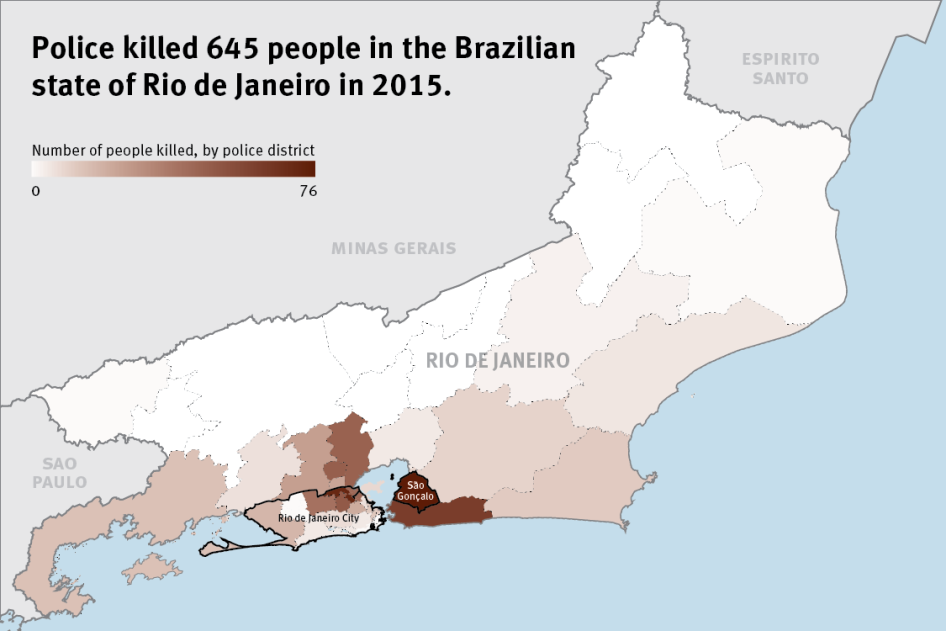
Police in the state of Rio de Janeiro have killed more than 8,000 people in the past decade, including at least 645 people in 2015. One fifth of all homicides in the city of Rio last year were police killings. Three quarters of those killed by police were black men.
The Rio police report nearly all such killings as legitimate acts of self-defense in response to attacks by suspected criminals. Given that police in Rio often face real threats of violence from heavily-armed gangs, many of these killings are likely the result of the legitimate use of force.
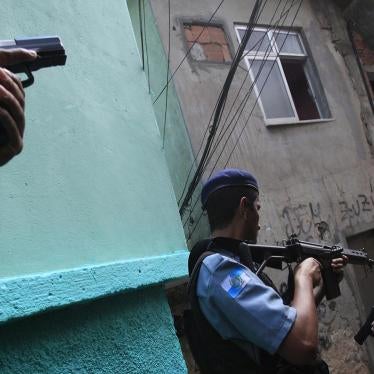
Many others, however, are in reality extrajudicial killings. Police shoot at unarmed people. They shoot people in the back as they are fleeing. They execute people who have been detained with a bullet to the head.
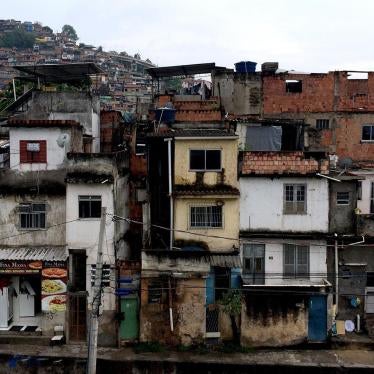
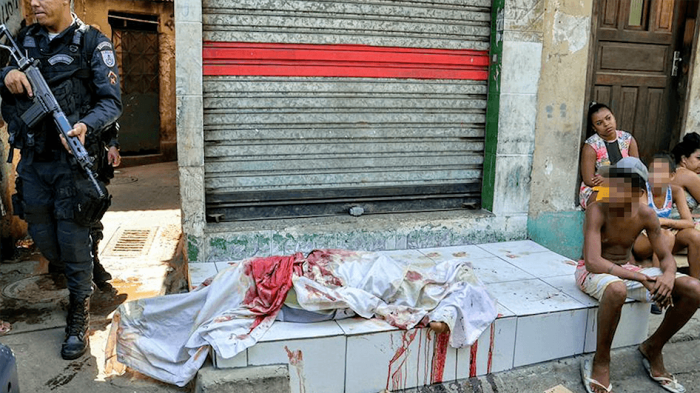
Police officers involved in these unlawful killings routinely seek to cover up their criminal behavior. They threaten witnesses. They plant guns on their victims. They remove corpses from crime scenes and deliver them to hospitals, claiming they were trying to “rescue” them.
Human Rights Watch first documented this pattern of killings and cover-ups in our 2009 report Lethal Force, which exposed 35 cases in which there was credible evidence that police officers sought to cover up unlawful killings. Since then we have documented an additional 29 such cases, including 12 that occurred in the past two years. In these 64 cases, a total of 116 people lost their lives, including at least 24 children.
The 64 cases reflect a much broader problem, according to local justice officials, who told Human Rights Watch that a large number of the “shootouts” reported by police in the state in recent years were in fact extrajudicial executions. Official government data supports this conclusion.
To understand the causes and consequences of these killings, Human Rights Watch conducted in-depth interviews with more than 30 police officers, most of whom serve in favelas—as the city’s low-income neighborhoods are known—with high numbers of reported shootouts. Several recounted their experiences with the use of lethal force; two described participating in extrajudicial executions.
Unlawful killings by police take a heavy toll—not only on the victims and their families—but also on the police force itself. The killings fuel cycles of violence that endanger the lives of all officers serving in high-crime areas, poison their relationships with local communities, and contribute to high levels of psychological stress that undermine their ability to do their jobs well.
The officers responsible for unlawful killings and cover ups are rarely brought to justice. The state’s attorney general, Marfan Martins Vieira, told Human Rights Watch he believed a large percentage of the reported shootouts were “simulated,” but conceded that his office had prosecuted only a “very small” number of police killings. He blamed this failure on the poor quality of the investigations conducted by the state’s civil police.
It is true that, under Brazilian law, criminal investigations are initiated by investigators within the state’s civil police force, and that those investigations have been woefully inadequate. However, responsibility for ending this impunity ultimately lies with Rio de Janeiro’s Attorney General’s Office, which has legal authority to oversee the work of the police investigators, as well as to carry out its own investigations.
After releasing Lethal Force in 2009, Human Rights Watch presented its findings and recommendations in multiple meetings with authorities in Rio de Janeiro—includingthe then-governor, public security secretary, and the attorney general. In the years since, the authorities have implemented several of our recommendations as part of a much broader effort to improve policing in the state.
This broader effort—whose centerpiece was the implementation of a community policing model in high-crime areas—initially showed great promise. The numbers of police killings and overall homicides decreased significantly between 2009 and 2013. But this effort now appears to be unraveling, in large part because the state failed to address what is perhaps the most important factor in allowing unlawful police killings to continue: impunity.
Rio authorities have recently taken several steps to improve how cases involving police killings are handled—including, most notably, the creation of a special prosecutorial unit focusing on police abuse. These measures could have an important impact, but only if the state attorney general and public security secretary take additional steps—outlined in this report—to strengthen them. If, instead, these initiatives are allowed to fall short, it will be very hard for Rio to make real progress in reducing unlawful police killings and improving public security.
Police Officers’ Accounts of Executions
Human Rights Watch’s interviews with more than 30 Rio police officers revealed a routine disregard for international standards, Brazilian law, and internal police regulations governing the use of lethal force. Officers attributed the excessive use of lethal force to a pervasive “culture of combat” and corruption within military police battalions.
Several military police officers recounted their own involvement in violent encounters, including two who told of direct participation in executions. One described his participation in an operation in which a fellow officer executed a suspected drug trafficker as he lay injured on the ground, and said he feared he would be killed if he reported what happened. Another recounted an incident in which he and other police officers set an ambush for suspected gang members, gunning them down as they fled from other officers, then planted guns on their two victims as they lay dead and dying in the street. He also described participating in torture, an abduction, and receiving payoffs from criminals.
Unlawful Police Killings and Cover Ups
Human Rights Watch found substantial credible evidence that many persons killed in alleged shootouts were in fact executed by police officers.
In a majority of the 64 cases we examined, the officers’ accounts of the shootings appeared incompatible with the autopsies or other forensic reports. In at least 20 cases, the autopsy reports detailed gunshot residue patterns consistent with the victim having been shot at point blank range. In other cases, witness testimony or other evidence indicated there was no shootout.
In June 2015, for example, military police reported that they had injured a man in a shootout in the Morro da Coroa favela. The police took the man to the hospital, where he died. Yet an autopsy showed he had been shot seven times, at least once at point-blank range. And a witness at the scene of the shooting reported having seen the victim injured but alive on the ground, hearing a single burst of gunfire shortly after the police arrived, and three hours later seeing police take the victim’s lifeless body away.
While it is impossible to determine the precise scope of extrajudicial executions by police, official government statistics are consistent with the view of local criminal justice officials that the practice is widespread. The high number of police killings—more than 8,000 since 2006—is all the more dramatic when viewed alongside the comparatively low numbers of non-fatal injuries of civilians and police fatalities in those same incidents or areas of operation. This disparity suggests that in many cases police report killings as the result of armed confrontations that did not happen.
For each officer that died while on duty in Rio in 2015, police killed 24.8 people, a rate that is more than double that of South Africa and triple that of the United States. The disparity was even more dramatic in the 10 police districts with the highest number of reported “shootouts”: the police units in these zones were responsible for 483 killings in 2015 while suffering 15 police fatalities. Moreover, Rio police killed five people per each person they injured from 2013 to 2015, the reverse of what one would expect.
In the 64 cases we documented, police officers sought to cover up the criminal nature of the killings. One common technique was to remove a shooting victim’s corpse from the crime scene, deliver it to the hospital, and claim that the removal was an attempt to “rescue” the victim. These false “rescues” serve to destroy crime scene evidence while providing a veneer of good faith on the part of the police.
In some cases, police officers forged evidence by placing a gun in the victim’s hand and firing it, or planting drugs on the victim. Some officers threatened witnesses to discourage them from reporting what they have seen. In a case from July 2011, for example, police officers tortured and killed the 14-year-old son of the witness of an earlier execution in the Salgueiro favela as a means to intimidate her, according to prosecutors.
Impunity for Police Killings and Cover Ups
Only eight of the 64 cases that Human Rights Watch examined went to trial, and only four cases ended with convictions of police officers involved in the killings. In 36 of the 64 cases, prosecutors did not even seek indictments despite credible evidence that the police sought to cover up an unlawful killing.
All the state justice officials with whom Human Rights Watch spoke—including the attorney general—said police officers responsible for unlawful killings are rarely brought to justice. Official data lends support to their assessment, though a lack of up-to-date and reliable information makes it difficult to determine the precise scale of this impunity. The Attorney General’s Office reported to Human Rights Watch that it had filed charges in only four—or one-tenth of one percent—of the 3,441 police killings recorded between 2010 to 2015 (though in fact we documented 15 cases from these years in which prosecutors filed charges). The most recent state-wide study of prosecutions of police killings, coordinated by Michel Misse, a professor at Rio de Janeiro´s Federal University, found that of all the killings by police that occurred in 2005, prosecutors had, by 2007, filed charges in less than 1 percent.
Police investigators routinely fail to conduct proper inquiries into police killings, disregarding basic tenets of homicide investigation. In 52 of the 64 cases we examined, there was no record of the police investigators ever having conducted a crime scene analysis. Often they do not question all police officers involved in a killing, do not seek out and interview non-police eyewitnesses, and do not conduct basic forensic tests.
Brazil’s Constitution grants the Attorney General’s Office the legal authority to exercise “external control” of the police forces. This includes making sure the civil police conducts thorough and professional investigations when there is evidence that police themselves have committed crimes. Prosecutors have several tools at their disposal to ensure that police conduct more thorough investigations—from institutional pressure, to referral of officers who fail to conduct or impede investigations for disciplinary action, to, in extreme cases, criminal prosecution for malfeasance. Yet Rio’s Attorney General’s Office has consistently failed to use these tools and fulfill its constitutional responsibility.
Where civil police do not conduct adequate investigations, moreover, the Attorney General’s Office has the power to conduct its own independent inquiries, hear witnesses, and obtain evidence. However, the Attorney General’s Office has rarely used that power to investigate police killings.
Prosecuting police killings in Rio is possible, as was demonstrated in São Gonçalo, the state’s second largest city, between 2008 and 2001, when a judge, a prosecutor, and civil police officers made a concerted effort to address the issue. Prosecutors filed charges against 107 military police officers—about 15 percent of the troops in the military police battalion in São Gonçalo during that period. The number of police killings in the city subsequently dropped by 70 percent. Some police officers had warned that this effort to promote accountability would impede police work and result in a rise in crime, but the number of robberies and overall homicides in São Gonçalo also declined. Progress came to a halt when the judge was murdered by some of the police officers who were facing prosecution. In the absence of accountability, the number of police killings climbed again and is now higher than in 2008.
Toll of Police Killings on Law Enforcement
To serve as a military police officer in Rio can be extremely dangerous, largely due to the heavily-armed and violent criminal gangs that operate in many of the city’s low-income neighborhoods. Officers interviewed by Human Rights Watch described having to face these gangs with poorly-maintained weapons and vehicles, as well as inadequate training that leaves them unprepared to respond to life-threatening situations.
Illegal killings by fellow officers make an already dangerous job even more so. One reason, police officers said, is that gang members are less likely to surrender peacefully to police when cornered if they believe they will be executed while trying to surrender or once in custody.
Unlawful killings may also stoke anti-police sentiment, which may motivate criminals to kill police whenever they have the opportunity, even targeting officers who are off-duty. Several officers told Human Rights Watch that they avoid public transportation and do not carry their police identification while off-duty. The fear of being recognized as police officers during robberies, and killed, pushes officers to draw their guns quickly if they happen upon a robbery while off-duty, even if they are facing several criminals alone, police officers told Human Rights Watch. Some police officers are killed in the ensuing shootouts, which explains why one in six people killed during robberies in Rio is an off-duty police officer.
Unlawful police killings have another, more immediate impact on police units: the perpetrators’ fellow officers must choose between keeping quiet and even participating in the cover up—and thus breaking the law themselves—or speaking up and facing reprisals that can be deadly.
Two police officers told Human Rights Watch that they felt pressured by superiors to participate in unlawful killings. The Disciplinary Code of the Military Police of Rio de Janeiro offers them little choice but to comply if that pressure takes the form of a direct order: it does not protect a police officer who refuses to obey illegal orders.
The biggest disincentive to reporting or objecting to their fellow officers’ crimes is the threat of death at the hands of the officers involved in misconduct. Several members of the military police told Human Rights Watch that they would not report fellow officers for fear those officers would kill them or attack their families.
Participation in unlawful killings or cover ups with impunity may also have an insidious impact on police officers’ overall conduct. Rio officers who can successfully rationalize their own misconduct may find it easier to cross the line the next time. They may also be more likely to engage in corruption and other crimes, several officers said.
Multiple studies have found that Rio’s military police officers suffer from very high levels of psychological stress. And yet, in Rio de Janeiro, mental health care for military police officers is very limited. Some 70 psychologists provide counseling to the 48,000-member military police—a ratio of 1 for every 686 officers—and there are no psychiatrists. Very few officers see a psychologist after participating in a violent encounter.
Police abuses also undermine public security by driving a wedge between the community and the police. The current difficulties faced by the community policing units—called Pacifying Police Units (UPPs)—show how mutual mistrust opens the door to an increase in violence. UPPs led to a decrease in crime and police killings initially, but unlawful killings and other police abuses have played a central role in the unraveling of the project.
Key Recommendations
Authorities in Rio de Janeiro have recently taken important steps to address the problem of police killings. In addition to the creation of the special prosecutorial unit focusing on police and prison abuses—called the GAESP—civil police are now assigning cases of police killings to its three homicide divisions, and military police have instituted a pilot program to outfit military police with “body worn cameras.”
These steps, while welcome, fall far short of what is needed to end impunity for unlawful police killings and cover ups, and break the cycle of violence that has prevented Rio’s police from properly protecting the communities they serve.
Ending Impunity for Unlawful Police Killings and Cover Ups
Rio de Janeiro’s Attorney General’s Office should:
- Assign more prosecutors to the GAESP.
- Provide the GAESP with technical support from forensic experts.
- Seek commitment by civil police to inform the GAESP of police killings within 24 hours.
- Authorize GAESP prosecutors to intervene in the investigation of all police killings in the state.
- Instruct the GAESP to visit the sites of police killings.
- Instruct the GAESP to pursue vigorous investigations and prosecutions of cover ups.
- Instruct the GAESP to exercise effective oversight over civil police investigations.
The civil police should:
- Improve the quality of the homicide divisions’ investigations.
- Alert the GAESP of cases involving police killings immediately.
- Investigate evidence of cover ups by police.
- Grant homicide divisions the authority and resources necessary to investigate all police killing cases in the state.
The military police should:
- Implement its body-camera project throughout the state.
- Apply protocols and operating procedures in its body-camera project that promote transparency while also protecting privacy.
Brazil’s Congress should:
- Approve a bill, 4471/2012,that seeks to improve investigations of killings by police nationwide.
Improving Working Conditions for Military Police
The military police should:
- Provide psychological support for police officers after shootouts.
- Identify and address other factors causing undue stress to police officers.
Related Content
July 7, 2016 News Release
Brazil: Extrajudicial Executions Undercut Rio Security
Police Killings Persist as Summer Olympics Approach
July 14, 2016 Witness
Kickbacks and Killings: A Brazilian Cop Tells His Story
August 11, 2016 Commentary
What Olympic Fans Won’t See in Rio de Janeiro
Methodology
This report is based largely on 88 interviews carried out in Rio de Janeiro from November 2015 to May 2016, including interviews with 34 current and former military and civil police officers, as well as families of victims, prosecutors, forensic experts, public defenders, academics, and members of non-governmental organizations.
We also examined 64 cases where there was credible evidence that the police had sought to cover up an unlawful killing. These include 35 cases originally documented in the 2009 Human Rights Watch report Lethal Force[1]—most of which occurred between 2006 and 2009—and 29 cases that came to our attention since then, nearly all of which occurred since 2010, including 12 from the past two years.
In the vast majority of these cases we obtained the case files—including statements by police officers and witnesses, and autopsy and other forensic reports—from prosecutors, public defenders, and defense lawyers. In some cases we also interviewed the families of the victims and witnesses, as well as civil police officers who investigated the cases and military police officers who had direct knowledge about what happened.
In addition, we analyzed state data, some publicly available and some that the Public Security Institute, a Rio de Janeiro state entity, provided to Human Rights Watch upon request. We reviewed academic studies, reports, and other documents as well.
Most low-ranking military police officers whom we interviewed requested that their names not be used for fear of being disciplined by their superiors for their comments. Four military and civil police officers who talked about illegal activities within the police, including corruption, torture, and executions, asked us to withhold their identities for fear of being attacked or killed by fellow officers.
We also withheld the names of some victims and favela residents for security reasons. Where we have used pseudonyms, we have indicated so in the relevant citations.
All interviewees were informed of the purpose of the interviews and that their interviews might be used publicly. No incentives were offered or provided to persons interviewed. The interviews were conducted in Portuguese.
During the research, we visited three Pacifying Police Units (UPPs)—military police units based in favelas—a military police battalion, and two civil police stations within Rio de Janeiro’s metropolitan area.
I. Police Officers’ Accounts of Executions
Human Rights Watch’s interviews with more than 30 Rio police officers and the 64 cases we reviewed revealed a routine disregard for international standards, Brazilian law, and the military police’s internal regulations that govern the use of lethal force. Some officers attributed the excessive use of lethal force to a pervasive “culture of combat” and corruption within military police battalions.
Several military police officers recounted their own involvement in violent encounters. Two military police officers interviewed separately by Human Rights Watch admitted participating in executions. Both said that the use of unlawful force was routine within battalions in which they worked. They also gave details of widespread corruption–one of them admitted benefiting from it–and accused higher-ranking officers of taking kickbacks from drug traffickers.
Both said they feared being killed if identified. Human Rights Watch has withheld their identities and some details of the situations they described to preserve their anonymity. Both were serving as mid-ranking military police officers at the time of the interviews, in late 2015 and early 2016, respectively.
Danilo
Danilo’s first deployment after military academy was in a battalion in a high-crime region of Rio de Janeiro’s metropolitan area. Danilo graduated in the last ten years. (We have withheld the exact date to preserve his identity.)
Killing suspected gang members was a routine practice in the battalion, he said.[2] “Killing criminals was required as good performance by my superiors,” he said. As an example, Danilo recalled witnessing a high-ranking official scolding a lieutenant for detaining a man who had an assault rifle instead of killing him. “There cannot be a man alive with an assault rifle,” he recalled the official saying.
Danilo said that the objective of some operations he participated in was to kill suspected drug traffickers because officers believed that was necessary to fight crime, while in other instances, officers carried out killings to further their own corrupt activities. Danilo said that some police officers kidnapped traffickers, obtained ransom, then killed them. Some police officers also executed people to become known among traffickers as killers and thus be able to extort more money from them, Danilo said.
In other cases, he recalled, officers accepted money from traffickers in return for allowing them to operate unmolested by law enforcement. Typically, those directly involved with drug traffickers were low-ranking officers, while higher-level officers “squeezed” the lower-ranking officers to get a cut, Danilo said. Every week, his police battalion would get about 120,000 reais (about US$34,000) from drug traffickers operating in dozens of favelas, he said. “The money is to keep us from going into the favela, or to warn them before entering,” he said. That’s an arrangement common enough in Rio de Janeiro that it has a name: “the fix” (“o arrego”).
Danilo admitted he participated in several operations in which the police executed injured suspected gang members, and he described one of them to Human Rights Watch. It occurred in the last three years, when a group of police officers entered a favela in the north of Rio de Janeiro. The reason for the raid was to kill drug traffickers and confiscate their weapons, Danilo said. That would demonstrate that crime was strong in the area and thus explain the high robbery rates, which the battalion was under pressure to reduce, he explained.
While most of the police officers left the favela after the operation, a small group stayed behind, hidden in a house, a strategy that police call “Troy,” in reference to the famous ruse used by the ancient Greeks. They chose the house because it had line of sight to a point of sale of drugs. They waited for someone to appear with an assault rifle, but it got late, and they decided to attack several men who had handguns and were surrounded by drug users. Without any warning, the police officers, including Danilo, fired their assault rifles from a distance. They killed one of the armed men, and another fell to the ground, injured. The police officers approached the injured man, and one of them and killed him as he lay on the ground, Danilo said.
“I did not report what happened because I was afraid of being killed myself. Those people have no scruples,” he said of his fellow police officers. He also feared corrupt police officers would kill him because he did not bring drug money to his superior officers. He eventually obtained a transfer out of the battalion, but his fear persists.
In Rio de Janeiro, Danilo said, “the good cops are afraid.”
João
João is a military officer with experience in several battalions in Rio de Janeiro’s metropolitan area.[3] He joined the force because it offered a good career path, good retirement benefits, and an adequate salary, he said.
For a while, João was a member of a tactical unit within a battalion—a Tactical Action Group (GAT, Grupamento de Ações Táticas). “To remain a member, you have to kill and confiscate weapons,” he said. João described to Human Rights Watch several operations whose objectives were not to detain suspects but to kill them, including one employing the “Troy” ruse described in Danilo’s account just above. In one action in the last three years, they used a private car to approach a favela. They lay down in the foliage in an area they knew to be an escape route for suspected drug traffickers, while another group of officers entered the favela from the opposite side. Shortly after, two men fled toward them. The police opened fired, killing one instantly, while the other fell to the ground with several gunshot wounds.
One of the officers then went to get guns to plant on the suspects. (João said he did not know where he got them.) Meanwhile, the rest of the police waited, without providing help to the injured man. “We wanted him to die there,” João admitted. Once they had the new guns, they fired some shots with them and placed them in the hands of the suspects. After a while, local residents started congregating around them, and they decided to leave. They threw the injured man into the back the car and the dead man on top of him. They got to the hospital about an hour after the shooting, he said, whereas they could have been there in about 20 minutes if they had left right away. The man died at the hospital.
The approximately eight police officers who participated in that operation went to the civil police station afterwards, but only two gave statements. That was their standard procedure after they committed unlawful killings: only two of the officers would report participating in a shootout. They would alternate which two so that none would accumulate a larger record of kills that might appear suspicious. “The civil police do not ask every person who shoots a weapon to give a statement,” João said. The two police officers told the civil police that they were attacked when they entered the favela and shot back in self-defense, the same narrative they used for all killings, João explained.
In another operation in a favela in 2014, João and some fellow military police officers entered a house chasing “three or four” youth who had fled upon seeing the police. João believes they were about 18 years old. “They were very young,” he said. There were two “girls” with them, João explained. The police officers found two guns hidden in the house and believed there could be more. To get the young men to talk, they tortured them, João told Human Rights Watch. (They did not torture the girls.) They took them, one by one, to a separate room, and placed an empty ice bag over their heads to asphyxiate them. (A regular plastic bag would not work because victims can tear them with their teeth, João explained.) They kicked them in the ribs, beat them in the face, and pepper-sprayed them. “We did not use electric shocks because we did not have the gadget”used to apply them, João said. None of the men revealed the existence of more weapons, and after 20 or 30 minutes of torture, the officers took them to the civil police station, where they were charged with the possession of the two guns. “We were not afraid that they would accuse us (of torture) because we did not leave any marks, and it would be their word against ours. They were happy to be alive,” João said.
João described another torture session, involving a man believed to have killed a woman for being friendly to the police during a police operation in a favela. Police officers found the man in his house and proceeded to beat him so severly until he “did not have strength even to shout,” João said. . “The torture was not to obtain information” but to punish him, João said. The session lasted about an hour.
It might seem that João took the law into his own hands in the belief that his mission was to put an end to crime, but the truth is murkier than that. At the time, João was taking kickbacks from drug traffickers. The “arrego”—or payments—arrived regularly at the dormitories of the battalion where he served. Drug traffickers paid up to more than 2,000 reais a day (about US$600) to each of the police officers on duty over the weekend, he said. The payments were in exchange for not conducting operations in favelas, João said. Of the two successive commanders who were in charge of the battalion while he was there, one took drug trafficking money, while the other did not, he said.
João also told Human Rights Watch that a member of a drug-trafficking gang approached him to betray the drug trafficker’s boss. The man’s objective was to enrich himself and climb the crime ladder. João, in cooperation with other military police officers, agreed to kidnap the drug boss. They stopped the car that the boss was riding in and took him to an area not covered by public cameras. They obtained a ransom of money and jewelry for his release, which they split among those participating in the plot, including the member of the gang who betrayed his boss. The officers released the hostage unharmed, João said.
“We were virtually a 157 gang,” João said, in reference to article 157 of the Penal Code, which codifies robbery.
João works in a different military police battalion now. He said he would not tell on his former fellow officers. “They would not think even a millisecond before killing me or my family,” he said.
II. Unlawful Police Killings and Cover Ups
Police in Rio de Janeiro state have killed more than 8,000 people during the past decade, according to official statistics.[4] While the number of officially recorded killings decreased after a peak of more than 1,300 in 2007 to around 400 in 2013, the number has risen since then. In 2015 alone, officers killed at least 645 people. In the capital city of Rio de Janeiro that year, police committed one in five of all homicides.[5]
The state military police, the 48,000-strong force that patrols the streets, are responsible for the vast majority of killings, while the state civil police, the 9,000-strong force that investigates crimes, carried out the rest, according to official data obtained by Human Rights Watch.[6]
In nearly all such cases, police report the killings as legitimate acts of self-defense in response to gunfire by criminal suspects. However, close analysis of case files, statements by officials, and official statistics strongly suggests that a substantial portion of these cases are in fact extrajudicial executions.
Brazilian law governing use of force by police personnel dictates that they should only use “necessary means with moderation” in reaction to an “unjust attack, current or imminent,” against themselves or someone else. This is substantially in line with international human rights standards, which provide that any use of force should be proportionate to the threat confronted. Police officers in Rio de Janeiro often face real threats of violence from members of criminal gangs, and many reported shootout deaths are likely the result of legitimate use of force by officers during confrontations.
Nonetheless, Human Rights Watch obtained credible evidence in 64 cases—involving 116 fatalities, including at least 24 children—that the police had sought to cover up unlawful killings.These include 35 cases originally documented in the 2009 Human Rights Watch report, Lethal Force, and 29 cases that occurred or came to our attention since then, including 12 in the past two years. (Amnesty International documented an additional nine cases of police killings, which occurred in the Acari favela in 2014, in which the organization concluded there was credible evidence that police committed extrajudicial executions, for instance, by killing people who had already surrendered or were fleeing.[7])
The pattern of unlawful police killings revealed by the cases we studied remains the same as the one documented in the 2009 report. In some of these cases, the evidence indicates that the killing occurred after an alleged shootout had ended. In others, the evidence shows that no “shootout” took place at all.
These cases of police officers falsely reporting extrajudicial executions as legitimate killings are not isolated incidents. Senior officials within Rio state’s criminal justice system told Human Rights Watch that a large portion of reported police killings fit the pattern.
Moreover, and as discussed in more detail below, the ratio of people the police have killed in alleged shootouts to the number of people people injured gives further reason to believe that a significant number of police killings in Rio state are extrajudicial executions.
Unlawful Police Killings
In 32 of the 64 police killings that Human Rights Watch examined, police reports saying the individuals shot by police were killed in a shootout appear to be inconsistent with forensic evidence. For instance, in at least 20 cases,gunshot residue patterns on the skin of victims indicates shots were fired at point-blank range (from a distance of less than 50 centimeters),even though such close range shots are not typical of shootouts.[8] For example:
- On July 10, 2014, military police officers belonging to the Special Police Operations Battalion (BOPE), an elite unit, in the Morro do Faz Quem Quer favela, shot Carlos Diego Santos da Silva, and transported him to a hospital, where he was reported dead. The officers claimed that they had opened fired after being shot at by a group of gang members, da Silva had died in the shootout. Yet according to da Silva’s autopsy report, he suffered three shots at point-blank range, one in the back and two in the chest, close to each other. The shots hit his heart, liver, and lungs, and severed his spinal cord.[9]
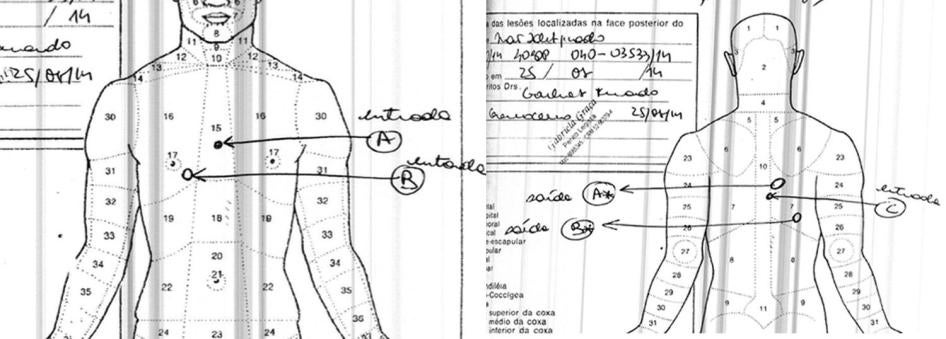
- Police officers reported that on June 14, 2012, they injured Jackson Lessa dos Santos, 20, in the Fogueterio favela, and transported him to a hospital, where he was registered as dead on arrival. The police said they had responded to gunfire from a group of armed men. The autopsy report says that dos Santos was killed with a shot to the nape of the neck at point-blank range.[10]

- Military police officers killed Francisco Gomes de Oliveira, 32, in a supposed shootout in the Complexo do Alemão favela on March 11, 2009. They took him to the hospital, where he died, they said. He was shot twice in the back, once from less than 50 centimeters (20 inches) away.[11]
Lethal Force documented similar cases. In several of them, autopsy reports show gunshot entry wounds at the back of the head or nape of the neck, injuries that would seem unlikely in most shootout situations but are consistent with executions. For example:
- On June 27, 2007, during operations aimed at securing the city in advance of the July Pan-American Games, police killed 19 people in the Complexo do Alemão favela in what they claimed were shootouts.[12] Five of the 19 suffered shots at point-blank range. Two of the 19 people killed suffered shots exclusively from behind, and nine others were shot in the back as well as in other places (four of them in the back of the head or neck).[13] At least two of the victims were shot while lying flat on their backs.[14] A forensics panel appointed by the federal government concluded that “several of the deaths were the result of a procedure of summary and arbitrary execution.”[15]
- Military police officers killed 17-year-old Maykon S. Pereira Lima on June 16, 2007, in a supposed shooutout. Lima was shot six times, twice in the back and once from less than 50 centimeters (20 inches) away.[16]
- Military police officers killed Michael Pereira Motta, 21, and Reinaldo Ferreira, 18, on February 14, 2008, in an alleged shootout. Both victims were shot once. Motta was shot in the back, and Ferreira was shot at a range of less than 50 centimeters (20 inches).[17]
Besides forensic evidence, witness accounts also contradict police reports of what happened in some cases. In at least 14 of the 64 cases that Human Rights Watch reviewed, witnesses described police killings in terms that, if accurate, would make them extrajudicial executions.
Recent cases in which witness evidence suggests that an extrajudicial execution occurred include:
- Morro da Coroa favela, members of BOPE shot three men who they said had shot at them.[18] The officers told civil police investigators that they took the three men to a hospital after a BOPE paramedic said they were still alive. One survived.
In a statement made to civil police officers investigating the case, a witness said she saw one of the victims, “Antônio,” 28, alive, lying on the ground. She did not notice any injuries, but he told her he had a head injury; he explained to her that he had told the police he was merely a resident of the favela, but they had still shot at him. The police dispersed the neighbors who had congregated around Antônio. As the witness was leaving the area, she heard many shots; she believes this was the police killing Antônio. More than three hours later, she saw the police put the bodies of Antônioand another man in the trunk of a truck and throw the surviving man on top of them. The registry from the hospital records Antônioas dead on arrival. A medical report included in the case file shows at least one of his wounds had an abrasion ring, indicating point-blank range. The forensic report said Antônio was shot seven times. The witness told civil police investigators that police officers threatened that “they would come back to do the same” to any resident who testified against them.[19]
Lethal Force documented similar cases. For example:
- In December 2006, two civil police officers said that they shot “Roberto,” age unknown, in self-defense during a firefight between them and a group of four men to which Roberto belonged.[20] The police officers said that Roberto was injured and that they tried to save his life by taking him to a hospital.[21] However, the mother of Roberto’s girlfriend told Human Rights Watch that she saw police shoot him while he was kneeling and had his hands up in surrender, begging for his life.[22] It is not known whether Roberto died at the scene of the shooting or at the hospital.
The spread of patrol car and cell-phone video has brought to light a number of cases in which officers appeared to open fire without justification on people who were unarmed and who did not appear to pose any threat to the officers. For example:
- On August 2, 2014, two police officers in a patrol car equipped with a video recorder saw a car that they considered suspicious. They said they turned the siren on to order the driver to stop, but he did not. One of the officers opened fire, killing 22-year-old Haíssa Vargas Motta. Police later claimed they fired after they heard a gunshot, but no gunshot is heard in the video and the police officers do not mention any gunshot in the recording. The people in the car were unarmed.[23]
- On February 20, 2015, police officers killed Alan de Souza Lima, 15, and injured Chauan Jambre Cezário, 19, in the Palmeirinha favela. The two officers involved said they opened fire in response to an attack by “criminals” and that they confiscated two handguns. Cezário was accused of resisting arrest and of illegal possession of a weapon. Five days later, a news outlet published a video of the wounding of Cezário and the killing of de Souza Lima, recorded on de Souza Lima’s own cell phone. It shows the youths playing and then running, and then comes the sound of a single burst of shots. No other shots that might indicate a shootout are heard. In the video, a police officer asks the injured Cezário why they ran. “We were playing,” he says. A second video, recorded by the camera in the police car, shows the boys running away and not shooting at the police, and one of the two police officers firing from inside the car.[24]
Police Cover Ups
After fatal shootings by police, officers routinely manipulate, disrupt, or fail to preserve evidence that is vital for determining whether the killing was lawful. Human Rights Watch documented the repeated use of several tactics to cover up misconduct and suppress information. These include false “rescues,” the planting of evidence, and witness intimidation.
False “Rescues”
Some police officers in Rio de Janeiro routinely remove the bodies of people killed by police from crime scenes and deliver them to hospitals in what they claim are “rescue” attempts. While these false “rescues” give the appearance of legitimate effort by officers to help victims, in reality they destroy crime scene evidence and hinder forensic analysis.
Of the 32 cases Human Rights Watch examined in which police took a shooting victim to the hospital, the victims were dead on arrival in at least 27.
Police officers in Rio de Janeiro do not typically provide medical assistance or transport to the hospital for people in any context other than police killings, whether the incident involves a traffic accident or an attempted homicide, several police officers and a prosecutor told Human Rights Watch. Instead, police call medical services and preserve the site.[25]
Military police officer João told Human Rights Watch that the job of police is “to call emergency services” when they encounter victims of traffic accidents or an attempted homicide because police are not trained to provided medical help. At the same time, he told Human Rights Watch of an instance in which he carried out an extrajudicial execution with his unit, planted guns on the two people they had just shot, and waited 40 minutes to take them to the hospital. (One was already dead and the other died at the hospital, he said.) In that case, transporting the victims to the hospital was an attempt to hide what really happened, he said.
In July 2015, the military police command signed an agreement with the state Attorney General’s Office whereby it promised to establish rules about how to provide assistance to people shot by police by December 2015.[26] The agreement said that those rules should establish that medical emergency services should transport the person injured to the hospital. Only in cases when that is impossible could police officers take a person they had shot to the hospital, and the officers should arrange for a relative to travel along whenever possible.[27] By June 2016 the military police command had not yet designed these rules.[28]
In many of the cases that Human Rights Watch examined in which police took people they had shot to the hospital, they were not only declared dead on arrival, but autopsy reports indicate that the wounds were so severe that the victims most likely died at the scene.
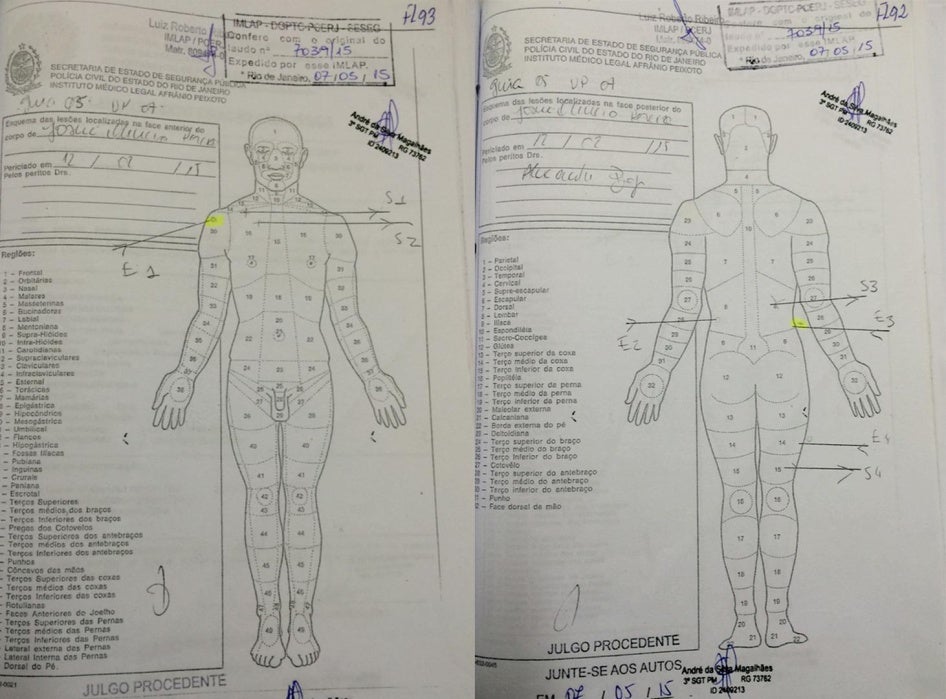
- On February 11, 2015, two officers belonging to BOPE reported on an incident in which they said they had come under fire in the Fallet favela. The officers said they shot back, from a distance of 5 meters (more than 16 feet), and injured Josué Oliveira Pereira, 21. They said they took Pereira to a hospital in a BOPE ambulance after a BOPE paramedic confirmed that he was still alive. The officers said Pereira was alive when he arrived at the hospital, but hospital records show he was already dead. The autopsy report concludes that Pereira was shot four times and that two of the shots, from a distance of 15 centimeters (six inches), were lethal.[29]
Removing Clothes
In some cases, police fail to safeguard the clothing of people they kill, thereby depriving investigators of a key form of evidence. Items of clothing, for instance, may contain traces of soot that could reveal that a shot was fired at close range or bullet fragments that could determine the caliber of the projectile and thus the weapon that shot it.[30] It is usually not possible to determine whether victims’ clothes have been discarded before, during, or after a victim’s body was taken to the hospital (or perhaps by the hospital itself). But what is clear is that some of those who are subject to purported rescue attempts arrive for their autopsies naked.
- In the 2015 killing of Antônio in Morro da Coroa, the witness who saw Antônio after police shot him said he was wearing a shirt and jacket. However, the autopsy report notes that his body came without a shirt or jacket.[31]
- In the 2007 Complexo do Alemão case, photographs show that at least 17 of the 19 persons killed by police were wearing clothes at the scene after they had been shot and were in police custody.[32] However, all 19 victims arrived naked for the autopsy.[33]According to a federal panel of forensics experts commissioned to study the reports in the case, “the original garments [of the victims] were not subsequently sent for [forensics] examination.”[34]
Planting Evidence
In addition to removing victims improperly, some police officers alter crime scenes in other ways before forensic teams arrive (if they arrive at all).
Officers sometimes fabricate evidence of shootouts by placing a gun in the victim’s hand and firing it. They also sometimes remove evidence of an unlawful killing or plant fake evidence of criminal behavior, such as drugs.
- In the 2012 killing of Jackson Lessa dos Santos in Fogueterio, police claimed they had responded to gunfire from a group of armed men, and that dos Santos had been carrying drugs and a gun. However, a witness told police investigators that she saw Lessa dos Santos dead on the ground and watched police officers wearing medical gloves place a gun in his left hand and shoot it. They also put a backpack on him, she said. [35]
- On November 28, 2015, military police officers killed Roberto de Souza Penha, 16; Carlos Eduardo da Silva Souza, 16; Cleiton Correia de Souza, 18; Wilton Esteves Domingos Júnior, 20; and Wesley Castro Rodrigues, 25.In their statements to civil police investigators, the police officers said they opened fire on the car the youths were riding in after one of the youths shot at them out of the window. But two witnesses said to civil police investigators that they saw one of the officers, wearing a glove, place a gun in the hand of one of the bodies. Forensic experts concluded there was no gunpowder residue in the hands of any of the five young men killed.[36]
- On September 29, 2015, military police officers killed Eduardo Felipe Santos Victor, 17, in the Morro da Providência favela. They said he died in a shootout and had a radio transmitter, munition, and a gun. However, a video, shot surreptitiously by a neighbor, showed the child bleeding heavily into the ground, while a police officer shoots in the air with his gun to make it seem like the child was wounded in a shootout. Another officer puts a gun into the boy’s hand and fires twice. The officers then spend five minutes moving the body and otherwise altering the crime scene. At no time do they give medical assistance to the boy. A witness told Brazilian media that Victor had not shot at the officers and tried by raising his hands, but they still fired at him. Forensic experts concluded there was no shootout.[37]
Intimidating Witnesses
In some of the cases reviewed, Human Rights Watch found that police officers who appear to have carried out extrajudicial executions allegedly threatened witnesses, and in one case faced criminal charges for killing a witness’s son. Such threats create a pervasive fear of testifying against the police, which makes it hard to hold police officers accountable for abuses.
- On July 29, 2011, police officers killed 14-year-old Anderson Matheus da Silva. They claimed they killed him during a shootout and said they found a gun, ammunition, and marijuana on him. However, an investigator who worked on the case told Human Rights Watch the military police officers went to the Salgueiro favela looking for a woman who was a witness in the case of their alleged execution of 18-year-old Diego Beliene.[38] They found da Silva, the woman’s son, and tortured him to reveal where his mother was, according to the investigator. When they were finished, they allegedly killed him with three shots from an assault rifle.[39]
- On November 2, 2008, police officers chased three armed men up a street in the middle of backed-up traffic, according to the case file. The officers shot at the running men but hit “Douglas,” a 31-year-old man who was driving a van used for public transportation, according to a statement made by a witness and included in the case file. The officers said they took Douglas, who was hit in the head, to the hospital, where he died. The witness said he saw the officers altering the crime scene to make it appear that one of the fleeing men had killed Douglas. One of the officers told the witness that he knew him, and warned: “Watch out what you say, because I can find you on the street.”[40]
- Witnesses reported being threatened by police investigators in the killing of “Cesar” in 2008. According to police, Cesar was riding a bus with a gun in his possession. During the bus ride, a military police officer boarded the bus and walked toward Cesar.[41] According to one of Cesar’s friends who said he witnessed the incident, the officer drew his gun and shot Cesar in the neck while simultaneously reaching for the gun on Cesar’s waist.[42] In the police report, the officer said Cesar started reaching for the gun as he approached and then the officer shot him. After the shooting, three of Cesar’s friends were detained and taken to a civil police precinct. The officer did not secure any corroborating eyewitnesses on the day of the shooting even though it happened in the middle of the day on a public bus.[43] Cesar’s three friends later said they were visited in jail by a police officer who warned them to not contradict the account of the shooting officer.[44] One of the youths said that an investigator had prepared written statements for them prior to the time he interviewed them, which he then asked them to sign.[45] The written statements of the youths in the police file mainly concern their relationship with Cesar and do not give any indication that the youths were asked about whether they witnessed the shooting.[46]
Allegations of witness intimidation by police continue to be reported in the Brazilian media and by other non-governmental organizations, including three recent cases in which witnesses claimed police officers pointed their guns at them and threatened them if they talked about what they saw, and in one case in which a police officer shot at the witness without hitting him.[47]
Widespread Scope of Unlawful Killings
The failure of Brazilian authorities to investigate police killings thoroughly and systematically makes it impossible to give a precise estimate of how many such cases are extrajudicial executions.However, several criminal justice officials who worked on the cases examined by Human Rights Watch said they believe that the problem is widespread.
Rio de Janeiro Attorney General Marfan Martins Vieira said that “a large proportion of the killings by police are a blatant fraud, and shootouts are faked.”[48] Prosecutor Alexandre Themístocles de Vasconcelos—who is responsible for cases in two areas of Rio with very high numbers of police killings—told us that “in the vast majority of cases, there is no shootout.”[49]
Government statistics on police killings lend credence to the view of officials who assert that extrajudicial executions are widespread. The number of suspects killed by police vastly outstrips the number of officers killed, to the point that it strains credulity to believe that all of the killings took place when police were under fire. In 2015 Rio police killed at least 645 people in supposed shootouts, while 26 officers died on-duty—at least four of those in traffic accidents—a ratio of civilian to police deaths of 24.8 to 1.[50] In the territories covered by the 9th, 39th, and 20th Military Police Battalions, police killed, respectively, 49, 47, and 25 people in 2015, without suffering any losses of their own.[51]
Moreover, the high number of people killed during supposed “shootouts” contrasts with the low number of people injured in those incidents—the reverse of what one would expect. According to official records obtained by Human Rights Watch, on-duty police injured 324 people during the period from 2013 through 2015, while they killed 1,645 people, a ratio of five people killed for each one injured.[52]
The high ratio of killed to injured is even more surprising given that two military police colonels who were part of the military police command in 2015 told Human Rights Watch that the police force’s shooting aim is very poor.[53] Many police officers interviewed by Human Rights Watch themselves complained that marksmanship training is deficient.
A look at comparative numbers from South Africa and the United States helps further reveal just how disproportionate Rio’s rate of killings by police, in relation to population, really is. Rio had a rate of 3.9 police killings per 100,000 people in 2015,[54] almost five times higher than South Africa’s rate of 0.8 killings per 100,000[55] and almost ten times higher than the rate of the United States, where the highest national estimate in 2015 was 0.35 killings per 100,000.[56] The differences cannot be explained away by a higher rate of homicide in Rio de Janeiro, because the homicide rate is higher in South Africa.[57]
A comparison of ratios is likewise revealing. The most recent data available for South Africa shows that 11 civilians are killed by police for every police officer killed by civilians; in the US that ratio is 9 to 1; in Rio it is 25 to 1. Human Rights Watch could not find national data about people injured by police in South Africa or the United States. The latest report from New York City’s Police Department shows a ratio of almost two people injured per person killed, compared to Rio’s ratio of one person injured per five persons killed.[58]
Why Police Kill
Collusion with criminals, a police culture that encourages violence, stress, and insufficient training in the lawful use of force all contribute to high numbers of extralegal killings by police.
International law, Brazilian law, and military police internal regulations restrict the use of lethal force to what is unavoidable, proportional, and necessary for the safety of civilians and police. Yet instead of following the laws and regulations, officers in Rio de Janeiro often obey the unwritten rules of a police culture that encourages armed confrontation—and sometimes even measures success by the number of suspected gang members killed.
When police establish illegal relationships with criminals—whether involving extortion, bribes, kidnappings, or other crimes—they may kill either to exact retribution or to establish their stature and power within those relationships.
And when police are poorly supported and untrained in the legal use of force, they are likely to act out of panic and to learn informal, improper behaviors from colleagues—including from corrupt colleagues. Several low-ranking officers interviewed by Human Rights Watch admitted they did not know when to shoot and said that their training in when to shoot and in the use of non-lethal weapons was insufficient. Retired colonel Robson Rodrigues admitted in 2015, when he was deputy commander of the military police, that most police officers do not know when to shoot.[59]